DISTRAUGHT PEOPLE walk the streets of La Guaira, a city 30 minutes’ drive from Caracas, Venezuela’s capital. They carry pamphlets bearing images of relatives who have not been seen since June 24th, when two powerful earthquakes shook the country. Their voices are hoarse from calling out their loved ones’ names.
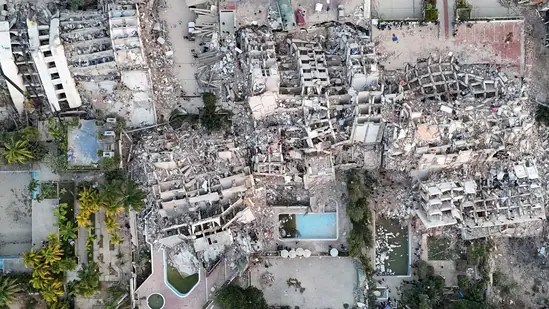
A drone view shows buildings destroyed by earthquakes, in La Guaira, Venezuela on June 26, (Reuters)
La Guaira, on the coast, was worst affected by the tremors which struck only 39 seconds apart. Four days on, the search for survivors continues. In the beginning brave individuals lifted rubble with their hands. Now international teams from at least 20 countries have turned up with state of the art equipment, dogs, and heavy-lifting machinery. People are, remarkably, still being retrieved alive. But the death toll is rising. By June 28th the number of people known to have been killed across Venezuela had reached 1,450 with another 3,150 injured.
Morgues in La Guaira are overflowing. Thousands of people have been displaced. And anger at aspects of the response is growing. Police and some emergency rescue teams were deployed around Caracas immediately after the quakes. However, residents in La Guaira say they were left totally on their own for the first 48 hours. “It was all volunteers, the government was no help at all,” one woman told The Economist, while standing in front of a collapsed apartment block. Inside, she said, lies the dead body of her aunt.
Twenty-seven years of systemic corruption under the purportedly socialist governments of President Nicolás Maduro and his predecessor Hugo Chávez have wrecked Venezuela’s economy, hollowed out institutions, and left services from hospitals to fire brigades hopelessly run down. Mr Maduro and Mr Chávez had a stock answer to critics who observed this: that they were confronting an aggressive American empire that was ideologically set on undermining them. But that excuse will not fly anymore.
The current interim president, Delcy Rodríguez, is in power thanks to the Trump administration. Following the capture of Mr Maduro, her boss, by American commandos on January 3rd, the dictator’s former vice president has been working closely with Washington under an arrangement which both sides have sold as mutually satisfactory. America has eased sanctions. In return Ms Rodríguez has maintained stability and reformed rules that discouraged foreigners from investing in Venezuela’s oil and mining sectors. Mr Trump has taken to portraying all this as one of his great strategic successes. “Venezuela is doing better right now than they’ve ever done in the history of their country. It’s sort of like a joint venture,” he said on March 26th.
The earthquake will imperil that narrative. Mr Trump’s response so far has been strange. “Outside” of the earthquake “the people are happy, they’re dancing in the streets,” he said, preposterously, on June 26th. His administration must now decide how far it will get involved in a large-scale reconstruction effort. The quakes have caused $6.7bn in material damage, according to satellite analysis carried out by the United Nations Development Programme.
James Story, a former American ambassador to Venezuela, says America has a duty to the country given its overt interference to date. “Clearly Delcy was not an elected president,” he says: “The actions of the United States put her in power.” He recommends “a full effort” of American assistance, including the deployment of a hospital ship. The Trump administration has not yet indicated that it is ready to do so. But it has dispatched a military vessel towards the Venezuelan coast and sent specialised search-and-rescue teams. American military personnel have also repaired the earthquake-damaged runway at the main Caracas international airport, which America has since been using for humanitarian flights.
America’s grand plan for Venezuela is supposed to involve three stages: stabilisation, recovery and transition. The idea is that stabilisation and recovery (both of Venezuela’s economy, and its battered institutions) can take place while Ms Rodríguez serves as interim President. The third stage, “transition”, requires democratic elections (in which she might be a candidate). No timetable has ever been given for this process, and the earthquakes may provide a reason to delay the third stage. That would doubtless suit the unpopular regime. “There is every reason to believe that this terrible tragedy will be instrumentalised to keep them from moving to elections any time soon,” says Mr Story.
As for the Trump administration, it has hardly shown much urgency in returning Venezuela to democracy. In recent days American officials have been telling journalists that María Corina Machado—a Nobel Peace Prize laureate and by far Venezuela’s most popular opposition leader—has been irritating them by asking for America’s assistance to help her return to Venezuela. One American official insisted her requests to go to her homeland after the earthquakes were part of a “political stunt”, reported the New York Times.
Having the Trump administration clearly on her side will be of some comfort to Ms Rodriguez. But being the leader of an unpopular regime following the mass trauma of a natural disaster brings no shortage of risk. On Friday the interim president visited a collapsed building in Caracas. A trip designed as a positive photo opportunity soon turned into something else. “Where is the aid?” screamed someone in the crowd. “Go away!” shouted another.