The United States is reviewing its military presence in West Asia after Iranian missile and drone strikes caused far greater damage than previously revealed at more than 20 American sites, including the US Navy’s base in Bahrain, according to a report.
Notably, Bahrain has been repeatedly targeted by Iranian missile and drone attacks during the conflict in West Asia.
On Sunday, Iran fired missiles and drones at US military facilities in Bahrain and Kuwait shortly after the US military said it had carried out strikes in Iran, accusing Tehran of attacking a tanker in the Strait of Hormuz despite a peace agreement being in effect.
Iran ‘extensively damaged’ only US naval base in West Asia: Report
From late February until June, Iran launched repeated attacks on Naval Support Activity Bahrain (NSA Bahrain), the lone American naval base in West Asia.
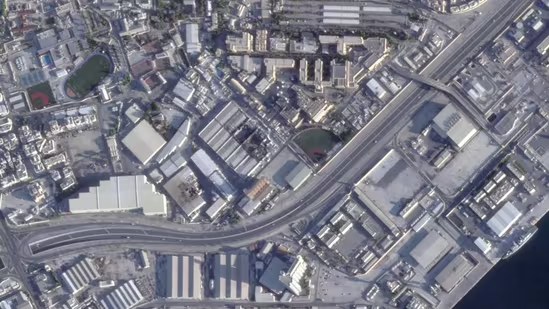
The strikes that broke through defences caused major damage that the Pentagon has not publicly confirmed, according to a Wall Street Journal investigation based on satellite images, videos shared on social media and interviews with current and former service members.
The command headquarters and at least a dozen other buildings were badly affected, along with two satellite communication terminals.
The military said there were no deaths at the base and that its operations were not seriously disrupted. Most personnel were evacuated, although a small number have remained at the site.
US ‘re-evaluating footprint’ in West Asia
The heavy damage at the naval base in Bahrain, together with strikes on at least 20 US sites across the region, including military bases and diplomatic buildings, has reportedly pushed Washington to reassess its overall presence in West Asia, officials familiar with the discussions told the WSJ.
The military is looking at redesigning the Bahrain base, cutting back its presence in Kuwait and Saudi Arabia, and relocating some bases or military functions farther west, beyond the range of Iranian missiles and drones, as per the report.
Some of the damaged buildings may not be rebuilt. Command-and-control facilities could be shifted underground, while military assets may also be dispersed across more locations in the region. However, officials said no final decisions have been taken.
Israel is among the places being considered for future basing, two officials told the publication. During the conflict, the country hosted dozens of US aircraft, including fighter jets and aerial refuelling planes.
Rebuilding could cost Pentagon up to $400 million
Last month, Pentagon Comptroller Jay Hurst told Congress that the department’s estimated war cost of $29 billion did not include damage to US military bases.
The WSJ estimated that rebuilding structures similar to those damaged at NSA Bahrain would cost about $400 million, as per a publicly available defense department cost model and procurement records.
This estimate only covers construction costs. It does not include additional expenses that could arise if rebuilding takes place, such as clearing debris or strengthening the new structures.
The estimates cover only construction and do not include other costs that could factor into the total if the buildings were to be rebuilt, such as debris removal and reinforcement.
A report released on Tuesday by the Center for Strategic and International Studies (CSIS) put the total cost of the war at roughly $40 billion. That figure includes an estimate of between $2.2 billion and $5.1 billion in damage to US bases across the region, based on buildings the think tank identified as having been hit.
Before the conflict began, some military officials had already warned that bases in the Gulf were exposed, the report said. A proposal to move military facilities farther west was reportedly discussed during US President Donald Trump’s first term but was never implemented.
NSA Bahrain functioned like a small American city: Report
NSA Bahrain was built well before Iran developed the kind of precision missile and drone capabilities it has now, and the war exposed how exposed the base really was.
It was the only US posting in West Asia where military families were allowed to live. The base operated much like a small American town, with a softball field, restaurants, a naval exchange and a school. Sailors returning after weeks at sea would arrive in Bahrain and use the base to unwind.
“We’ve been there for more than 50 years, and the base grew up the way the base grew up,” retired Vice Admiral John “Fozzie” Miller, who commanded US naval forces in West Asia, told the WSJ.
“When I was there last time, they were having a dance party,” said Mark Cancian, a retired Marine Corps colonel and senior adviser at CSIS, who served at NSA Bahrain on two occasions.