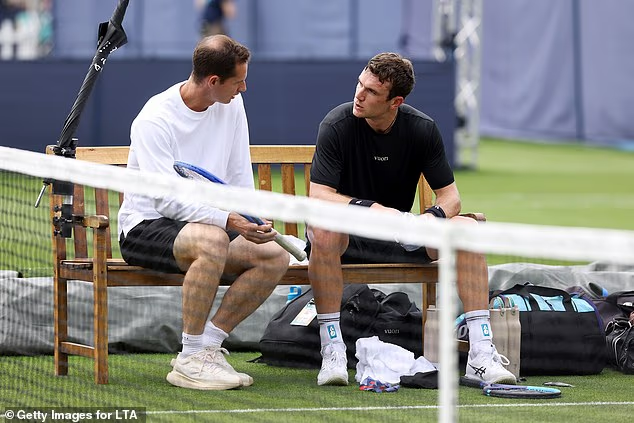
Leftie; righty. Big serve; great return. Jack Draper and his new coach Andy Murray are very different tennis players but something in their souls is the same. It is a wild-eyed competitiveness, a will to win that is so frenzied they enter a state which is ‘almost insane’.
Those are the words chosen by one of Draper’s first coaches, Justin Sherring, who saw that demonic light in the eyes of a teenage Jack.
‘Andy had it, Rafa had it and there’s moments, if you look closely enough, you can see it in Federer as well,’ Sherring, who coached Draper from age five to 15, tells Daily Mail Sport. ‘The eyes light up and you’re like “you better not be in his way if you’re walking down that alleyway”.’
At Wimbledon, Draper and Murray will be walking down that alleyway side by side, the latest evolution in the relationship between Britain’s best male players of the last 20 years.
First they were devotee and idol. Then competitors or, occasionally, Davis Cup team-mates. And now, player and coach.
As Draper prepares to take on the unique challenge of Wimbledon with Murray in his corner, we take a look at what his new coach will bring to the party – and delve into how he can help Jack the lad solve his most frustrating riddle: why he cannot seem to produce his best tennis at Wimbledon.
Jack Draper has drafted in Andy Murray to supercharge his grass-court game

‘‘As a kid, everything was about Andy (for Draper). He was the absolute role model’
‘As a kid, everything was about Andy,’ says Sherring of those early Draper years. ‘He was the absolute role model. What a great time to be a kid, to have a guy from your own country showing you what it really takes to be great, what a warrior you have to be.’
Hard to imagine now but Draper was an extremely slight junior, one of the smallest in his age group. He had to scrap his way to victories and so, at the time, Murray was a perfect example.
‘Game style was very relevant at that age: grinding, finding a way to win points,’ adds Sherring. ‘Not anywhere near as relevant now, unless you reflect on the fact of just how badly they both want to win.’ And that brings the conversation to those bulging eyes; to the verge of insanity.
So what kind of mentor will Murray be to Draper? The best way to answer is to speak to those who coached the coach. Daily Mail Sport asked Mark Petchey, who coached Murray as he emerged on to the tour, whether he saw the makings of a super-coach even then.
‘In hindsight I should have,’ he replies. ‘He had one of the most analytical minds ever for a teenager, obsessed with the game and could pick apart a player’s weaknesses like a surgeon does a patient with a scalpel. At that time, I would be lying if I was thinking about whether he would be a good coach or not but as time has gone by you didn’t need to be Nostradamus to see he would be world-class in a coaching capacity.’
This is Murray’s second coaching stint, after his dream-team alliance with Novak Djokovic in 2025. At the Australian Open that year I spoke to Jamie Delgado, another former coach of Murray who also worked with Draper this year before being ironically replaced by his former employer.
The 49-year-old said at the time: ‘He had a natural eye from a young age. Even when he was practising with a player he would always, from the strategy side of things, take a couple of things from the practices. That’s a coach’s talent, those are coach’s qualities that you need.’
Djokovic was delighted with Murray, although the partnership petered out as results flatlined. Their greatest work together was the Serb’s defeat of Carlos Alcaraz in the quarter-finals of that US Open, when the gameplan of going extremely aggressively into the Spaniard’s forehand wing worked a treat.

Mark Petchey coached Murray in his younger years – ‘he had one of the most analytical minds ever for a teenager’

Murray previously formed a super-team with Novak Djokovic

Draper is in need of a grass-court turnaround, having never passed the second round at his home Slam
Murray was always going to be a tactical genius as a coach but he came out of that Djokovic job feeling that his technical knowledge was not yet up to scratch. He has clearly made some strides in that area, as Draper told us in Eastbourne that Murray had been instrumental in making biomechanical changes to his serve.
From the start of discussions, Murray has made it clear to Draper he will not be a full-time travelling coach. The grass season is the easiest time for Murray to contribute, as he can be based at home, but is also the time when his contribution will be of most value.
Draper has reached the fourth round or better at the other three Grand Slams but is yet to get past the second at Wimbledon. After his defeat by veteran Marin Cilic last year, Draper said: ‘I’ve been really disappointed with the way my game’s been on the grass this year. I felt great on hard courts, great on clay, I felt there weren’t many holes in my game. As soon as I came on to grass, I felt a big difference.’
Draper could not have a better man to plug those holes in his game than one of the finest grass court operators of the last 20 years.
Another man who knows his way around the lawns is Tim Henman, who has no doubt over the priority area for Draper to improve. ‘Jack has the arsenal to be very good on grass,’ Henman, who is working as a commentator here for the BBC, tells Daily Mail Sport. ‘The one area he needs to improve is his movement. He’s a big, tall, strong athlete and on a hard court, when you’ve got that sure footing, you can drive in and out of the corners.
‘On grass you’ve got to be more subtle, you’ve got to glide in and out of shots. Andy did that so well himself and understands those details, so that would be great for Jack to have that input.’
As for Sherring, he suggests Draper must play with more aggression, posing a theory that his success on the slower courts last year counted against him on home turf, where a different swing path is required for the lower bounce.
‘Last year he made the final of Madrid (on clay), which is high bouncing, he won the title at Indian Wells on slow hard courts,’ says Sherring. ‘So it’s quite tricky to come away from something where you’ve had obvious success, and your body knows you’ve had success. On grass it’s about being a bit braver on the forehand side, being a bit more offensive.’
A look into the data shows Draper did indeed play too deep last year, compared to 2024 when he won Stuttgart on the grass then beat Carlos Alcaraz at Queen’s Club. The graphics below, via TennisViz, show Draper’s contact points with the ball for groundstrokes on grass, first in 2024 and then 2025.
We can see how much more passively Draper was playing in 2025, with baseline returns up eight percentage points. His proportion of points played at the net has also fallen by six percentage points from 2024 to 2025.

Draper interception points in 2024

Draper interception points in 2025

Draper’s rally profile in 2024

Draper’s rally profile in 2025
So, it’s simple: Draper must simply up the ante, wind the clock back two years and play with more aggression? ‘It’s a bit like Andy,’ says Sherring. ‘When you’re so used to grinding and almost enjoy the suffering, it’s tough to move away from that DNA.’
Petchey has a slightly different perspective. He believes coach Murray can adapt his new pupil’s naturally attritional gameplan into one that suits grass, rather than try to make Draper into something he is not.
‘Seeing his game through Andy’s eyes will allow him to produce his best tennis,’ says Petchey. ‘Andy believes great defence beats great offense – I think Jack has a similar outlook. Andy will help Jack feel like he is doing the right thing on grass, rather than thinking he should be playing a more extravagant brand of tennis he is less comfortable with.’
When it comes to Wimbledon and Draper there is also that which cannot be plotted as dots on a tennis court: the glare of the British sporting public which is trained on SW19 for a fortnight.
‘A really big thing Andy can help him with is the expectation of being a British player going into Wimbledon,’ says Sherring. ‘It didn’t happen for Andy immediately at all. Jack can be patient – everyone’s got their own journey. His time will come.’
Petchey, now a racket sports ambassador at Neilson Beach Clubs, says: ‘Andy will have a complete understanding of what it’s like for Jack to have that pressure on him and how to deal with it.
‘But one of the most common misconceptions is Brits don’t like the pressure. The ones that have a genuine shot of winning Wimbledon revel in the pressure, they don’t fear it. Andy will see that in Jack too.’
Henman agrees: ‘The question I’ve probably been most asked most in my life is about the pressure of expectation, but I never felt that it was a burden, I absolutely loved it. It gave me an enormous lift.’

Justin Sherring with Draper at the Under 14 World Championships

Who better for Draper to learn from than a two-time winner of Wimbledon?

‘One of the most common misconceptions is Brits don’t like the pressure. The ones that have a genuine shot of winning Wimbledon revel in the pressure, they don’t fear it’
In theory, expectations for Draper should be low this fortnight. He is coming off 12 months of injuries and has No6 seed Taylor Fritz in the first round on Tuesday .
But it is hard to come in under the radar when the guy who will have a statue here next year is in your box. Then there was the run to the semi-finals in Eastbourne and Sherring, who now coaches doubles player Joe Salisbury, reports good signs from seeing Draper in training over the last few weeks.
‘There’s always going to be rust, like a boxer that’s been out of a ring for a year,’ he says. ‘But if you’re born to compete and you fight like a dog… I think getting on court competing will spark him into life.
‘I’ve seen him around the National Tennis Centre. I look at him a little bit different: I look at him and think, is there still that fire in the eyes and that hunger in his voice? One hundred per cent. I don’t see anything different. He’s ready to go.’