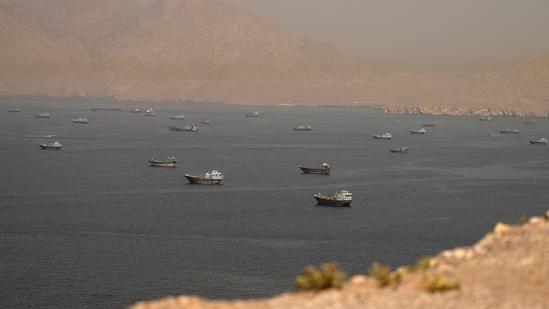
A week after the US and Iran signed a 60-day truce ending nearly four months of war, the assumption that the Strait of Hormuz was returning to normal came undone even as shipping traffic through the route was picking up pace.
Singapore-flagged container ship Ever Lovely was struck in the Strait on Thursday by what Washington said was a one-way Iranian attack drone. The US Central Command retaliated by targeting Iranian missile and drone storage sites and coastal radar installations and calling it a “powerful response to yesterday’s attack”. Iran’s Islamic Revolutionary Guard Corps claimed its forces had “successfully repelled the attack” and said it had struck “US military positions in the region”, according to the semi-official ISNA news agency and state broadcaster Press TV.
President Donald Trump, who had signed off on the 60-day truce last week, had made clear before the US strikes that patience was running out. “I don’t like the fact that they took a shot.”
The exchange lands at a delicate moment. The ceasefire had begun to coax tankers back into one of the world’s most important oil and gas corridors, even as fundamental disputes over mines, navigation routes and tolls remained unresolved.
Live updates: Ceasefire in strain
Here is where things stand:
Traffic is rising, but all isn’t normal
Shipments through Hormuz rose this week to their highest level since the US-Israeli conflict with Iran began on February 28, Reuters reported. Exports from the Gulf recovered to about 80% of pre-war levels in recent days, another Bloomberg report said, and Saudi Aramco resumed loadings at its Ras Tanura terminal on Friday after a near four-month halt. Two very large crude carriers were seen taking on cargo and a third was waiting nearby.
Even so, overall traffic remains far below pre-war daily averages, and the danger has not passed.
The International Maritime Organization (IMO) estimated on Friday that roughly 80 mines remain in the strait’s traditional shipping lanes, concentrated in a middle area known as the Traffic Separation Scheme — the route the IMO has mapped out in 1968.
The risk of sailing over mines and geopolitical swings since the war have forced the creation of two separate channels: one hugging Oman’s coast, coordinated by the US, and a separate, Tehran-controlled route closer to the Iranian shore.
Under the US-Iran ceasefire’s memorandum of understanding (MoU), Iran is supposed to clear the mines within 30 days, though it is unclear how much progress has been made.
Pakistan, which has been coordinating navigational warnings in the area, reported detecting a mine near Oman last week, though the US Navy has said the southern route is mine-free. Earlier this month, Britain and France drew up plans for a multinational mine-clearing mission.
IMO has separately carried out emergency evacuations for ships stranded in the Strait for months. Its secretary-general Arsenio Dominguez said on Friday that 115 vessels and around 2,500 seafarers had been able to transit the strait since Tuesday. The agency paused the wider scheme to evacuate some 600 ships and 11,000 sailors after Thursday’s attack on Ever Lovely.
Intertanko, a tanker owners’ association, advised members to delay transits “until the situation is clearer” and called the Iranian-controlled route “a cause for concern”.
Also read: US-Iran agreement: What next?
Different scripts
Governments around the world, including the US, UK, France, Saudi Arabia and the UAE, have cited international maritime law to say that no single country can own or control the Strait of Hormuz. Any imposition of fees on ships transiting the waterway would breach this law, they say.
Yet, that assertion hasn’t stopped the dispute. Iran has said vessels crossing the strait need to apply to it for insurance, and has signalled that the policy will remain free only for roughly the next 60 days, indicating that a formal toll system could follow. Its ceasefire MoU with the US stopped short of settling the matter. It commits both sides to the free flow of vessels through the strait but did not directly address the possibility of toll after the 60-day period.
Washington has otherwise maintained that the strait needs to remain open and free. US secretary of state Marco Rubio, visiting Gulf nations over the week, said Iran would have to keep the strait toll-free to secure a formal peace. He warned that any tolling would invite other governments to do the same at other maritime chokepoints and “then we’re going to have chaos.”
Citing a joint statement – signed by Oman, the US and Gulf Cooperation Council – Rubio said: “They said in the meeting and they signed on to the statement that said that there aren’t going to be any fees or tolls, and so I think that’s good news.”
A senior US official also told Bloomberg Iran has told the Trump administration it is not seeking tolls, insurance costs or any other charges on transiting ships.
But Oman’s own position in this scenario is unclear. Two days before signing that US-GCC statement, Muscat had issued a separate statement with Iran, saying the two countries would discuss how to operate the waterway and the costs associated with doing so.
Oman has since told European officials, according to Bloomberg, that there is no way of returning to the pre-war status quo and that ships may have to be charged some fees — for services such as de-polluting the strait or assisting navigation — though it remains unclear if such charges would be mandatory.
Muscat is studying systems used at other global chokepoints, including the Malacca Strait, where Indonesia, Malaysia and Singapore charge vessels for navigation and security services without imposing mandatory tolls.
French President Emmanuel Macron is due to meet Oman’s Sultan Haitham bin Tariq in Paris on Monday to discuss what his office called “the security of maritime routes, which depends on free and unconditional passage through the Strait of Hormuz”.
Bader Al-Saif, an assistant professor at Kuwait University and associate fellow at Chatham House, said of Muscat’s position: “Oman is caught between a rock and a hard place trying to maintain a balancing act between Iran and the US. Doing so has more or less worked in the past. But with the two sides at war and constantly trying to outmaneuver one another, this Omani behaviour will bite them eventually.”
Also read: All is not well with the US-Iran peace deal
Escalation further complicates path
The US-Iran exchange this week underscores how fragile the ceasefire remains even as commercial traffic has recovered.
Oil markets had already priced in de-escalation: Brent crude settled at $71.99 a barrel on Friday, down 4.34% on the day and 10.86% over the week, while West Texas Intermediate fell 3.74% on the day to $69.23, down 9.62% for the week. “There is a growing sense that oil is going to keep moving through the Strait of Hormuz,” said Phil Flynn of Price Futures Group. Whether the exchange marks an isolated flare-up or a lasting rupture in the ceasefire will shape tanker traffic and the West Asia conflict.