There were once cricket pitches where the marquees stood. There were once schoolboys where legends of a certain age drifted across the grass, seemingly blown across the scene like multi-coloured butterflies in a soft wind.
‘This is a very, very special place,’ said Gavin Hastings, retired rugby player and full-time legend. He was speaking of George Watson’s College where the world of rugby gathered yesterday to honour a favourite son.
It is where the four Hastings boys went to school. Two of them became British Lions. ‘We grew up here,’ said Gavin in reference to his brother, Scott, who died last month. ‘We had lots of happy memories.’
He glanced across at the marquees erected in front of the school that would hold the hundreds of invited guests to a celebration of a life.
‘There were two cricket pitches there. We tried to break a window by hitting a six. I did hit a six but never quite managed to break a window.’
The statement was almost rueful and the view was colourful. The guests had been asked to wear something bright. They obliged. The view was akin to the aftermath of an explosion in a paint factory.
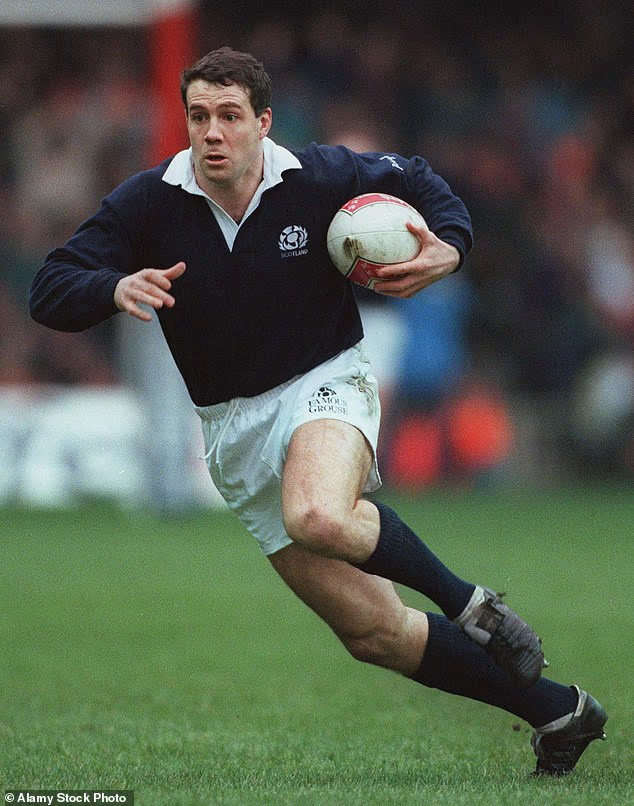
Scott Hastings earned 65 Scotland caps and went on two British and Irish Lions tours
Hastings, bedecked in a suitably garish Japanese rugby shirt, made every effort to keep the outlook bright as the sun jousted with clouds above the school.
But he was, of course, braced against the reality of losing a younger brother, who was only 61.
‘I can’t believe he has gone,’ he said as the great and the very good prepared to hear tributes to Scott.
It was a kaleidoscope of colour and legend. There was Jim Telfer in natty suit, there were the greats such as Sean Lineen, Gary Armstrong, David Sole, John Beattie, Colin Deans and so many others. It was a march of Caledonian gladiators from a sumptuous past.
There was also Abdelatif Benazzi, once a towering French forward, now president of the Six Nations Council. At 55, he maintains a powerful presence, marked by his 6ft 6ins stature and his almost regal air.
Keith Wallace, the 31st president of the Scottish Rugby Union, was also on hand to pay tribute. ‘Scott was a fantastic servant to the game in many guises,’ said Wallace of the player who won 65 caps, went on two Lions tours, played pro rugby and will always be associated with so many roles at Watsonians.

Scott’s brother Gavin was keen for the occasion to be a celebration of colour and joy
‘I believe rugby is the game that keeps on giving,’ said Wallace. ‘The more you put in, the more you get out. And that was Scott. He put so much into the game over the years and he never changed.’
He cited Scott’s speech when he was inducted into Scottish rugby’s Hall of Fame less than a year ago. The one-time centre then pointed out how much rugby had given him and how it was incumbent upon him to give something in return. ‘He leaves a great legacy,’ said Wallace.
That legacy, of course, is not restricted to Scottish rugby. There were those who gathered at the school yesterday to speak softly of how a rugby legend had quietly but effectively helped a variety of charities.
It was pointed out by so many that the My Name’5 Doddie campaign was given considerable impetus because of his early and sustained involvement. It was also remarked in doleful tones that in Doddie Weir and Scott Hastings, the world of rugby had simply lost two titans too soon.
It is a testament to his personality that this combative competitor was simply loved by those who he had first bruised.
Rob Andrew, the English stand-off who toured alongside Scott with the Lions, was warm in his appreciation. ‘Your view of Scott initially depended on whether you were on the same side as him or were facing him,’ he said. ‘So I saw the two Scotts, the fierce competitor at Murrayfield and the great team-mate in Lions rugby.
‘He was a wonderful human being and player, though I always preferred him to be on the same side. He was full of life, full of fun.’

Scott Hastings with his wife Jenny, who died in 2024 at the age of 60
Andrew, who also played alongside Weir for Newcastle and the Lions, said: ‘Scott and Doddie were just remarkable people who transcended rugby. They were huge characters. You can’t put into words how it feels to have lost them both.’
Brian Moore, a belligerent hooker but a thoughtful observer of the game and of personal character, was typically insightful on the lasting impact of his friend.
The Lions bond was strong between the two players and it endured as team-mates became solid friends.
‘There are so many parts to Scott’s life that we can talk about,’ he said. Moore referenced the great man of history theory and how people are sometimes judged by their achievements and are forgiven frailties because of their conspicuous success.
‘The older I get,’ said Moore, now 64, ‘the more I believe that there are more prosaic achievements that are more important for the people you leave behind.’
He added of spectacular worldly success and substantial character: ‘There are those who argue you can’t have it all, but you can.’
Moore said he reached out to his friend after the death of Scott’s wife, Jenny, in 2024. She drowned in Wardle Bay, aged only 60.
‘I passed on my best wishes by email, saying to him I knew he would be inundated with best wishes and he had no need to reply. He got straight back to me. He had no need to do that but he did.’

Guests flocked to George Watson’s College in Edinburgh to celebrate the rugby giant
The former England hooker pointed out that Scott was more concerned about asking about the health and welfare of Moore’s family. This scene was replayed recently.
In his final broadcast as a commentator, Moore delivered a measured but emotional tribute to his friend. Moore and Scott were room-mates on several occasions on tour and the Englishman said then: ‘He was a man of huge integrity, honesty and empathy.’
He expanded on this just before he was scheduled to speak to the guests. ‘After I gave that tribute, his daughter, Kerry-Anne, contacted me to thank me. She was the same as her dad. She was interested in how I was.
‘To pass that down as a trait is as big an achievement as you can get as a human being. The people you leave behind are your legacy.’
He spoke as serving staff buzzed about the lawn. They were adorned with ‘Hastings 13’ on their shirts and were serving a very special drink. A beer brewed in tribute to Hastings was on draught.
It was part of an atmosphere of determined celebration. There was a feeling, almost tangible, that to be sombre was to belittle the memory of such a positive and energetic character.
The challenges to Hastings in later life were obvious. His wife suffered from health issues. He was diagnosed with non-Hodgkin’s lymphoma.
Yet he appeared perpetually bright, determinedly carefree. There must, of course, have been dark moments but he kept those contained to a close circle.

Former Scotland star John Jeffrey drinks a beer brewed in tribute to Hastings
To the world, he was Scott Hastings, rugby legend, informed commentator, family man, assiduous helper of charities, and all-round good guy.
His legacy is already felt in those he has touched. His rugby legacy will continue, almost certainly marked by something from Scottish Rugby in terms of a trophy or whatever.
For the moment, just off Colinton Road, Scott’s presence was reflected in the brightest of colours and resonated to the regular peal of laughter.
There was one moment that would surely have raised a smile in the devoted Watsonian and rugby obsessive. It came, oddly, in Kutaisi, Georgia, where Scotland Under-20s defeated their Italian counterparts 38-32 in the World Rugby Junior World Championship. The first Scottish try was scored in spectacular style by Dan Kelly, an alumni of George Watson’s.
Earlier, Gavin Hastings had said of his brother: ‘Scott was magic.’ The celebration of his life was not his final trick. There was a communal statement that cannot be silenced.
There was a recognition that this was a life well-lived and a gratitude that so many had witnessed it in whatever form, whatever the size.