Ali Akbar Velayati, an advisor to the Iranian Supreme Leader Ayatollah Mojtaba Khamenei, lashed out at Western countries, accusing them of bringing “nothing but plunder and violence” to West Asia.
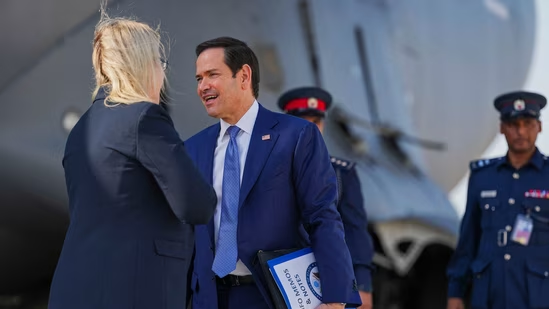
This comes after US Secretary of State Marco Rubio visited the region to discuss the interim deal between the US and Iran with Arab Gulf allies. In a post on X, Velayati said that the stability of Gulf Arab states “is indebted to Iran’s century-long management of the Strait of Hormuz”.
“The stability of Persian Gulf Arab states is indebted to Iran’s century-long management of the Strait of #Hormuz. The West has brought nothing to the region but plunder and violence,” Velayati wrote.
The Iranian official also targeted the nations in the region, calling them “political minors of the periphery”.
“These political minors of the periphery should not be comforted by commissioned statements; know this, your survival feeds off the scraps of this table. In the great realignment, peripheral minor players have no seat at the table. They are eliminated, and their strategic survival is at the mercy of Tehran’s tolerance,” he further said.
Response to Rubio’s threats?
The statement from the Iranian official came after US Secretary of State Marco Rubio, wrapping up a tour of the Gulf to reassure nervous regional allies about the interim pact with Iran, told reporters on Thursday that if Tehran threatened or blocked ships in the Strait of Hormuz, “we’re going to have a problem.”
In their joint statement, Rubio and the Gulf Cooperation Council (GCC) called for “free, unconditional, and unrestricted navigation” in the strait without tolls or “attempts to assert control”, and said a lasting peace must address Iran’s ballistic missiles, drones and support for proxy groups.
Iran on Hormuz
In a more direct response, Tehran reasserted its right on Friday to control shipping in the Strait of Hormuz and warned Gulf states against siding with the US, a day after an attack on a ship near Oman highlighted the fragility of a preliminary deal to end the Iran war.
Iran was responding to what it called an “interventionist, irresponsible and provocative” joint statement by the United States and six Gulf states that rejected Iran’s insistence that it could charge tolls on vessels transiting the strait.
“Safe passage through the Strait of Hormuz cannot be guaranteed under ambiguous arrangements, parallel routes or decision-making that does not take Iran’s role as a coastal state into account,” Deputy Foreign Minister Kazem Gharibabadi said on X.
Underlining the risks facing shipping, Iranian state TV later reported that three foreign tankers attempting what it called an “unauthorised passage” of the strait were turned back after a warning from the Islamic Revolutionary Guard Corps. It gave no further details.
Oil prices dropped by more than 3% on Friday, on course for steep weekly losses despite the conflicting interpretations of last week’s interim deal between Iran and the US and a slowdown in traffic through the strait, where a fifth of global oil and liquefied natural gas supplies typically pass.
Saudi Aramco resumed crude loadings on Friday at its Ras Tanura terminal in the Gulf, the world’s biggest oil port, after a nearly four-month halt, shipping data showed.