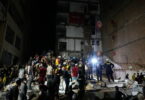
Rescue efforts in the aftermath of back-to-back earthquakes in Venezuela are now in a “very dangerous” window, with emergency services likely focused on finding survivors in mounds of debris at a time when powerful aftershocks are possible, scientists have warned.
The two earthquakes — with epicentres Morón and near San Felipe, reported just 39 seconds apart on Wednesday evening — have killed at least 164 people and injured around 1,000, acting president Delcy Rodriguez said on Thursday. Follow the aftermath live here
La Guaira a disaster zone
The worst-hit area was La Guaira, north of Caracas, where dozens of buildings collapsed in the earthquakes.
La Guaira, one of Venezuela’s smallest states, sits along the country’s central northern coast on the Caribbean Sea, just a few kilometres from Caracas. The government declared it a “disaster zone”.
BBC reported that rescuers were searching through the rubble, and people were heard calling for help.
The quakes measured magnitude 7.2 and 7.5. The second is reported to be the strongest to hit Venezuela since 1900. A modelling projection by the US Geological Survey has said the eventual death toll can exceed thousands.
ALSO READ | Two earthquakes, two epicentres, 39 seconds apart: The ‘doublet’ that shook Venezuela
‘Very dangerous time’
Adam Pascale, chief scientist at the Seismology Research Centre in Australia, told Al Jazeera there needs to be “great awareness” of the potential of powerful aftershocks in Venezuela, especially during rescue operations.
“It is a very dangerous time for those undertaking the recovery,” he said, adding that the possibility of another earthquake of similar or greater magnitude could not be ruled out though the likelihood “significantly diminishes after a few days”.
Seismologists have described the back-to-back earthquakes as a “doublet”. The term is used when two earthquakes of similar magnitudes occur one after the other, not too far apart in time and space. These are different from an earthquake that is followed by aftershocks or tremors of lower magnitudes.
Mark Allen, professor of earth sciences at Durham University, told the Science Media Centre that the two earthquakes were “unusual for being so close together in time”, given their scale, CNN reported.
“It is likely that the first earthquake ruptured one fault segment and transferred stress onto another fault, which failed, in turn, causing the second earthquake,” Allen said.
Caracas, over 160 km from epicentre, shook violently
The earthquakes occurred along the tectonic boundary between the South American and Caribbean plates, he said, where “the plates are moving past each other, laterally, in this region”.
He added that seismic risk near Venezuelan capital Caracas remains as it lies in an earthquake-prone area and “local faults may have been loaded by events”.
ALSO READ | Venezuela struck by two earthquakes: How scientists detect tremors and measure magnitude
Although the epicentres of the two earthquakes were around 160 km west of Caracas, residents in the capital reported violent shaking.
Stephen Hicks, research fellow and lecturer in environmental seismology at University College London, said this was likely due to the direction in which the rupture propagated.
“When an earthquake rupture propagates towards a populated area, seismic energy can become concentrated in that direction, producing stronger ground motions than would otherwise occur,” he told the SMC.
He added that “this was the case of Caracas, which was in the ‘crosshairs’ of the eastward earthquake rupture”, and suggested that shaking may have been amplified by “deep sedimentary deposits that underlie parts of the Caracas Valley”.
Karen Lythgoe, an independent research fellow at the University of Edinburgh, also pointed to the eastward rupture direction. “The earthquake ruptured to the east toward Caracas and likely stopped just before the city. This explains why the shaking is so large in Caracas,” she told SMC.