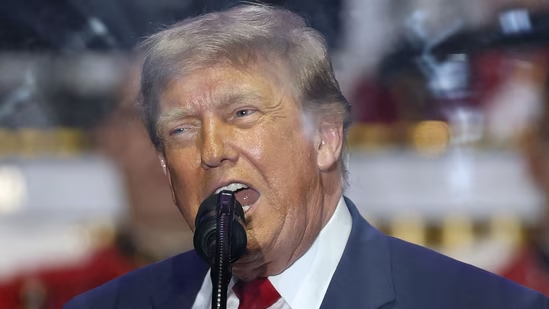
President Trump is pulling from a familiar Democratic playbook as he wrestles with sticky gasoline prices: blaming Big Oil.
During the U.S. war against Iran, Trump repeatedly promised that prices at the pump would fall quickly once the conflict ended. But 10 days after he announced an agreement with Iran, the price of a gallon of gasoline still hovers around $3.93—nearly $1 higher than before the hostilities broke out.
Now, Trump is accusing his own oil allies of gouging consumers. Late Tuesday, Trump said on Truth Social that big oil companies aren’t dropping their price at the pump in a way that is commensurate with the sharply lower prices they are paying for crude—and he has instructed the Justice Department to investigate.
“Customers are being ‘gouged,’” he wrote. “Gasoline prices better start going down a lot faster than what I’m seeing!”
The U.S. oil benchmark fell to around $70 a barrel on Wednesday, a roughly 27% drop from early June, quickly approaching the $67.02 where it settled the session before the conflict began. By comparison, the average price of a gallon of gasoline has dropped by less than 4% since the deal was reached.
The president’s threats echo former President Joe Biden’s feud with Big Oil after Russia’s invasion of Ukraine sent gasoline prices soaring to $5 a gallon in 2022, when he accused the industry of war profiteering. Trump’s rhetoric is also similar to that of California Gov. Gavin Newsom, who has frequently crossed swords with the industry over high fuel prices in his state.
Some oil executives were privately critical of Trump’s comments, saying his accusations weren’t based on facts. CEOs and trade groups noted the fuel supply chain is a slow-moving machine and it will take time before consumers see the benefits of lower crude prices.
“The market doesn’t reprice every gallon overnight,” said Bryan Sheffield, managing partner of West Texas oil-and-gas producer Formentera Partners. “Some patience is needed.”
Trump’s stick-wielding is sure to test the relationship between the administration and the fossil fuel industry. Oil executives had until now emerged largely unscathed from the conflict, with Trump pressuring Iran to reopen the choked Strait of Hormuz and touting the U.S. status as the world’s largest oil producer.
Executives did warn the Trump administration publicly and in private that failing to clear the waterway would lead to higher fuel prices, possibly for months. Now, they face the prospect of a potential pressure campaign by Trump.
In 2022, after Biden and his Democratic allies in Congress accused the oil industry of keeping gasoline prices artificially high in the wake of Russia’s invasion of Ukraine, Chevron CEO Mike Wirth penned an open letter to Biden in defense of the industry.
“Your administration has largely sought to criticize, and at times vilify, our industry,” he wrote.
Chevron played defense in California when Newsom accused Big Oil of price gouging. Exxon Mobil, Chevron and ConocoPhillips all referred questions about Trump’s accusations to the oil industry trade group American Petroleum Institute.
“Gasoline prices don’t move in lockstep with crude oil, especially during a major global disruption that is still affecting supply, refining and inventories,” Bethany Williams, a spokeswoman for the American Petroleum Institute said in a statement. “Our focus remains on supporting market stability and delivering the energy consumers need.”
The fossil fuel industry has generally enjoyed a harmonious relationship with Trump, who has killed environmental rules it long complained about, opened up federal land to drilling, and saved companies billions of dollars in tax payments. But tensions flared when the president initially imposed tariffs on energy imports from Canada and slapped duties on steel, which producers use in huge quantities. His calls for $50 oil frustrated the industry.
In private, administration officials have often made the point that at the end of the day, Trump would side with consumers over his oil allies. As the war in Iran unfolded, many in the industry feared that the administration would restrict fuel exports, a step that cabinet officials said publicly they wouldn’t take.
But Trump officials appeared to anticipate that gasoline prices wouldn’t retreat quickly after the conflict with Iran and made veiled threats. In April, Treasury Secretary Scott Bessent said on CNBC that “I’m sure the president will call out anyone who’s a bad actor.”
It is “standard fare” for presidents from either party to criticize high fuel prices, said Kevin Book, head of research at energy-research firm ClearView Energy Partners, and Trump’s accusations of price-gouging have the same populist appeal as Biden’s back in 2022, he said. But Trump has demonstrated “his ability to go beyond words, and maybe in a way that Biden did not.”
Book noted that Biden wielded investigations by the Federal Trade Commission into oil deals as an implied threat that firms wanting a green light on their mergers should plan to keep drilling. While Trump hasn’t used that threat, “presidents learn from their predecessors.”
People close to the oil industry said they expected the friction with the Trump administration to dissipate relatively quickly—though they acknowledged the administration has been less than predictable. Price-gouging investigations leveled at oil companies have been tried several times before, and have come up empty-handed, they said.
Studies point to a variety of factors to explain why gasoline prices are slow to fall even after a precipitous drop in oil prices. Refiners and marketers move barrels they often purchased weeks earlier. Gas station owners have to finish selling the fuel they bought at a higher price before they can consider lowering it.
Executives have also warned that oil prices could surge higher again if inventories continue to dwindle. Ships coming out of the Strait of Hormuz can take weeks or months to reach their destinations, particularly in Asia, where demand has been curtailed. Some analysts said they expected resurgent demand from countries such as China, Japan and South Korea to bolster prices as flows from the strait recover, as well.
Write to Benoît Morenne at benoit.morenne@wsj.com and Collin Eaton at collin.eaton@wsj.com