
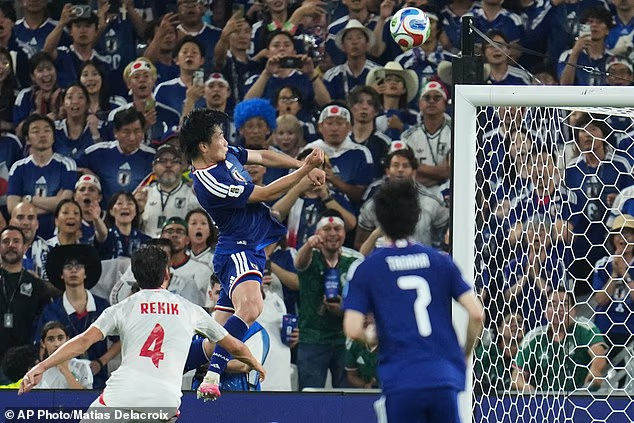
Such has been the swashbuckling nature of Japan’s football in their opening two World Cup games that talk of a 100-year plan to be the best in the world would seem to be a little conservative.
Hajime Moriyasu’s pacy, technically gifted side have turned heads by twice coming from behind to draw 2-2 with Netherlands and then dismantling Tunisia 4-0. Next up, Sweden tonight.
‘How far can Japan go in this tournament?’ wondered co-commentator and former Scotland midfielder Charlie Adam, when the Samurai Blue led the north Africans 2-0. Seconds later, Leeds United’s Ao Tanaka passed through the lines to the brilliant Ayase Ueda, whose flicked assist for Junya Ito to finish was one of the moments of the tournament.
Feyenoord striker Ueda, top scorer in Eredivisie with 24 goals and rated at £70million, finished off the rout with his second of the night and Japan’s fourth. Adam’s question was now being repeated in bars and living rooms across the globe.
Pep Guardiola joined the chorus of approval, too, saying they can no longer be regarded as underdogs. Not when Moriyasu can routinely field 11 players who operate in Europe’s top five leagues and who have beaten Brazil, England, Germany and Spain in the past four years.
Only the absence of key men Karou Mitoma, Wataru Endo and Takumi Minamino, and the fact they could face Brazil or Morocco on the ‘wrong side’ of the draw, can temper expectations. That and Japan’s humble, cautious nature.
Ayase Ueda (centre), pictured scoring in the win over Tunisia, is one of the Japan team’s stars
So, back to that ‘100-year plan’, which was referenced by former Celtic and Tottenham boss Ange Postecoglou on pundit duties for ITV after the draw with Netherlands.
The Australian managed Yokohama F Marinos from 2018, guiding them to the J League title in 2019. ‘I loved my time there, you grow as a person when you experience different cultures,’ he said. ‘They see themselves as a developing nation and have a clear plan about what they want to do. The 100-year vision for their football they are following meticulously.
‘But I say to them: “Look, you’re not at year 20 you’re at year 60”, but they are really methodical about that. Once they have that real belief they can beat the best nations, they can one day win the World Cup.’
There is a common misconception between the J League’s Hundred Year Vision, set out in 1992, and the JFA’s own long-term plan to win the World Cup by 2050, formulated in 2005. Both are quintessentially Japanese, in stark contrast to most federations… not least Tunisia, who sacked their coach before the Japan clash.
Among the cornerstones of the 1992 mission were pledges to ‘create a square covered with green grass and sports facilities in your town’ and ‘promote futsal while building a system that allows families and communities to enjoy it easily’.
‘The Japanese game’s long-term, detailed approach has certainly worked wonders in the last 30-odd years, so it would be incredibly foolish to write them off,’ says Sean Carroll, a football journalist in Tokyo and author of Between the Lines: Navigating the World of Japanese Football.
‘Clubs rooted in regional communities rather than being affiliated with companies helped create bonds, the level of play improved, and the sport started to gain more attention in a country where football wasn’t (and still isn’t) the No.1 sport.
‘That gave children something to aspire to, and as they grew up and became J League players, then started to move from Japan to Europe, the cycle gathered pace as more youngsters saw that playing in the biggest leagues was an achievable aim.’

Japanese supporters gather on the famous Shibuya Scramble crossing in Tokyo to celebrate their side’s victory over Tunisia
When I lived in Osaka from 2012 to 2015, baseball was clearly the dominant sport, but you sensed football making strides.
What always stood out was the technical level of the players, while the dedication of kids also struck me. They join sports clubs and in some cases, notably baseball, practise five days a week, all year round.
Tom Byer is an American coach who finished his playing career in Japan in 1988 and has lived in Tokyo ever since. He helped launch a chain of football schools based on the renowned Dutch coach Wiel Coerver, who focused on ball mastery, quick footwork and one-on-one moves.
The J League’s 1992 plan may have provided the perfect backdrop for this. Byer soon became a household name as the face of a popular kids’ TV show and featured in a manga series called Tomsan’s Let’s Try Soccer. The ethos — that football starts at home, effectively with toddlers having a ball their feet.
‘It’s not a football culture in Japan,’ says Byer, 65. ‘You’re not going to get into a cab and the driver talks about how FC Tokyo played. No-one really talks about football in this country, but it is popular.
‘What really makes Japan tick is a culture that accepts overtraining. Japanese parents will accept that when their boy or girl at the age of six crosses over the line at organised play, they will train four times a week, three hours of training, 12 months a year.
‘Not many countries will accept that kind of culture. They specialise here, too. It rewards the early starters. The golden age for skill acquisition is between two and five years old. The Coerver schools also played a major role and the two captains who are unfortunately injured, Endo and Minamino, came through them. A lot of the players in today’s squad will have grown up with that.
‘The technical level of the players is very good. When you see Japan attack, you know that any one of the players can score a goal, they are a real threat.
‘Japan qualified for their first World Cup in 1998 and have been in every World Cup since. It is a very humble culture, but there are three key factors to their football development — discipline, repetition and commitment to mastery.’
Three key factors that may yet bear early fruit.
Can YOU master Craig Hope’s World Cup quiz? Test your knowledge HERE