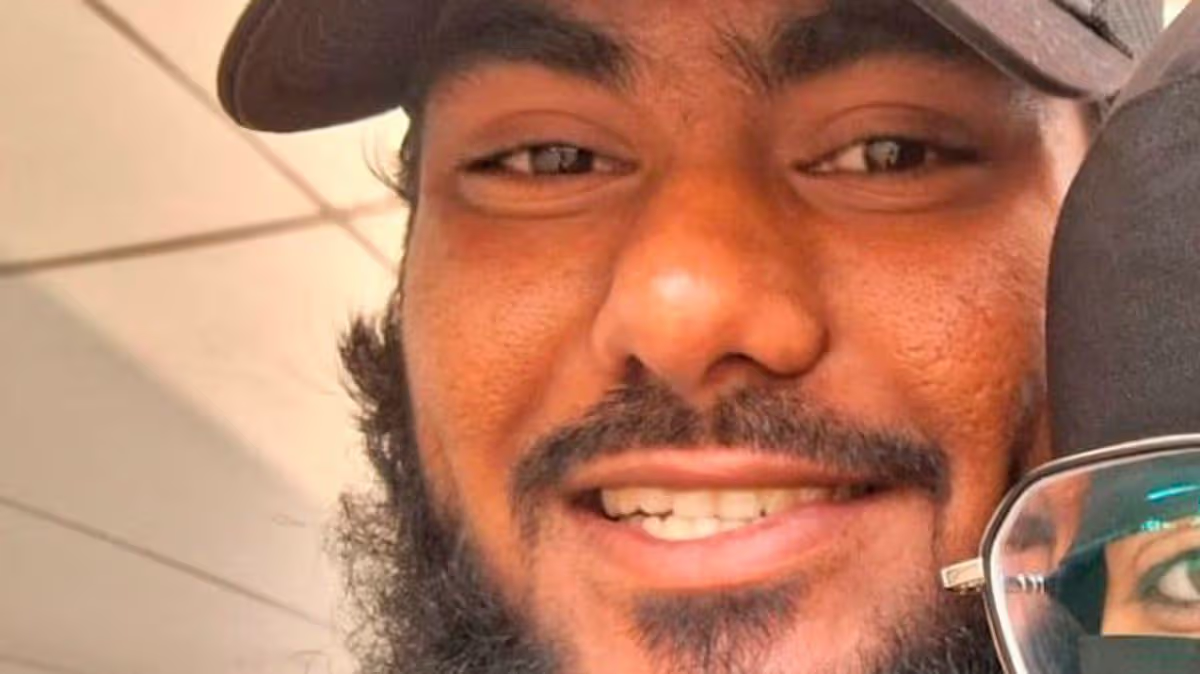
EXCLUSIVE: Faizan Rafik, 25, was on his way home to the UK when he lost his life along with 259 others after Air India flight 171 plummeted moments after take off
Beaming next to his wife, this is the haunting final picture of Faizan Rafik taken before he boarded the ill-fated Air India flight last year.
A few hours later, he died along with 259 others when the London-bound plane fell from the sky moments after take off. Now on the first anniversary of that fateful day, Faizan’s cousin Sameer Rafik describes how the 25-year-old lit up the lives of everyone he met.
In an exclusive interview, he also shares their final conversation, Faizan’s special resting place next to his tragic mum, and the charitable work he’s doing to make the world a better place in his cousin’s name. Sameer, 27, told the Mirror: “Life is completely empty without Faizan – we don’t have peace in our lives anymore.
“Faizan was a very good person – I have never seen a brother like him in my whole entire life. He always kept a smile on his face. I tried to be like him, but I couldn’t.”
Faizan perished when Air India flight 171 crashed into a medical college building in the west Indian city of Ahmedabad less than a minute after leaving the runway on June 12 last year. The crash killed 260 people, including 19 on the ground, and injured dozens more, making it the worst aviation disaster in a decade. One passenger, a British citizen, miraculously survived.
Sameer had driven Faizan from Leicester to Gatwick Airport on his way to India 10 days earlier. Neither knew it would be their final journey together. “He hugged me – and if I knew that was his last hug I would never have let him go,” Sameer says, welling up.
“He told me every single thing about his life on that journey. He was sharing his goals and what he wanted to do. He had just passed his driving test and was so excited. He said he will have his driving license when he gets back and wanted me to go with him to buy his first car.”
Sameer, who considered Faizan a brother, misses the small, everyday moments they spent together in Leicester. He said: “We saw each other every single day. When he came to my house, he would continuously press the bell. I still miss the sound of that bell. Since last year it hasn’t rung. He would always walk to work past my shop. He would stop by and always asked me to drop him home.”
Sameer recently travelled to the family’s hometown of Diu, in the Indian state of Gujarat, to visit Faizan’s grave. He is buried next to his mum, who died when Faizan was a child. Sharing a photo of their resting place, adorned with flowers, Sameer said: “[Faizan] was lucky enough to get a space right next to his mum. They were close. It’s very special.”
Before he died, Faizan, who previously worked at Leicester’s Walker’s crisps factory, was about to qualify as a religious scholar. He was in the process of securing a visa for his wife, also a scholar, so they could live and work together in Leicester.
Sameer added: “They wanted to support kids, to keep them on the right path. Right now, Leicester is on high alert with drugs and things – so he wanted to save the community from that. That was his plan.”
Sameer is now in the process of launching a charity in Faizan’s name, to continue his work helping others. Currently self-funded, he is donating to causes close to Faizan’s heart, including contributing to care packages for families in Gaza.
He has also donated three wells for an impoverished area in Pakistan, and provides financial and emotional support to needy members of the community in Leicester. “Doing this work, I feel like Faizan is still with me – not physically, but emotionally,” he says. “No one can bring him back, so maybe by doing this he might get some reward, and I will remember my brother.”
Sameer plans to spend the anniversary helping others in the community, just as Faizan had planned to spend the rest of his life. “I will try to help as many people as I can. It’s not going to make me feel better, but it might make me feel a little bit closer to Faizan.”
Despite trying to remember the happy times spent together, Sameer says a lack of support from Air India, as well as the Indian and UK governments, has made grieving harder. “Faizan was a taxpayer in this country, but nobody came to our property to support us when this happened. It makes you feel like you’re just a piece of paper to them. I’m not satisfied with the UK government, nor with the Indian government, and especially Air India.”
US-based lawyer Mike Andrews is representing more than 100 families who lost loved ones in the disaster. He told the Mirror: “The families have run into roadblocks both from Air India in India and their representatives in the UK [working on behalf of Air India] at many stages in this process.
“They have been stonewalled in many cases, some of their representatives in the UK have flatly refused to assist with providing information which the families are entitled to have. It’s been very frustrating and hurtful for the families to continue to be victimised now a year after the crash.
“Grief as we know is not linear. It does not proceed on a linear timeline of improvement and also is different for every single person. Every day is a new day of grief in some way. It is very much an emotional rollercoaster for these families trying to pick up the pieces while they’re still looking for answers.”
Mike is working around the clock to bring the families answers about what happened. He is convinced an electrical or system failure is responsible, rather than a deliberate plot by the pilots.
Under international regulations, investigators must aim to provide a final accident report one year after an incident, revealing what they have found about the probable cause of the crash and providing recommendations on how to avoid similar incidents in the future. If they cannot do so, they must release an update on their probe on each anniversary of the crash.