
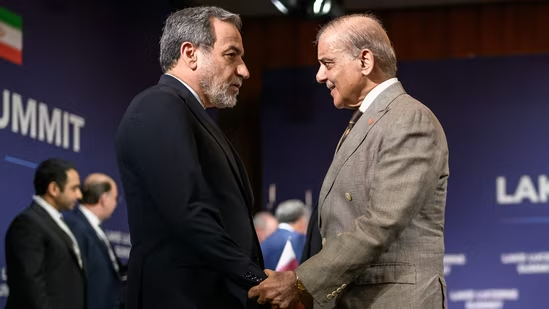
After the United States Vice President JD Vance’s public praise for the country, Republican Senators raised questions regarding Pakistan’s role in negotiations to end the West Asia conflict.
In the midst of the US-Iran conflict, both Pakistan and Qatar had emerged as the primary mediators in negotiations. The deal to end the war was signed last week, following which Pakistan Prime Minister Shehbaz Sharif thanked both sides “for their commitment to finding a diplomatic solution.”
However, two US lawmakers have now called into question Islamabad’s and Qatar’s place at the negotiating table, as talks on the technical details of the final deal are underway.
Also Read | US-Iran complete first round of talks. But Trump’s threat nearly threw them off course
The senators pointed to the countries’ “history of harbouring terrorists”, claiming they were helping in “propping up Iran’s…terror campaign.” This came after Vance’s “we love Pakistan” remark in Switzerland, where US and Iranian representatives, along with leaders from Iran and Qatar, are holding negotiations.
‘Pak hid Bin Laden’: What did the senators say?
In a post on X on Monday, Republican senator Rick Scott said, “It should be clear to everybody by now who our friends really are. Qatar and Pakistan have long histories of harbouring terrorists, and right now they seem far more invested in propping up Iran’s decades-long terror campaign than achieving a meaningful peace.”
He added that while there was scope for a “workable agreement” which is beneficial to everyone, there must be “zero chance Iran comes out of this able to build a nuclear weapon.”
Another Republican senator also pointed out Pakistan’s role in harbouring Al Qaeda leader Osama bin Laden. “Pakistan, let’s not forget, Pakistan hid bin Laden for a decade. They funded Ayatollah through ISI insurances,” Tim Sheehy, US lawmaker from Montana, told Fox News in an interview. “The Pakistanis through the ISI funded insurgencies against us and hid bin Laden. So to assume they’re going to be objective middlemen here, I don’t think is accurate,” he said.
Sheehy suggested that if Pakistan and Qatar were given a place at the negotiating table, UAE, Israel and Saudi Arabia should also be included in the talks. The lawmaker said that these countries were the “real allies” of US in the region. “I think we need to make sure that we stand with the UAE, and we stand with Israel unequivocally, because they will be our vanguard in the region no matter what happens,” the lawmaker asserted.
Also Read | US-Iran war underlines India’s need for a Gulf doctrine: Arrive earlier, act faster, absorb less damage
‘Pak as mediator problematic’: Lindsey Graham
The two lawmakers’ remarks come after Republican Senator Lindsey Graham made similar statements in May. Graham had questioned Pakistan’s reliability as a mediator and called on the country to diplomatically recognise Israel through the Abraham Accords.
“It has been apparent to me for quite a while that Pakistan as a mediator is more than problematic. Their animosity towards Israel is long-standing. It is undeniable that Iranian military aircraft are being housed on Pakistani air bases, and past rhetoric from the highest Pakistani officials against Israel is disturbing,” Graham, a close ally of President Donald Trump, had said then in a post on X.
Graham had further, during a Senate Appropriations subcommittee hearing with US defense secretary Pete Hegseth and joint chiefs chairman Gen. Dan Caine. The senator grilled Hegseth and Caine on a CBS report which had cited US officials as claiming that Pakistan had allowed Iranian military aircraft to be parked at its airfields.
Graham questioned whether the report was accurate, and asked if such a thing would be inconsistent given Pakistan’s role as a mediator. Hegseth declined to comment citing the classified nature of the intelligence.
“I don’t trust Pakistan as far as I can throw them. If they actually do have Iranian aircraft parked in Pakistan bases to protect Iranian military assets, that tells me we should be looking maybe for somebody else to mediate,” Graham said.