
How did the far right take over Latin America?
An extraordinary political revolution in favour of the populist far right is sweeping Latin America: Argentina, Ecuador, Bolivia, Chile, Peru and now Colombia have all seen the left defeated.
The far right has won elections along the entire Pacific coast, from the southernmost tip of Chile in Tierra del Fuego, all the way north to the Panama isthmus, bringing to a close more than two decades of a left-wing ascendancy, the so-called Pink Tide.
In Argentina, Javier Milei was the first of a new wave of ultra-right candidates who won in late 2023, running as a libertarian who vowed to dismantle the state and become a firm ally of the US and Israel. Milei came to power wielding a chainsaw and has wrecked the economy, plunging millions into poverty while dismantling state institutions.
This is not happening in a vacuum – Milei has been backed by US President Donald Trump who has openly supported this far-right political wave, and now has a string of allies across the continent.
Trump stated in his National Security Strategy 2025 that Latin America is now firmly within the US sphere of influence, under a new Monroe Doctrine in which direct intervention will be used to enforce US hegemony on the continent.
In practice this means overt and covert intervention to support allies and help them win elections by fair means and foul, alongside military action such as the abduction of Venezuela’s Nicolas Maduro, and the ongoing brutal siege of Cuba.
A brief survey of this political upheaval will show the common elements at work and the national differences.
Common elements
In Ecuador, billionaire oligarch Daniel Noboa won a second term in April 2025 despite overseeing a massive crime wave in the once peaceful country. Ecuador recorded 9,216 murders in 2025, the highest in its history – a decade ago, the country was among the safest in Latin America.
The last election was disputed by the left-wing candidate Luisa Gonzalez, who was tied in most polls but then decisively defeated in the presidential vote.

Read More »
Noboa has used Ecuador’s security crisis to declare a “war on drugs”, expanding emergency rule and cracking down on political opponents. The US has provided millions in military aid since Ecuador signed a military pact with Washington, after years when the US had been ejected from the country by the previous left-wing administration.
In Bolivia, the conservatives won the elections in October after the government of Luis Arce, successor to leftist union leader Eva Morales, effectively collapsed due to internal divisions. This electoral victory followed a coup against Morales in 2019, that itself was overthrown by mass protests.
The new president Rodrigo Paz moved to dismantle fuel subsidies, enable large landowners to buy up smallholdings, and impose social cuts. The moves were met with a concerted campaign of strikes and highway blockades by Andean unions that brought the country to a standstill. Paz has now imposed emergency rule and brought out troops to restore government control.
In Chile, the ultra-right president Jose Antonio Kast, the son of a Nazi war criminal, decisively won the presidential election in December. He replaced a left-wing government led by the former student leader Gabriel Boric that lost popular support following a constitutional referendum, with 62 percent of Chileans rejecting it because they viewed it as too leftwing.
Kast, an admirer of Chilean dictator Augusto Pinochet, was elected on an anti-migrant platform vowing to build border walls and deport tens of thousands of migrants from countries including Venezuela and Haiti. He has faced protests since he took office and imposed cuts to social programmes.
In Peru, the former left-wing president was removed from office by a rightwing congress, with dozens killed in protests. Then, in a razor-close election in early June, the daughter of former dictator Alberto Fujimori, Keiko, won the election by just 40,000 votes against left candidate Roberto Sanchez, winning thanks to overseas voters in Spain and Japan.
On Monday, Sanchez alleged administrative irregularities in the handling of overseas votes, which massively favoured the far-right winner.
And then there is Colombia, ruled by the continent’s most outspoken leftwing president who has brought significant reductions in poverty for millions in Colombia since his election in 2022. He could not stand again under Colombia’s constitution.
The two incredibly close votes in Peru and Colombia point to societies that are split down the middle, with the old centrist liberal and conservative parties that once played a major role now irrelevant
Gustavo Petro was the country’s first elected leftist leader after a 50-year civil war that killed more than half a million Colombians.
He backed his rhetorical opposition to Israel’s genocide with sanctions on exports of coal that he enforced, unlike other countries in the pro-Palestine camp, such as South Africa and Brazil.
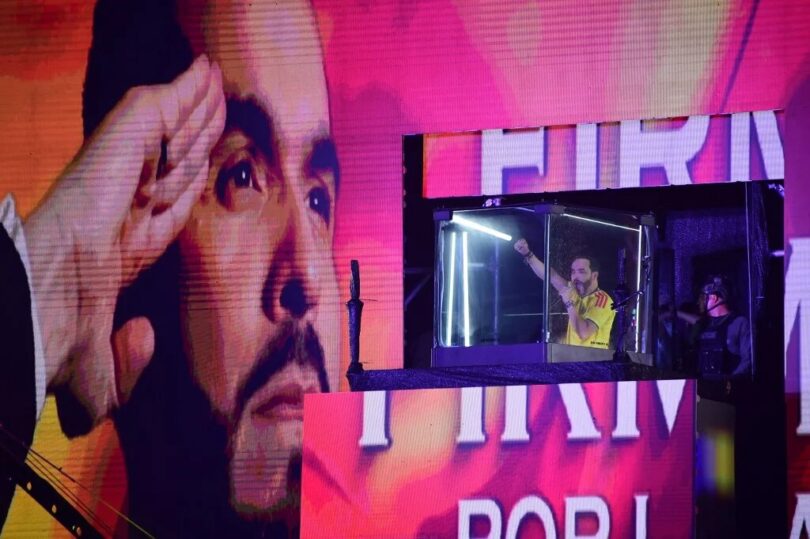
The new president of Colombia, a far-right millionaire lawyer Abelardo de la Espriella, won the presidential runoff with leftist senator Ivan Cepeda. In the initial count on Sunday, De la Espriella had 12.96m votes, or 49.66 percent, just 250,830 more than Cepeda, who received 12.7m votes, or 48.7 percent.
However, numerous anomalies in the E14 voting forms have been alleged by the opposition. Outgoing president Petro is demanding a full accounting of the vote due to alleged manipulation of results in the privately owned voting system.
De la Espriella is a dual US-Colombian citizen who has vowed to form a close alliance with the US and Israel. Weeks before the elections, he was in Florida meeting with far-right US politicians. Trump crowed about the victory of de la Espriella, saying: “The tiger? Oh yeah, that one was tenth in the polls and he won because I backed him.”
These two incredibly close votes in Peru and Colombia point to societies that are split down the middle, with the old centrist liberal and conservative parties that once played a major role now irrelevant.
US intervention and social media
The question is how did this political shift to the right happen?
US interference by the Trump administration, as was seen in the Honduras election in 2025, is part of the answer. Vote rigging is not proven, but a suspicion exists and this is enough to create mistrust of the election system in several countries.
Social media and the right’s mastery of US-controlled platforms like TikTok, X and Instagram is a major way in which the left was outplayed in the smartphone election battle.
The dream of a new nationalist political hegemony led by Trump’s US is now a reality in Latin America
Fear of migrants from poorer countries, and linking it to crime, has also been effectively weaponised in countries like Chile.
Left-wing social programmes may also have paradoxically created new aspirational classes that no longer identify with solidarity and socialism, as Petro himself admits. Having joined the middle class, some voters want to push away the ladder and aspire to more wealth.
In Latin America, one can see a version of the same phenomenon taking place in Europe: rising social inequality and a polarised society in which the centrist parties are squeezed out, replaced by a new kind of politics of personality, led by anti-establishment figures who weaponise social media.
To some extent this model is anathema to much of the left, which bases its project on mass movements and popular social programmes, rather than extreme personalities who build a following by tapping into grievance and prejudice.
The dream of a new nationalist political hegemony led by Trump’s US – the nightmare of minorities and progressive voters – is now a reality in Latin America.
Reckoning for the left
However, the legitimacy of these new rulers is in question because of the allegations of electoral manipulation, especially where the vote was very close.

Read More »
There is a broader problem for these new far right rulers – they inherit countries with mass, organised social movements, some with experience of governing at national level, and all of whom will not simply let the new regimes roll back the hard-won social gains of recent years.
This means that the continent now faces a prolonged, potentially unstable period of governance and unrest, in a 21st century version of the left-right conflict that caused so much suffering in the 20th century.
And once again, Uncle Sam looms large over it all, with Trump’s administration backing the right in power and intervening with all means to keep it there.
This regional earthquake is not over.
In October, Brazil goes to the polls; veteran leftist president Lula de Silva, who was first elected in 2002 and then – after a period out of office and in jail on disputed charges – was re-elected in 2022. Could he join the list of leftwing governments ejected after his third term in power?
The fall of Brazil to the right, after the defeat and jailing of neofascist Jair Bolsonaro only four years ago, would be a further setback for progressives.
The views expressed in this article belong to the author and do not necessarily reflect the editorial policy of Middle East Eye.