
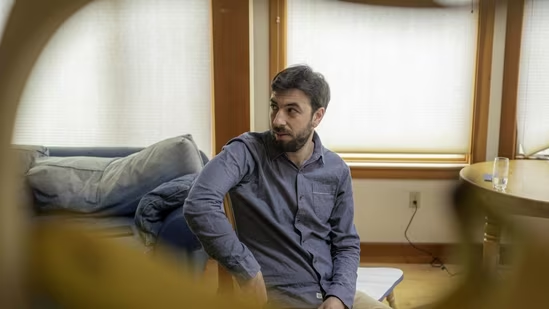
Rushing to launch Graham Platner’s Senate bid, Dan Moraff, a progressive up-and-comer and Platner’s top strategist, asked a Democratic research firm to vet the political novice.
A thorough background check of a Senate candidate, which has become standard practice in key races, can take several weeks and cost roughly $20,000 or a monthly retainer. Moraff asked for an expedited, cheaper review to be done within days, according to people familiar with the matter.
In three days, New York-based Northside Research produced a brief, risk-assessment memo for Moraff in lieu of a detailed research book—or the start of one—that can be hundreds of pages long. The expedited product laid out risks for the campaign, flagging some of Platner’s Reddit posts as the biggest threat to his budding campaign, some of those people said. The firm, which was paid $6,250, according to federal disclosures, followed up days later with additional limited vetting. They didn’t do a candidate interview or questionnaire.
Less than two weeks later, Platner announced his bid. The expedited research didn’t discover issues that would later hurt his campaign, including the full trove of Platner’s Reddit posts or sexually explicit texts Platner sent to other women while married.
In pulling an oyster farmer and Marine veteran from obscurity, and then opting for an abbreviated vetting process, Moraff has placed Democratic Party hopes for capturing a majority of Senate seats this year on unsteady footing. Platner faces continued scrutiny and a barrage of GOP attacks over old posts, a covered-up Nazi-linked tattoo and his previous relationships with women.
It is the latest example of the mix of ambition, bravado and corner-cutting that Moraff has shown in a political career that has had a measure of success in elevating populist, Bernie Sanders-style candidates but also a trail of missteps that has left some political partners feeling betrayed.
A Platner campaign official said they didn’t have the resources to do a more extensive vet, which the official said wouldn’t have turned up any more meaningful information.
With a disdain for traditional Democratic campaign organizations, Moraff has set out to disrupt the party’s ecosystem of consultants and campaign strategists. Over the past decade, he has attempted to prove he can identify winning candidates better than the party’s leaders and build successful campaigns from scratch, testing his ideas in New York, Pittsburgh and Nebraska. Those efforts drew little national attention until this year, as Moraff has now put himself at the center of the Maine Senate race that Democrats widely consider to be their best opportunity to flip a Senate seat.
Core to Moraff’s political philosophy is a belief that voters want outsiders to run for office and are willing to look past personal transgressions, as long as the candidate can connect with them. In Maine, Platner won more than 70% of the Democratic primary vote this month, becoming his party’s Senate nominee.
“Real people who have lived real lives are giving voters something they’ve been starving for,” Moraff said in a statement. “People want someone who will fight for them, not someone who’s been dreaming of power since they were in middle school and lived their lives accordingly.”
Moraff said criticism of his management was coming from party insiders “to smear the people resisting their control over a party in dire need of change.”
Platner’s working-class message and political charisma have broken through with Maine voters, and his bid to unseat Republican Sen. Susan Collins remains competitive despite revelations about his past. But some Democrats fear Platner’s unvetted background could still cost them.
Some of Platner’s family members have expressed unease with Moraff’s decision-making, according to people familiar with the matter, raising concerns with some campaign staff about the race causing long-term problems for Platner.
Moraff handled the nonstop hits on the candidate’s past posts with an air of nonchalance, according to people familiar with the matter. He has told staff, “Good vibes only,” when problems come up.
Past campaigns
Moraff’s backers call him a brilliant disrupter with a fresh perspective who doesn’t mind rubbing people the wrong way to win. But his work for Platner fits a pattern of management of previous campaigns, according to more than a dozen people who have worked with him over the last decade. In particular, candidate vetting has been a frequent source of tension.
In Pittsburgh, he was involved in Turahn Jenkins’s 2018 campaign to take on the county’s district attorney, Stephen Zappala Jr. Less than a week into his campaign, progressive groups backed away from Jenkins when it emerged that he belonged to a church that held antigay views. Jenkins, who lost the election, declined to comment on the race or on Moraff.
Moraff said he did a vet for Jenkins that was beyond what would normally have been done for local office.
Brandi Fisher, who leads a police-accountability organization in Pittsburgh, where Moraff worked with progressive groups and a small corps of Democratic Socialists of America, called the campaign “a debacle.” But she said she holds Jenkins, rather than Moraff, responsible for not revealing the views of homosexuality that undermined his support.
She acknowledged that Moraff’s work has caused friction with other activists. “Daniel moves fast,” she said. “Daniel makes mistakes, because he’s aggressive. Any time you’re a very aggressive, risk-taking person, things are going to come up.”
In New York, Moraff worked as campaign manager for state Senate candidate Debbie Medina. Her 2016 admission that she beat her son as a child with a belt derailed her campaign. The revelation came after older testimony from the sentencing of her son in a murder trial surfaced.
Moraff later touted her getting 40.5% of the vote despite “a major scandal in the middle of her campaign” in a 2017 op-ed for a progressive magazine, In These Times. Moraff told The Wall Street Journal he didn’t recruit Medina, who had previously run for office.
More recently in Iowa, Moraff recruited another political novice last year, Nathan Sage, a veteran and former executive director for the Knoxville chamber of commerce, to run for U.S. Senate. In that race, Moraff also did a preliminary vet instead of a more thorough check. Campaign staff wanted to get a full opposition research book on their candidate, but Moraff wasn’t interested, according to people familiar with the matter. Moraff said his standard vet didn’t turn up any significant flags.
Sage, who dropped out this February, failed to gain enough traction and financial support in a crowded primary.
Sage said Moraff, who showed up at his workplace unexpectedly and convinced him to run, shifted his attention almost entirely from Iowa to Maine once he found Platner. He would sporadically make calls and join meetings only to criticize the campaign’s strategy or offer ideas that didn’t align with Sage’s views and the electorate in Iowa.
“It’s like the kids are at home cooking supper, and mom’s not there. But when mom comes home, she’s mad because they burned something,” Sage said.
“I feel like Daniel is goal-oriented, mindset-oriented,” he added. “He will run through a wall for people, but he’ll also run through people for his mindset.”
Breaking the ‘progressive blob’
Moraff got his start in politics as a teenager, when he volunteered for the gubernatorial campaign of Deval Patrick, who became the first Black governor of Massachusetts. He later volunteered on the presidential campaign of Democrat John Edwards before earning a degree in engineering and urban studies from Brown University and then working as a tenant organizer in New York.
It was Sen. Bernie Sanders’s 2016 presidential campaign that set Moraff on his current course. Moraff, who called himself a Sanders “supervolunteer,” meaning he performed unpaid work that usually is assigned to paid staff, says he drew two conclusions from the independent senator’s unexpectedly competitive race against Hillary Clinton for the Democratic nomination.
One conclusion was that a populist candidate could build a campaign organically, without the help of the ecosystem of established progressive groups, which he found to be ineffective. “Bernie Sanders comes along and is very much not a part of the progressive blob and does things very differently than the progressive blob, and almost overnight builds something much, much bigger than the progressive blob had ever built itself,” Moraff said in an interview.
The second conclusion was that Democrats were bad at recruiting candidates—and that he could do better, himself.
He scored a series of early successes, including recruiting Summer Lee, who was then a recent law school graduate protesting perceived racial bias at a local high school, to run in 2018 for state representative in Western Pennsylvania and managed her campaign. She won the race and was later elected to Congress representing the Pittsburgh area, in 2022.
Fisher, who leads the police-accountability group in Pittsburgh, called Moraff a “genius” and credited him for a string of other election successes that replaced centrist Democrats, some of whom backed “tough on crime” agendas, with a more progressive generation.
After testing candidates in deep-blue places like Pittsburgh and out-of-reach GOP areas like Nebraska, the operative’s foray into battleground races such as in Maine has caused panic among some Democrats.
Moraff works closely with his fiancée, Leanne Fan, whom he met while working for Sanders in 2020. The pair recruited Platner and Sage together last year. And Moraff, who is affiliated with different consulting entities, including Dark Forest LLC and Independent Campaigns LLC, has hired staff to travel the country to look for other working-class candidates to back.
‘Mad scientist’
Moraff’s policy goals are in line with those of Sanders in “fighting the oligarchy,” as the Vermont senator frequently puts it, and although he has worked in the past on criminal-justice reform issues, those who have worked with Moraff on recent campaigns say he is not as focused on policy specifics. He wants his candidates to back Medicare for All and characterize the Israel-Hamas conflict as a genocide, but beyond that, doesn’t believe voters care about detailed proposals.
In Platner’s race, Moraff crowdsourced proposals from activists on Discord, a social-media platform, according to people familiar with the matter, who viewed it as outsourcing. A Platner campaign official disputed the characterization, saying Moraff led the development of policy proposals and used Discord as a convenient place for people to share issues they cared about.
Meanwhile, Platner’s campaign has suffered from staff turnover since launching last August, in part because of his previous social-media comments and tattoo, but also because of disagreements with Moraff, those people said.
Paige Loud, who worked for Platner before leaving to run unsuccessfully for Congress, publicly criticized Moraff in a story on Instagram.
Fan, according to those who have worked with the couple, at times tries to smooth over any tensions between Moraff and staff. Her engagement ring opens up to a tiny comb that she has used to brush Moraff’s beard.
Platner still holds Moraff in high regard and closely follows his advice. He marveled that Moraff this year completed a law degree at Yale University while also running his campaign. “He’s a mad scientist with politics,” Platner told the Journal.
Write to Tarini Parti at tarini.parti@wsj.com and Aaron Zitner at aaron.zitner@wsj.com