
By midday, the Muslim Quarter of Jerusalem’s Old City in occupied East Jerusalem had largely emptied.
“If I don’t want to get attacked, I have to close,” said Fadi, a 48-year-old shopkeeper, as he pulled a table inside and began lowering his metal shutter.
Under normal circumstances, Thursdays are vibrant and bustling in the Old City. But ahead of the annual Flag March by ultra-nationalist Israelis – marking “Jerusalem Day” and deliberately routed through the Muslim Quarter – Palestinian residents and traders were forced to shut up shop, barricade themselves indoors, or leave the area altogether.
Even so, groups of far-right settlers, donning their infamous knitted kippahs and long peyot, began marching through the streets hours before official festivities had started.
One group of teenagers walked past a still-open Palestinian store and began hurling insults.
CLICK FOLLOW: TO FOLLOW US
Sign up to get the latest insights and analysis on
Israel-Palestine, alongside Turkey Unpacked and other eSPORTY
This quickly escalated into physical attacks against two shopkeepers, who defended themselves with plastic chairs while “Protective Presence” activists attempted to de-escalate the situation.
The confrontation lasted no more than 30 seconds, but served as an early glimpse of the impunity these boys would be granted over the course of the day.
‘Every year there is bullying, verbal hate and physical violence’
– Yonatan Shargian, activist
Several business owners would go on to watch their shops be vandalised or ransacked, despite the heavy presence of armed police throughout the Old City.
The scene is repeated each year as Israel marks the occupation of East Jerusalem in 1967 and its subsequent “unification” with West Jerusalem – seized by Zionist militias during the 1948 Nakba.
Increasingly dominated by the far right, the march has grown more volatile over the years, unfolding as a display of Israeli dominance and control over the city’s Palestinian population.
Third Temple
While officers could have easily corralled the groups of boys – some no older than 12 years of age – Israeli forces have increasingly shown themselves unwilling to protect Palestinians or their property during the march.
Given this intentional neglect, activists have stepped in to fill the void.
“Every year there is bullying, verbal hate and physical violence,” said Yonatan Shargian, an activist with Standing Together.
He added that while the number of activists has grown over the years in step with the rising violence, their presence is also intended to send a message that “this place belongs to all of us, and everyone deserves to feel safe and protected”.

Not far from the crowds that swept through the Muslim Quarter, National Security Minister Itamar Ben Gvir stormed Al-Aqsa Mosque, alongside hundreds of settlers.
The far-right politician then brandished an Israeli flag and declared “The Temple Mount is in our hands”, invoking the extremist desire of full Israeli sovereignty over one of the holiest sites in Islam.
Alongside stood lawmaker Yitzhak Kroizer, who in a Facebook post later in the day said it was time to remove the mosque and build a Third Jewish temple in its place.
As the day wore on, settlers began to gather just inside Damascus Gate, the main entrance to the Muslim Quarter and Al-Aqsa Mosque.
About 200 teenagers and men came and went, taking turns chanting “Death to Arabs” and “A Jew is a soul, an Arab is a son of a whore”.
Activists from various organisations remained nearby, escorting the few Palestinians who came and went from their homes. Alongside journalists, they soon became the focal point for verbal and physical attacks.
At one point, a group of young men and boys crowded around a journalist, shoved him into a corner, threw his phone on the ground and spat in his face.
Like they had done all day, after police broke up each attack, the ultra-nationalists would break into a victorious chant, this time jeering: “May your village burn.”
Erasure of Palestinians
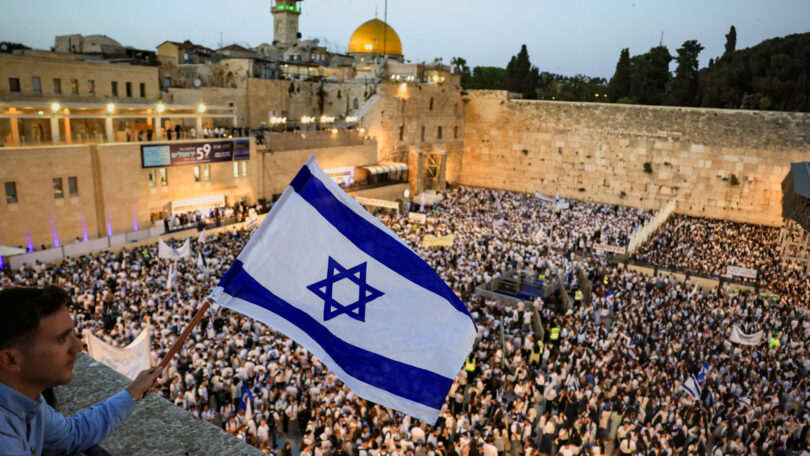
Shortly afterwards, activists and journalists were pushed out to make way for the incoming procession of those participating in the March of Flags.
What started as a small group quickly turned into a sea of young men, arriving at Damascus Gate in successive waves to make their way to the Western Wall.
The area was soon flooded with Israeli flags, alongside various iterations of the Third Temple flag – a symbol associated with calls for the demolition of Al-Aqsa Mosque and the construction of a Jewish temple in its place.

What is Jerusalem Day and the March of Flags?
Read More »
“It’s not Al-Aqsa, it’s the Temple Mount. You want a massacre? You’ll get the Nakba,” read one large banner.
Other participants wore stickers featuring Ben Gvir and a noose, a reference to the death penalty bill targeting Palestinian prisoners that he had helped pass in the Knesset.
Before entering the Old City, each cohort paused to belt out religious and nationalist songs, revelling in the display of dominance over the Muslim Quarter.
While the day was not without violence, many long-time activists said this year felt comparatively subdued, mainly due to Palestinians largely being pushed out of sight in their own neighbourhood, leaving fewer targets for abuse.
For a holiday celebrating Israel’s occupation of East Jerusalem, the temporary Palestinian disappearance may be its clearest statement: a city celebrated as “unified” through the quiet erasure of those who live there.


