CHORNOBYL, Ukraine—When Ukrainian emergency workers clambered onto a damaged structure above Reactor No. 4 at the Chornobyl Nuclear Power Plant, there were eerie echoes of 1986.
Back then, when Ukraine was part of the Soviet Union and the site was known by its Russian name, Chernobyl, firefighters suffered horrific aftereffects from exposure to radiation while dealing with the consequences of an explosion in the reactor.
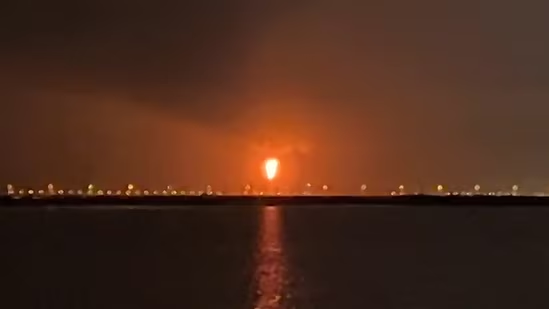
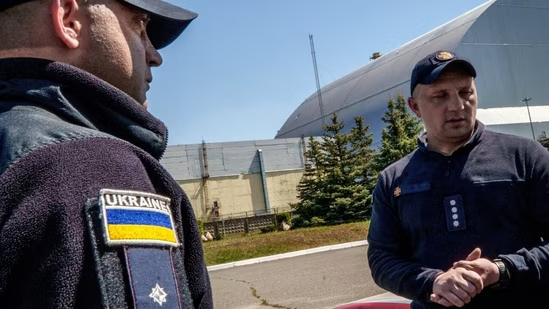
In February of last year, emergency workers again raced to help put out a fire that Ukraine said was triggered by a Russian attack drone. To tackle the fire, they climbed the so-called confinement structure that stands taller than the Statue of Liberty and covers the destroyed reactor to prevent radiation from escaping.
Over the next two weeks, dozens of workers from Ukrainian emergency services faced freezing winds as they battled to put out the fire that spread through the membrane between the roof and the ceiling. Climbers worked in shifts to limit radiation exposure while firefighters handed them hoses, but the water quickly turned to ice.
“We just did our job,” said Oleksiy Chuprov, one of the emergency workers. “These are simply one-of-a-kind facilities, and we can already say that fate gave us a chance to test ourselves and our colleagues to the limit.”
Chuprov said he fretted most about the daunting task on the 30-story ascent up the icy metal stairs leading to the top of the confinement. “There were nerves, but once you get the hang of it you just want to get up there faster—to get to the top and get to work,” he said.
The confinement has now been temporarily patched up, and Ukraine is asking its allies to help raise about $580 million for repairs that the European Bank for Reconstruction and Development says are needed to prevent irreversible corrosion and ensure the confinement can operate safely. In April, the U.S. announced its intention to pledge $100 million, while other contributions totaled around $80 million.
Ukraine’s nuclear reactors have seen a number of dangerous standoffs throughout the war, as Russia’s army has occupied power stations and turned them into military bases. Russia occupied Chornobyl in the first weeks of the war before retreating from the Kyiv province. Moscow’s army is also occupying the largest nuclear plant in Europe near Zaporizhzhia in southeastern Ukraine.
The biggest threat to Chornobyl, though, came from the skies. Russia is targeting Ukraine’s power stations and energy grid, leaving the country heavily reliant on nuclear reactors to keep the lights on.
Ukrainian officials have accused Russia of using threats to nuclear facilities as a way to scare and pressure the West over the war in Ukraine. Since last July, Russia has focused some of its energy assaults on substations connected to Ukraine’s nuclear power plants, according to the Ukrainian Prosecutor General’s office.
“This increases the risk of emergencies,” said Oleksandr Ziuz, who works at the office. “It is one of the key signs of the latest stage of attacks on Ukraine’s energy infrastructure.”
He said that Russian Kinzhal ballistic missiles have flown within a 12-mile radius over the Chornobyl Nuclear Power Plant 21 times, while the same happened over the functioning Khmelnytskiy nuclear power plant 15 times. Twice, a Kinzhal ballistic missile landed within a six-mile radius of the latter.
“We are in the situation where the real nuclear threat today comes much more from atoms for peace than it comes from the atoms for war, and the line between two types of atoms is really blurred,” said historian Serhii Plokhy, who has written a book on the Chornobyl disaster.
The Chornobyl plant was fully shut down in 2000, but it remains a danger because of the 200 metric tons of highly radioactive material under the original concrete shelter. A new structure costing $1.75 billion was built over the site in 2019 that is able to withstand tornadoes and forest fires, and was created so that the original “sarcophagus” below could be slowly be dismantled.
Then the Russians invaded in February 2022. Pouring south from Belarus, they soon occupied Chornobyl, but seemed oblivious to the situation there, digging trenches and laying mines.
“They didn’t understand; they had absolutely no idea about radiation monitoring or where they were,” said emergency-service worker Oleh Lebedev, who lived through the Russian occupation that lasted about one month.
Three years later, at around 2 a.m. on Feb. 14, 2025, a Russian explosive drone slammed into the confinement structure after approaching below radar level at about 280 feet, said Ukrainian officials.
Lebedev was one of the first rescuers on the scene. When he entered the building that houses the destroyed reactor, he looked up and saw the frosty dark gray sky through the hole left by the drone.
Over the next two weeks, Lebedev and over 100 of his colleagues in the state emergency services worked in shifts as brief as 30 minutes to limit radiation exposure. They faced freezing temperatures, gusts of wind and the daunting task of fighting fire with ice at the site of the largest civilian nuclear disaster in history without further damaging the confinement.
Serhiy Dyshkant, the head of Kyiv region’s emergency services, coordinated dozens of rescuers as they raced to the giant confinement arch. The fire was spreading in the membrane hidden beneath the metal roof. Drones with thermal imaging became the rescuers’ eyes as they played a giant, high-risk game of whack-a-mole in search of hot spots.
Rescuers perched atop the structure cut holes in the roof and sprayed a special solution onto the hot spots, as regular water could have frozen and quickly weighed down the entire structure.
“Emotions ranged from joy to anxiety and back to joy again,” said Dyshkant. He described believing the hot spots were cleared and the threat past, only to see the snow melting a few meters away, meaning the membrane there was burning.
The staircase leading to the top of the confinement iced over, making the ascent more perilous. The solution in firefighters’ hoses also froze and had to be replaced, requiring another hike up the icy 30 floors.
While firefighters manned the hoses, climbers like Ivan Khmelnytsky dangled from ropes and cut the holes in the roof to put the solution on the hot spots.
He worked through snow and rain, which posed risks to his rope, which could have snapped when frozen with ice and was weighed down by water, meaning he sometimes had to drop excess rope.
Khmelnytsky recalled being struck by fear once when he was almost 100 meters above ground and thought his rope had given way. A drone carrying a camera checked the rope and gave him the all clear, which allowed him to return to the task with a calmer mind.
Khmelnytsky, whose brother was diagnosed with cancer related to the original disaster, is anxious that his efforts could have exposed him to high levels of radiation.
“There was anxiety, there is anxiety, and there will be anxiety,” Khmelnytsky said about the radiation. After participating in the operation, he couldn’t return to the zone for a year to avoid absorbing more radiation.
For now, war risks remain as Ukraine readies for another winter that could bring additional devastation to its grid. Each time Khmelnytsky sees a drone passing over Chornobyl via monitoring channels, another disaster scenario flashes through his mind.
“All of this is just political games on their part, this pressure on the global community,” he said. “They don’t shy away from using such methods at all.”
Earlier this month, Ukrainian President Volodymyr Zelensky said that a Russian drone struck the territory around the Chornobyl plant again, hitting a building close to a facility that stores large amounts of spent nuclear fuel.
“As of now, there are no readings exceeding normal background radiation levels. But there is certainly an increase in Russia’s brazenness, which long ago went off the charts,” Zelensky said on X.
Write to Anastasiia Malenko at anastasiia.malenko@wsj.com