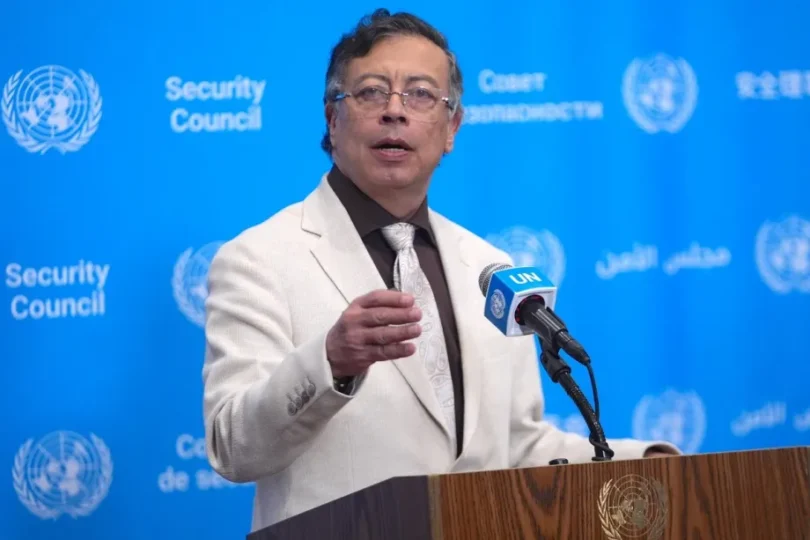
Colombian President Gustavo Petro has accused Israel of interfering in Colombia’s presidential election, weeks after French prosecutors opened an investigation into alleged foreign interference targeting pro-Palestine candidates from La France Insoumise in local elections. French authorities suspect the campaign involved BlackCore, an Israeli cyber and influence firm, though they have not identified who commissioned the operation.
In the latest case of alleged Israeli interference, Petro has raised serious irregularities in Colombia’s vote-counting process, claiming that changes to electoral server IP addresses indicate that the software may have been compromised. The Colombian president called for a full forensic audit, judicial oversight of the scrutiny process and a nationwide recount, while alleging that Israel was behind the purported interference.
The claims emerged as Colombia’s electoral authorities continued the official verification process after a tightly contested presidential run-off. Preliminary results showed right-wing candidate Abelardo de la Espriella ahead with 49.66 per cent of the vote, against 48.70 per cent for left-wing senator Iván Cepeda, with nearly all ballots counted.
Reuters reported that De la Espriella had narrowly won the run-off pending final legal verification, while AP said Cepeda planned to challenge results from more than 30,000 voting stations.
Petro stressed that no candidate can be declared president until Colombia’s official scrutiny process is completed, arguing that the preliminary count is not the legally binding result.
In a post on X, Petro said he had previously warned that the electoral software was vulnerable and had requested an expert audit, which he said the registrar did not allow. He then claimed that authorities had evidence of changes to the IP addresses of several national registry servers.
“This means that the software was compromised and others wrote data for polling stations and voting posts,” Petro wrote, before claiming: “The only entity in the world capable of doing that is the state of Israel.”
Advertí que el software de los hermanos Bautista era vulnerable según la sentencia del Consejo de Estado del 2018 y que debía cambiarse por un software público,
Solicité a tiempo una auditoría experta del software de los hermanos Bautista, y el registrador no lo permitió.…
— Gustavo Petro (@petrogustavo) June 21, 2026
Petro said he would provide judges with details of the allegedly altered servers so that they could order an expert audit during the scrutiny process.
The Colombian president also alleged other irregularities, including lawyers being blocked from entering the main vote-counting centre at Corferias in Bogotá and unsigned E14 polling forms being uploaded by election authorities. He called for an independent forensic audit of the electoral software, a recount of all polling stations and judicial oversight of the scrutiny process.
The remarks come weeks after French authorities linked Israeli firm BlackCore to alleged digital interference campaigns targeting elections in France, Scotland, New York City, Angola and Togo. Reuters reported that France’s foreign interference watchdog had flagged alleged BlackCore operations in those locations, but that investigators had not identified who commissioned the campaigns.
Read: Israel throws millions into new clandestine hasbara initiative
Israeli-linked private intelligence and cyber firms have long faced allegations of involvement in covert election interference operations. During the Cambridge Analytica scandal, whistleblower Christopher Wylie told UK lawmakers that the company’s parent firm, Strategic Communication Laboratories (SCL), had used Israeli private intelligence firm Black Cube during Nigeria’s 2015 presidential election.
Wylie alleged that Black Cube was hired to obtain compromising material on then Nigerian President Goodluck Jonathan. Black Cube denied the claim, calling it false.
The Nigeria operation became one of the most controversial examples of Cambridge Analytica’s work in the Global South. The Guardian reported that the firm sought to influence Nigeria’s 2015 presidential election on behalf of then President Goodluck Jonathan by circulating a graphic video portraying his challenger, Muhammadu Buhari, as a supporter of Islamist violence. Wylie said the material was designed to intimidate voters and damage Buhari, who went on to win the election.
Channel 4’s undercover investigation also exposed Cambridge Analytica executives discussing covert tactics including the use of front companies, compromising material and deniable operations in political campaigns. The scandal intensified scrutiny of private firms operating across borders to manipulate democratic processes.