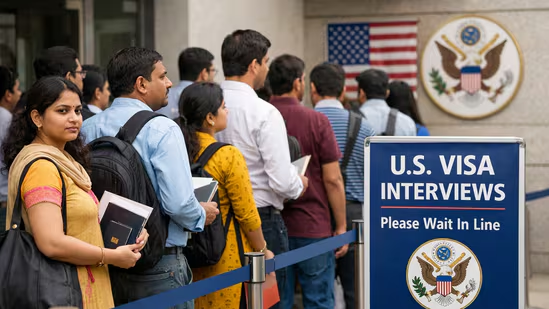
Indian nationals employed in the United States receive considerably higher salaries on average compared to US-born graduates, despite evidence showing that some H‑1B visa holders earn less than their American counterparts, according to a recent analysis.
These findings are derived from a report published in June 2026 by StudentEB5, which investigates earnings associated with high-skilled immigration routes, including H‑1B visas. The analysis, which utilizes data from the Economic Innovation Group (EIG), reveals that Indian nationals in the US have a median annual income of approximately $146,000—over two-thirds greater than the median earnings of college graduates born in the US.
The H-1B program is a focal point in an ongoing discussion regarding immigration, wages, and skilled labor. Recent data says that the situation is more complex than typically represented by either side, as Indian workers are reported to have some of the highest salaries in the nation, despite ongoing concerns about whether certain visa holders receive compensation that is lower than that of their US counterparts.
A representative from the US Department of Labor informed Newsweek that the department is dedicated to safeguarding “wages and employment” opportunities for American workers.
Also Read: H-1B applicants face new challenging questions amid visa policy changes; here’s what you need to do
Do Indian nationals get more salary that US-born graduates?
The report situates these statistics within a larger trend indicating that individuals who initially arrived in the United States on student visas generally earn higher salaries than their native-born counterparts.
Data from EIG referenced in the analysis revealed that these workers received a median income of $115,000 in 2023, in contrast to $87,000 for graduates born in the US.
Concurrently, the analysis references findings from the National Bureau of Economic Research, which suggest that H-1B visa holders earn approximately 16 percent less, on average, than American workers in similar positions.
Reasons for the ongoing H-1B wage debate
Critics contend that certain employers exploit the program to recruit foreign workers at lower wages, whereas proponents assert that it plays a crucial role in alleviating shortages in high-skill sectors like healthcare, engineering, and technology.
The program, limited to 85,000 new visas each year, has come under increasing examination from lawmakers regarding its effects on wage levels and employment practices.
The impact of age and industry on earnings
The StudentEB5 report states that, despite concerns regarding wage disparities, a significant number of foreign workers—especially those from India—are found in higher-paying sectors like technology and engineering, which contributes to their overall earnings being elevated.
Sam Peak, the policy manager at EIG, informed Newsweek that the organization’s research reveals a more modest wage gap when comparable workers are analyzed.
“On average, H-1B lottery winners make 5.1 percent less than US workers in the same occupation,” Peak stated, noting that the majority of visa holders receive compensation that exceeds that of their American-born peers.
Peak mentioned that the wage gap varies considerably with age. Younger H-1B employees frequently earn more than Americans in equivalent positions, whereas older workers generally earn less—a disparity that is partly influenced by mid-career hires in lower-paying IT outsourcing roles.
Younger visa holders are also more inclined to have pursued their studies in the United States and acquired experience through programs like Optional Practical Training, which are associated with higher earnings.
Trump’s H-1B fee encounters legal challenge
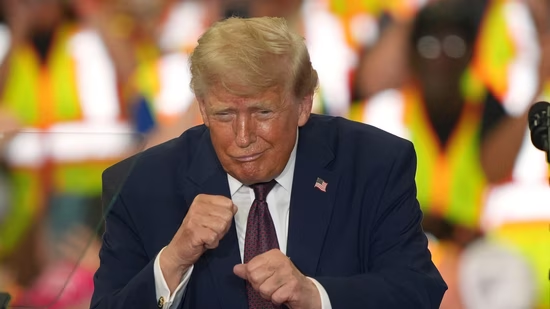
The H-1B program is under increased political examination. In September 2025, President Donald Trump announced a policy that would impose a $100,000 fee on new H-1B applications, claiming it would reduce misuse and give preference to highly skilled workers.
On June 8, 2026, a federal judge in Boston invalidated the fee, determining that it exceeded executive authority and constituted an unauthorized tax.
U.S. District Judge Leo Sorokin stated that the administration did not possess the authority to implement the fee, marking a setback for one of its most assertive initiatives to alter the high-skilled visa framework. The federal government has indicated its intention to appeal.
Administration officials indicated that the initiative aimed to reduce misuse and guarantee that visas were allocated to highly skilled, well-compensated workers instead of lower-wage labor.
Business organizations and immigration supporters contested the policy, asserting that only Congress had the authority to impose such a fee. Sorokin concurred, determining that it operated more as a tax than a regulatory fee.