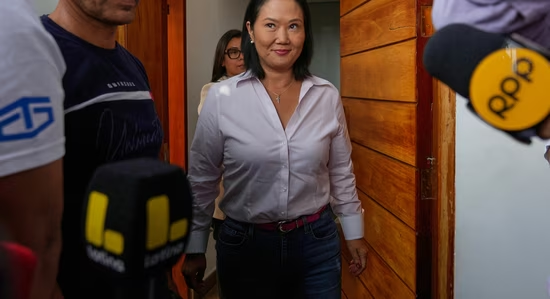
LIMA, Peru—As a teenager, Keiko Fujimori served as first lady to her father, Alberto, an iron-fisted ruler eventually imprisoned for extrajudicial killings. Now, she is following her father into Peru’s presidency as the latest right-wing leader to win power in Latin America.
As the heir of the movement founded by her father, her election has inspired both jubilation and fear among Peruvians who recall Alberto Fujimori’s rule from 1990 to 2000. Back then, he smashed a brutal Maoist insurgency and hyperinflation before his government collapsed amid widespread corruption and human-rights offenses.
The 51-year-old Fujimori shares her father’s law-and-order reputation and support for free-market economic policies. Aligned with the Trump administration’s regional approach, she pledged a crackdown on violent crime, a top concern among Peruvians facing a rise in extortion, illegal gold mining, and cocaine trafficking. She has promised to build maximum-security prisons, expel illegal migrants and allow judges to wear hoods to conceal their identities for security reasons.
“Justice won’t be afraid,” Fujimori said during the campaign. “The most important thing is to have the will to use force to be able to confront criminals, these scum who are killing us.”
With more than 98% of the votes counted in Sunday’s runoff election, she overtook her leftist opponent, Roberto Sánchez, with 50.002% support—a difference of just a few hundred votes out of nearly 20 million cast. Pollsters say that minuscule lead will hold as the remaining ballots fall in her favor.
She will join a growing faction of right-wing leaders elected across South America. Only Uruguay, Colombia, and Brazil have left-of-center governments, and the latter two face coming elections in which right-wing candidates have a strong shot at winning.
“The Trump administration can say, we got another one in our camp,” said Michael Shifter, former president of the Inter-American Dialogue, a think tank focused on the Western Hemisphere.
Fujimori will take over a country far different from the one her father inherited in 1990, facing significant challenges of her own. She will lead one of Latin America’s most dysfunctional political systems, becoming its 10th president in a decade—an era of turmoil that analysts blame in part on Fujimori’s ruthless tactics as opposition leader. She is also far less popular than her father ever was, losing three past elections and barely capturing this one.
“It’s going to be a difficult government for her,” said Alfredo Torres, head of polling firm Ipsos Peru. “She won by a very narrow margin, so she could end up having problems governing with a very aggressive opposition.”
Sánchez hasn’t conceded, and some of his allies are claiming fraud without providing evidence. Sánchez said he would defend his “popular victory.”
The younger Fujimori differs from her father in notable ways. Alberto Fujimori was a political outsider who won power in 1990 by sweeping up support among Peru’s poor masses who detested the establishment. Today, his daughter is a central figure of that Lima establishment.
While she lacks her father’s natural charisma, she also rejects his authoritarian tendencies, allies say. The elder Fujimori dissolved Congress, arrested political opponents and held fraudulent elections to extend his stay in power. His opponents and many historians have called him a dictator.
His daughter maintains she won’t stay in office beyond Peru’s one-term limit.
“There is no possibility that she will behave in an authoritarian or dictatorial way,” said Fernando Rospigliosi, a member of her Popular Force party and head of the Congress. “She’s proven to be absolutely democratic.”
Fujimori was thrust into Peru’s notoriously messy politics in 1994 at age 19. The oldest of four siblings, she was appointed first lady by her father during her parents’ bitter public divorce. Her mother, Susana Higuchi, called him a corrupt tyrant. In a scandal that riveted Peruvians like a telenovela, the president cut off water and power to his wife’s quarters at the government palace and locked her out of the building.
Fujimori launched her own political career to take the helm of “Fujimorismo,” as her movement is known. She won a seat in Congress in 2006 and then began a relentless run for the presidency, losing three times—twice by extremely slim margins.
She quickly realized her biggest asset—her last name—was also her largest liability. A loose coalition known as “Anti-Fujimorismo” repeatedly united hard-left politicians, centrist city liberals, and pro-democracy activists to block her by supporting whoever ran against her.
In her 2016 bid, Fujimori tried to distance herself from her movement’s authoritarian past, cultivating a more moderate image. She narrowly lost to Pedro Pablo Kuczynski, who said that her victory would turn Peru into a “narco state.” Fujimori used her party’s new congressional majority to aggressively target Kuczynski, who eventually resigned to avoid impeachment.
That battle sparked Peru’s current decade of political instability, weaponizing a “moral incapacity” constitutional clause that allows lawmakers to quickly oust sitting executives.
In 2018, Fujimori was arrested as part of a sprawling corruption probe involving Brazilian construction giant Odebrecht. Hauled away in handcuffs, she denied accepting illegal campaign contributions, calling the case a politically motivated persecution. Peru’s Constitutional Tribunal threw out the corruption case against her last year.
In recent years, critics have accused her of leading a right-wing congressional coalition that has undermined Peru’s democracy, pushed through laws defanging organized-crime investigations and stocked the judiciary with allies.
Still, voters exhausted by street crime and economic paralysis say she represents the best path forward.
“Her father was a great leader, and she has a coherent team that can pull the country out of the mess we’re in,” said Carlos Sigüeñas, a businessman on the outskirts of Lima. “Security will improve, there will be better jobs, more investment.”
Write to Ryan Dubé at ryan.dube@wsj.com