‘We don’t have to give the Iranians anything if they don’t make the commitments that we want long term on the nuclear program.” So said Vice President JD Vance on Monday, and it has become his mantra across a blitz of TV interviews. The problem is that if you read the memorandum of understanding that vaguely outlines the deal, this isn’t true.
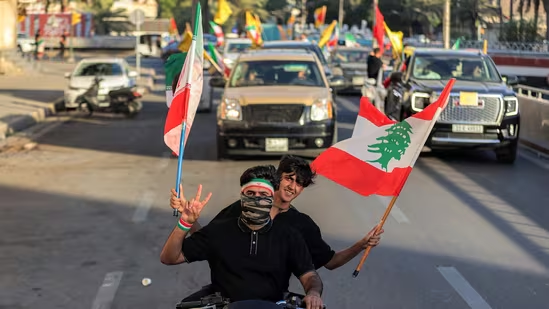
Youths ride scooters and vehicles while waving flags of Iraq, Iran, Lebanon and Hezbollah in Baghdad on June 15, 2026, during celebrations following the announcement of a deal to end the war between Iran and the US. (AFP)
The MOU commits the U.S. to give substantial sanctions relief up front, and throughout negotiations, though the regime has made no serious concessions on nuclear matters. Consider the deal’s 10th point:
“The United States of America undertakes that immediately after the signing of this MOU, and until the termination of sanctions, the U.S. Department of Treasury will issue waivers for exports of Iranian crude oil, petroleum products and derivatives, and all associated services including banking transactions, insurances, transportation, etc. [our italics].”
Oil sanctions would be lifted for at least the 60-day period of negotiations, which Iran will try to extend. President Trump has already said he’s open to an extension, and he has reason to agree rather than risk the collapse of the talks and closure of the Strait of Hormuz in advance of the midterm elections.
Even Barack Obama’s 2015 nuclear deal didn’t fully waive oil sanctions until after inspectors verified that Iran had implemented its nuclear commitments. This memorandum and the lifting of the U.S. blockade—through which several million barrels of Iranian crude have since passed—will allow Iranian oil exports worth billions of dollars a month.
Lifting related banking sanctions could compound the damage if it allows the regime to repatriate oil revenue. A broad waiver would rescue the regime financially and blow a hole, not easily repaired, through the U.S. sanctions wall.
The MOU also commits the U.S. to “not impose any new sanctions” pending the final deal. Miad Maleki, who led the U.S. Treasury’s sanctions campaign until last year, says this may be the most dangerous concession. “It tells the market Washington will tolerate violations, pushing risk tolerance up and enforcement credibility toward zero,” he writes. This could be cover for Iran to move trapped oil revenue out of China.
Next comes the billions in frozen Iranian funds. Rather than condition access on the performance of a final deal, the U.S. “undertakes to make fully available” the assets “upon the implementation of this MOU.” Iran says this means they are to be released immediately, and progress in Hormuz, before nuclear commitments, may be enough.
A senior Trump Administration official tells us these funds will be released to buy humanitarian goods, and the text says the parties “will mutually agree on the procedures related to the release of these funds during the negotiations.” Revolutionary Guard Commander Ahmad Vahidi has reportedly insisted the funds be fully available—language the MOU also uses—to cover military spending.
***
So what could Mr. Vance be talking about? There is the $300 billion economic rehabilitation fund that the U.S. “undertakes” to draw up and implement only after a final deal. The figure is fanciful, equal to Iran’s current GDP, and making it happen would take ample time and Iranian commitment.
The senior Administration official says, “We’ve tried to make the carrots so big that we’re tempting them to hopefully think about it.” But note that Mr. Vance has picked up the Obama-style evasion of insisting that it involves “not a single cent of American money,” as though the fund from allies facilitated by the U.S. wouldn’t help the regime all the same.
The MOU also says the U.S. “undertakes to terminate all types of sanctions” against Iran “in an agreed upon schedule as part of the final Deal.” This means full sanctions relief for Iran if the regime signs and implements a nuclear deal.
In other words, when Mr. Vance said, “We don’t have to give the Iranians anything if they don’t make the [nuclear] commitments,” it seems he really means that we don’t have to give the Iranians everything. In the chasm between those two lies tens of billions of dollars that could bail out an Iranian regime that is at its weakest in decades. This includes its military, economy, industrial base, proxy network and nuclear program.
Reuters reports that Iran has already promised Hezbollah more funding once its cash flow increases, and that’s true to form for the Iranian regime. The memorandum of understanding gives it plenty before securing commitments of substance on the nuclear program, let alone on missiles or proxies. That’s U.S. leverage, given up before it’s needed most.