“Here stood a great oak tree with branches spreading broadly around, beneath which was a seat of green moss where Robin Hood was wont to sit at feast and at merrymaking with his stout men about him,” wrote Robin Hood author Howard Pyle in his 1883 book.
More than a century later, that image continues to shape how millions view the Major Oak, an ancient tree in UK’s Sherwood Forest whose fame owes as much to literature and legend as to its remarkable age.
The tree, between 1,000 and 1,200 years old, is believed to have died after failing to produce leaves this spring. But long before conservationists fenced it off and tourists travelled to see it, Major Oak had already secured a place in folklore, literature and popular imagination.
Its story is inseparable from Robin Hood, Victorian romanticism and centuries of storytelling that transformed an old oak into one of Britain’s most recognisable natural landmarks.
Its earliest recorded name was the Cockpen Tree, according to Nottinghamshire County Council’s official website, a reference to the cockfighting that once took place nearby. The turning point came in 1790 when Major Hayman Rooke, an archaeologist and former British Army officer who lived near Sherwood Forest, included the tree in his book on the ancient oaks of Sherwood.
The association proved lasting and the name endured.
According to the Royal Society for the Protection of Birds, Rooke’s publication also helped spark some of the earliest waves of tourism to Sherwood Forest. Visitors increasingly arrived to see the ancient woodland and the giant oak that would eventually become its most famous resident.
Also Read | The Indian dream that ended in Hauz Rani fire: How 3 generations were wiped out
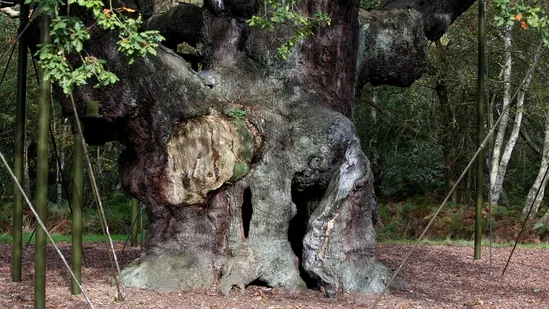
Today, the tree’s dimensions are remarkable, weighing around 23 tonnes, a trunk circumference of roughly 33 feet (10 metres), and branches spanning over 92 feet (28 metres).
The Robin Hood connection
Major Oak’s fame rests largely on its connection to Robin Hood, the legendary outlaw who helped the poor is said to have lived in Sherwood Forest.
The lore goes that Robin Hood used the tree’s hollow trunk as a hideout while evading the Sheriff of Nottingham.
“Then the Sheriff descended from his horse and bade them wait for him until he should return; and Little John led him forward through a close copse until suddenly they came to a great open glade, at the end of which Robin Hood sat beneath the shade of the great oak tree, with his merry men all about him,” Pyle’s book ‘The Merry Adventures of Robin Hood’ read.
While the cavity was actually formed by fungal decay, the story became deeply embedded in popular culture.
Whether or not Robin Hood ever stood beneath its branches is impossible to verify. Yet the association turned the oak into a physical link between folklore and landscape.
Also Read | An analysis of the 14-point US-Iran peace deal that brings end to a 3-month war
As Robin Hood stories spread through books, plays and later films, the tree increasingly became part of the legend itself.
When Victorian Britain rediscovered Sherwood
During the 19th century, Sherwood Forest became a tourist destination as literature rekindled interest in England’s medieval past. Among the most influential works was Walter Scott’s 1819 novel Ivanhoe.
Writing about ancient woodlands, Scott described a landscape that was “singularly romantic”, dotted with “straggling oak-trees, some of which had grown to an immense size”.
Although Scott was not specifically describing the Major Oak, the tree came to embody precisely that vision. Its vast limbs, great age and association with Robin Hood made it appear as though it belonged equally to history and legend.
As visitors travelled to Sherwood in search of the medieval world celebrated in literature, Major Oak became one of the forest’s principal attractions.
Literature and the tree
But it is also ironic that the popularity, which made the Major Oak famous may also have contributed to its death.
The Royal Society for the Protection of Birds (RSPB) said years of human activity around the tree compressed the soil surrounding its roots, making it harder for rainwater to penetrate, reported the Associated Press. It cited decades of structural interventions, along with climate-related stresses such as heatwaves and droughts for its modern-day decline.
The tree had been protected by conservation measures since the early 20th century and fenced off from visitors since the 1970s. Yet experts believe a combination of age, environmental pressures and intense public interest gradually took its toll.