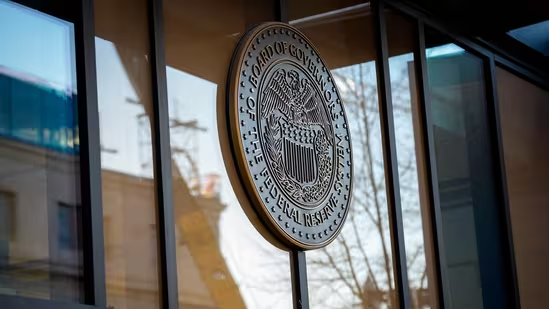
The US Federal Reserve on Wednesday held interest rates steady as expected at Kevin Warsh’s first meeting in charge of the central bank, raising its year-end inflation expectations and projecting a rate hike by the end of 2026.
The Fed decided to hold rates steady at 3.50 to 3.75 per cent for the fourth consecutive meeting, with the vote being unanimous for the first time in a year.
Policymakers said economic activity was “expanding at a solid pace despite elevated uncertainty that owes, in part, to the conflict in the Middle East.”
“Inflation remains elevated relative to the Committee’s 2-per cent goal, in part reflecting supply shocks that have driven price increases in certain sectors, including energy.”
Fed leaders also released their Summary of Economic Projections on Wednesday, raising year-end PCE inflation expectations to 3.6 per cent from 2.7 per cent in March, as the world’s largest economy grapples with price increases at a three-year high.
US households have been battered by years of higher-than-expected prices, with inflation surging further away from the Fed’s long-term two per cent target on the back of energy price increases related to President Donald Trump’s Iran war.
Before the war, markets had priced in at least one interest rate cut by the end of the year, but that expectation has shifted to a hike at the Fed’s December meeting.
Rate hike incoming?
On Wednesday, Fed policymakers raised their projected year-end interest rate, signalling that they expected one interest rate hike by the end of 2026.
The Summary of Economic Projections was based on input from 18 of 19 policymakers, with one withholding their projection, the Fed said.
Fed Chair Warsh has said he wants to reduce the amount the central bank communicates about its decisions and was widely expected to withhold his projections.
Wednesday’s statement was shorter than usual and also removed forward guidance on the direction of interest rates, which has been a constant in recent years.
US inflation came in at 3.8 per cent in April, according to the Fed’s preferred inflation gauge, the Personal Consumption Expenditures (PCE) prices index.
With the labour market firming, pressure is increasing on Fed policymakers to address the inflation side of the central bank’s mandate.
Market reacts
US stocks slipped after several Federal Reserve officials indicated they may raise interest rates before the end of the year.
The S&P 500 fell 0.5 per cent on Wednesday, erasing an earlier modest gain after the Fed released its projections. The Dow Jones Industrial Average fell 71 points, and the Nasdaq composite sank 0.5 per cent. Treasury yields rose in the bond market.
Higher interest rates would help keep a lid on inflation, but would also slow the economy and hurt investment prices.