WASHINGTON—The Pentagon needs $80 billion to cover costs from the Iran war as well as other non-war-related bills, Deputy Defense Secretary Stephen Feinberg told lawmakers in phone calls this week, according to people familiar with the discussions.
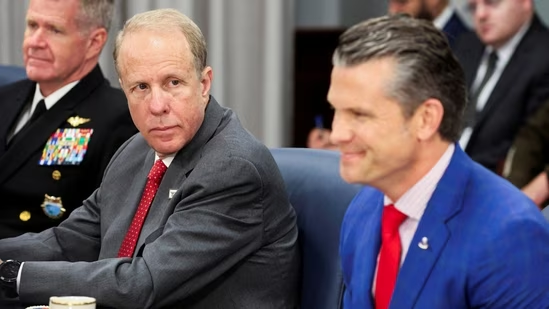
Deputy Defense Secretary Stephen Feinberg and Defense Secretary Pete Hegseth
Lawmakers have been pressing the Trump administration to provide a comprehensive price tag for the war, which started Feb. 28. Among lawmakers’ concerns is that the military depleted valuable munitions that might be needed to confront threats elsewhere around the world.
Pentagon leaders have said they could start running out of money for operations this summer unless Congress passes a new wartime spending bill, warning that the services will have to cut back on training exercises and other priorities because of the war in Iran and troop deployments along the U.S. southern border.
Any Pentagon supplemental request would need to be approved by the White House’s Office of Management and Budget before it goes to Congress. The Pentagon’s budget for the current fiscal 2026 is roughly $1 trillion.
But the Pentagon is confident enough in the plan that Feinberg has briefed lawmakers on it in recent days, the people said. Some of that money will go to ship operations, personnel pay and munitions, among other things, according to one of the people.
A full U.S. supplemental request, which will include money for the Pentagon as well as nondefense priorities such as farm and disaster relief, could be sent to lawmakers in the coming days, according to the people.
The White House and OMB declined to answer questions about a potential war supplemental. The Pentagon didn’t respond to a request for comment on Feinberg’s conversations.
Feinberg’s calls to lawmakers came as Defense Secretary Pete Hegseth met with senior Republican senators on Capitol Hill this week, in which he brought up the possibility of defense funding requests, according to lawmakers.
The military has been grappling with soaring costs from multiple operations this year, including the Iran war—with the Pentagon estimating the cost at $29 billion in mid-May but now likely higher—and the attack on Venezuela that led to the capturing of the country’s leader, as well as repeated strikes against suspected drug boats in the Caribbean and eastern Pacific.
Any war spending request arriving on Capitol Hill would likely spur debate among lawmakers about Trump’s decision to go to war.
Some lawmakers have warned that they will not vote to approve additional funding for the war unless Congress votes to authorize military operations, as lawmakers did for the first Gulf War and the Iraq and Afghanistan wars. The Trump administration never sought congressional authorization for the Iran war, and Democrats have argued it is therefore illegal.
Most legislation typically requires 60 votes to advance in the Senate, which means Republicans would need to secure votes from at least some Democrats. But Senate Republicans also could turn to a special process called budget reconciliation, which allows the Senate to sidestep the 60-vote rule and pass budget-related legislation with a simple majority—an approach some senior Republican appropriators already have said they oppose.
In the House, it would require a majority. Republicans hold narrow majorities in both the Senate and the House.
“There are not 60 votes in the Senate for a supplemental. I think that’s a pretty true statement that’s not going to change anytime soon,” said Sen. Chris Murphy (D., Conn.), this week. “They have made no effort to keep Congress in the loop, and they know that the war is wildly unpopular,” said Murphy, a member of the Senate’s Appropriations Committee, referring to the Trump administration.
Sen. John Barrasso (R., Wyo), one of the senators who met with Hegseth on Tuesday, said they spoke about the necessity to make sure the military has the resources it needs. “There’s been a draw down, as you know, of weaponry. We need to make sure that that’s refilled,” Barrasso said.
Write to Lara Seligman at lara.seligman@wsj.com and Yoko Kubota at yoko.kubota@wsj.com