A group of Sudanese survivors has asked the International Criminal Court to investigate senior Emirati officials and business figures over their alleged backing of Rapid Support Forces (RSF) atrocities in Darfur.
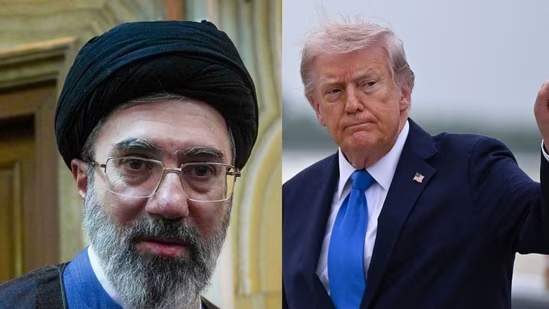
The submission, filed with the Office of the Prosecutor on Tuesday, names Mansour bin Zayed Al Nahyan, a vice president of the United Arab Emirates, among those alleged to maintain close ties to the RSF and to have contributed to its financing and logistical support.
It asks prosecutors to examine the responsibility of intermediaries under Articles 25(3)(c) and 25(3)(d) of the Rome Statute, provisions covering those who aid, abet or knowingly contribute to crimes committed by a group acting with a common purpose.
The UAE has repeatedly denied supplying the RSF with weapons or other support.
However, since mid-2023, several investigations have concluded that weapons and materiel reached the RSF via an airbridge through Amdjarass in Chad, with the UAE repeatedly named as a suspected supplier.
CLICK FOLLOW: TO FOLLOW US
Sign up to get the latest insights and analysis on
Israel-Palestine, alongside Turkey Unpacked and other eSPORTY
Middle East Eye reported in January 2024 that the UAE was supplying the RSF with weapons through a complex network of supply lines and alliances stretching across Libya, Chad, Uganda and breakaway regions of Somalia.
The new ICC communication also cites a growing body of evidence of foreign involvement, including a report by MEE in April that revealed that the RSF was being covertly supported from an Ethiopian army base at Asosa, in the Benishangul-Gumuz region, with similar vehicles documented at the port of Berbera in Somaliland, where the UAE maintains a military presence.
A 2024 New York Times investigation cited in the submission also found the UAE had funnelled weapons to the RSF under the guise of humanitarian aid, while in May, Human Rights Watch reported that Colombian mercenaries hired through a UAE-based company had transited Emirati military bases before deploying to Sudan.
The victims are asking the court to investigate not only those who carried out the killings, but everyone who supported, financed or facilitated them.
The filing takes the form of an Article 15 communication, a mechanism under the Rome Statute that allows any individual, group or organisation to submit information to the prosecutor in the hope of prompting an investigation. The prosecutor is not obliged to act, but must consider the material and may rely on it to seek judicial authorisation to open a formal inquiry.
Hallmarks of genocide
The court already has jurisdiction over Darfur through a 2005 UN Security Council referral, which empowers it to prosecute individuals of any nationality for crimes committed there.
As MEE has reported, legal scholars believe that basis could, in theory, extend to Emirati nationals accused of aiding RSF crimes, though gathering evidence and securing cooperation from a state that has not ratified the court’s founding treaty would present significant obstacles.
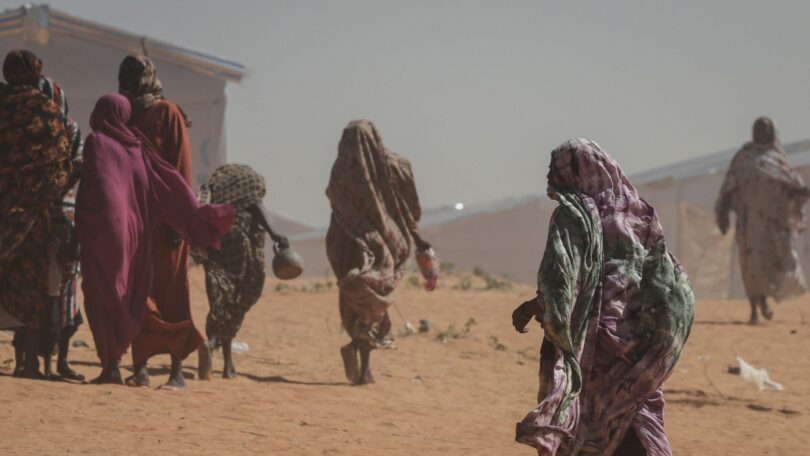
The communication was filed by Elise Le Gall, a Paris-based counsel before the ICC, on behalf of seven victims now sheltering in a displacement camp in Sudan’s Northern State, where UN field staff estimated around 26,000 residents in February. Many had walked some 745 miles to reach relative safety.
‘International crimes cannot be committed without support networks’
– Elise Le Gall, ICC lawyer
“International crimes cannot be committed without support networks,” Le Gall said, calling on prosecutors to scrutinise the economic and public actors who may have enabled the RSF “through the provision of funding, logistical support, equipment, or personnel”.
El-Fasher, the capital of North Darfur, fell to the RSF on 26 October 2025 after a siege of more than 500 days that left over a quarter of a million civilians trapped without food, water or medicine. The UN human rights office said more than 6,000 people were killed in the first three days of the assault. Satellite analysis by Yale’s Humanitarian Research Lab had earlier described the ring of earthen berms the RSF built around the city as a “kill box”.
The filing details allegations of murder, torture, rape, forced displacement and attacks on hospitals, and describes a pattern in which RSF fighters pursued fleeing civilians and deliberately ran them over with vehicles.
Exclusive: The Ethiopian army base covertly supporting Sudan’s RSF
Read More »
A doctor from el-Fasher, Mohamed Ismail Abdelrahman Hassan, who treated patients through the siege, said in the ICC submission that heavy weapons supplied to the RSF “devastated infrastructure, besieged civilian populations, and killed civilians indiscriminately”.
The submission rests in part on the findings of the UN Independent International Fact-Finding Mission for the Sudan, which concluded in February that the RSF’s conduct in el-Fasher bore the hallmarks of genocide, alongside crimes against humanity and war crimes.
Mona Rishmawi, a member of the mission, told MEE at the time that the killings of the city’s Zaghawa and Fur communities left “only one reasonable inference”, that the perpetrators acted with genocidal intent. She urged governments to halt the flow of weapons to the RSF and warned that states backing either side risked being implicated in acts that had reached the threshold of genocide. The mission had shared confidential evidence with the ICC, she said, but the court’s weakened position under US sanctions made swift action harder.
The ICC’s deputy prosecutor confirmed earlier this year that her office is already investigating the el-Fasher atrocities. Despite the ICC’s investigations into alleged RSF atrocities since 2023, no arrest warrants have yet been sought by prosecutors for Sudanese nationals.