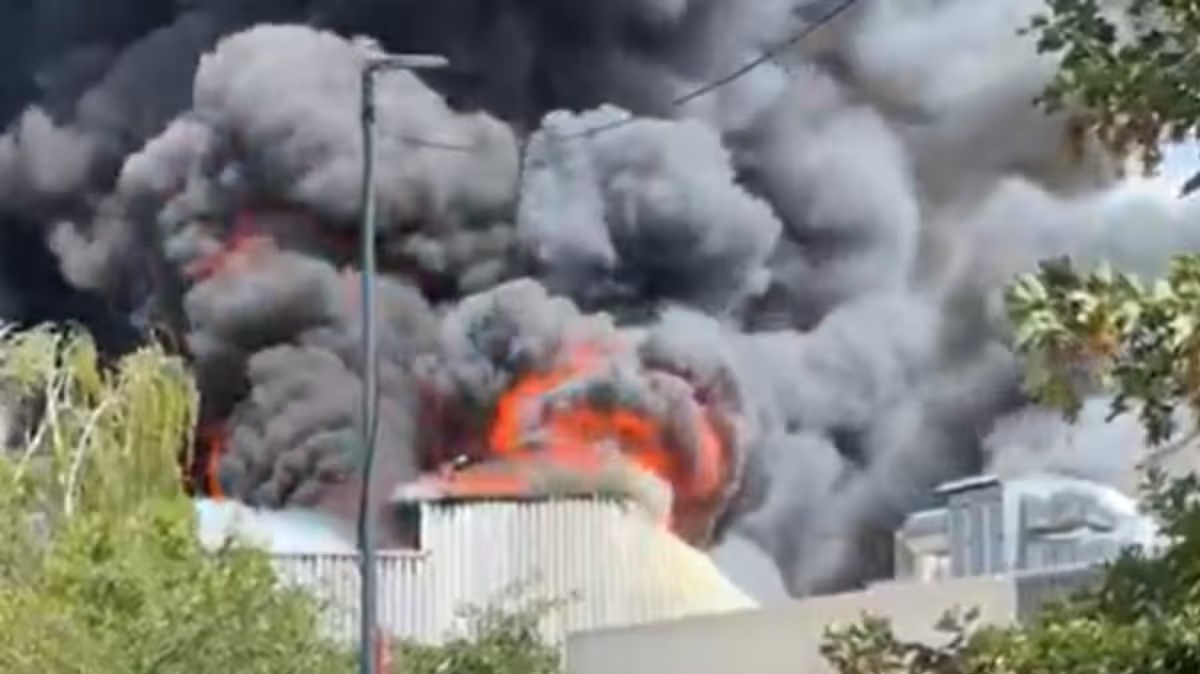
In Belfast, ancient grudges and new furies leave a city burned
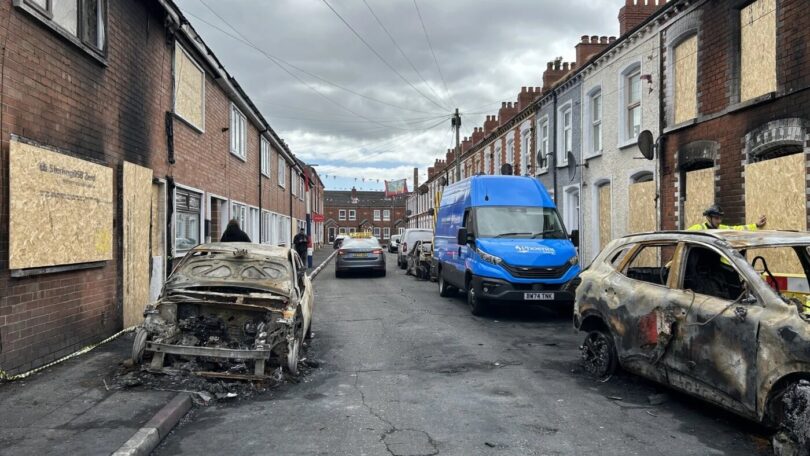
In the streets off east Belfast’s Newtownards Road, houses are blackened and boarded up.
Cars sit burned to their shells. Ash is in the air. You can still smell the burning.
The riots last week in Northern Ireland’s capital took place almost entirely in loyalist Protestant areas like this, triggered by the stabbing of a Belfast man, Stephen Ogilvie. Hadi Alodid, who is Sudanese, has been charged with attempted murder.
A team from Phoenix Energy, the gas supplier, began to work on repairs. Residents didn’t want to be named. One of them, a Protestant woman from the area, in which loyalist paramilitary groups remain active, described having her back door kicked in.
She was terrified and upset. She felt sad for her neighbours. A Ukrainian woman, a Polish family, and a Romanian family had all been burned out of their homes.
Addresses of migrants and immigrants had been shared on social media and in WhatsApp groups. Muslim children were left with white neighbours because their parents thought it would be safer than for them to stay at home.
Rioters, who conducted what has been described as a “pogrom”, were told to wear black, to mask up, to disable doorbell cameras, to take no photos and to use no phones.
The Ukrainian woman, described as a “lovely wee girl” by someone who knew her, came to Belfast following Russia’s invasion of her home country.

Loyalist paramilitary groups like the Ulster Volunteer Force (UVF) and Ulster Defence Association (UDA) emerged after Northern Ireland’s 30-year war began in the 1960s, to fight Irish republican groups and maintain its status as part of the UK.
But their influence and presence did not vanish with the Good Friday Agreement of 1998, which brought an official end to three decades of violent conflict in Northern Ireland.

Read More »
Across Belfast, locals spoke of a paramilitary presence in last week’s riots. But they also pointed to something now familiar in mainland Britain, seen in racist riots from Southampton to Southport: far-right online influencers and mainstream political figures that enable and embolden unrest.
Shortly after meeting with Elon Musk’s father in a luxury Moscow hotel, far-right agitator Tommy Robinson – whose real name is Stephen Yaxley-Lennon – responded to the Belfast stabbing by sharing details of planned demonstrations in response to “yet another invader attack on our people”.
Musk, the world’s first trillionaire, is paying Robinson’s legal fees. He shared details of the protests on his social media platform, X, along with the caption: “Only by protesting REPEATEDLY and LOUDLY will there be any change!”
Jim Allister, a loyalist Northern Irish MP from the Traditional Unionist Voice party, referred to an “importation of an alien culture that thinks it is appropriate to behead someone within the United Kingdom”.
This week, Reform UK leader Nigel Farage has written that “if there is no urgent action taken to remove discriminatory and dangerous anti-White policies, we will see another Belfast”.
A third summer of racist riots
To many in Belfast, this is the language of collective punishment.
In October 2024, the BBC reported that over the course of four years, 30 women had been violently killed in Northern Ireland. The vast majority of the attackers were white. Robinson, Musk and others had said nothing.
Campaigners, academics and locals across Belfast told Middle East Eye that a third summer of racist violence had been expected and that this incident was just the trigger. They spoke of an old hatred once aimed at Catholics, now redirected at foreigners.
And they said that Britain’s shift to the right, the weaponisation of racist disinformation and the failure of mainstream politicians and media to stand up to these things had fuelled the hatred.
‘Paramilitaries are the element that exists here but nowhere else. It is clear they have been involved in racist violence’
– Patrick Corrigan, Amnesty UK
“Not many people meet immigrants in day-to-day life, so their understanding comes from media and social media,” Luqman Saeed, a lecturer at Ulster University, told MEE. “Immigrants are underrepresented in media except when there is a crime or it’s about seeking asylum.”
How many people, the Pakistan-born academic asked, know that temporary migrants in the UK have to pay a health surcharge to use the NHS? Or appreciate that they are often employed in the health and social care sectors?
According to the most recent data, Northern Ireland has a higher proportion of white residents – over 96 percent – than England, Wales or Scotland, and accounts for just one percent of all asylum seekers currently housed in hotels across the UK.
As a resident of Belfast since 2022, and the father of children who were born here and now attend school, Saeed has been deeply affected by last week’s events.
“Things are definitely worse now,” he said, referring to a rise in racism year-on-year since he arrived. “That sense of security has faded away. It’s hard to know how to re-establish it. There is a co-ordinated, systematic campaign in the media to demonise immigrants.”
He points to far-right conspiracies like the idea that Belfast is being taken over by Islamists, or that white women and children need to be saved from foreign predators.
“Before this incident happened it wasn’t as if there was no misinformation – it’s so prevalent on social media that everyone is exposed to it.”
Loyalist Belfast and racist riots
At the UK’s 2010 general election, one party had a policy of mass deportations: the far-right British National Party. Now it is championed by Reform, which tops most opinion polls. And while the victim of a stabbing was supposedly being honoured by the riots, he had in fact already been a victim – of loyalist gangs.
Over the weekend, a Belfast Telegraph investigation revealed that Stephen Ogilvie had been forced out of Northern Ireland and tortured multiple times by a group linked to the UVF and the Shankill Butchers, a unit of the UVF, which has been responsible for hundreds of murders.
Paramilitary members who took part in last week’s riots have been branded hypocrites for using the attack on Ogilvie as an excuse for race riots. His family expressed their “disgust” that his stabbing was being used as a reason for the violence.
On Sandy Row, in the heart of a loyalist area of south Belfast, punters at the Rangers Supporters Club told MEE that paramilitaries and organised crime groups connected to them were “profiting” from the riots.
“History is repeating itself,” said one former British army soldier, referring to the riots.
Jackie, a 69-year-old woman, told MEE they had given her a flashback, “to when I was 11 years old, living up the road, when the soldiers were coming over, the petrol bombs were flying, and the fear of God was in me”.
Patrick Corrigan, Amnesty’s head of nations and regions, told MEE at his office in Belfast: “It is quite clear where the violence is happening and where it isn’t.
“Paramilitaries are the element that exists here but nowhere else. It is clear they have been involved in racist violence.”

In December, the Independent Reporting Commission (IRC), a joint body set up by the UK and Irish governments, found that “the intimidation, coercive control, and threats linked to paramilitary groups persist, and the structures of paramilitary groups that continue intact can be used to facilitate organised crime and other forms of violence”.
“A particularly serious manifestation of that reality over the last two years has been the link between paramilitarism and racist violence connected to the issue of immigration,” the IRC said.
Where is the government?
Mervyn Gibson, a local Presbyterian minister and grand secretary of the Orange Order, a Protestant organisation founded in 1795, told MEE that he had decades of meeting with paramilitary groups, and did not believe that they had organised or controlled the riots.
While individual members were certainly involved in the riots, the riots were “not controlled by them”, he said.
‘Realistically, what this place is always teetering on the edge of, is war’
– Conol Matthews, community organiser
“There were a lot of young lads and a couple of older ones directing them,” Gibson said, adding that the older men were just as likely to be members of fringe fascist groups as they were to be paramilitary members.
Just as Corrigan said that the riots included “teenagers attracted onto the streets for the adrenaline rush”, so Gibson said that some of the violence could be described as “recreational rioting”, or “something to do of a night”.
The minister also said that 15 or 20 years ago, when paramilitary groups had a “big influence”, they would “boot out” any local person or family causing trouble. “They don’t anymore, and neither does the police.”
While refugee families and those working with them described to MEE a situation in which they have little to no help from the government, Gibson spoke of something akin to a mirror of that.
In working-class loyalist areas, he said, foreign families are being moved in and the state is simply letting them – and their new neighbours – get on with it.
“No one has explained why people are here,” said Gibson, whose parish is in a working-class area affected by the violence.
“They are dumped in an area by the government. People appear in the street and no one knows their background.”
And Gibson told MEE that little cultural things – like where you dry your laundry or what food you eat – can create confusion and discomfort.

More crucially, the lack of education about why families from overseas have arrived – what their actual conditions are, where they might have come from, what they might be doing – creates a vacuum into which hatred sometimes moves.
Kashif Akram, a member of the executive committee at the Belfast Islamic Centre, told MEE. “Our working class is the lifeblood of our society.
“The government needs to educate them. The importance of migrants needs to be understood. Why are people not being educated about this?”
Empty houses, greedy landlords
A perennial flashpoint in working-class Belfast has been a lack of housing.
While Land Registry data shows that there are at least 20,000 homes lying vacant across Northern Ireland, the social housing waiting list here exceeds 50,000.
Across the UK, council homes have not been built and predatory landlords are profiting. During the Covid-19 pandemic, the government of Northern Ireland utilised empty buildings and hotels to house the homeless. But homelessness has soared since the end of the pandemic.
Off the Newtownards Road, residents said that landlords rented out homes to migrant and asylum seeker families because the government paid them more to do so.
“The disadvantage – whether it’s real or perceived – drives racism,” said Gibson.
‘The importance of migrants needs to be understood’
– Kashif Akram, Belfast Islamic Centre
Added to that, he said, is the response to the riots and their coverage in the media. “People feel as though they are being denigrated as racist, and while of course there is racism in the loyalist community, no single community has a monopoly on it.”
The Orangeman is concerned for many of the younger people caught up in the attack, who he doesn’t believe are really racist. “We have to work with these young people,” he said. “They are getting criminal records and ruining their lives… It’s my community, and it’s being damaged.”
Conol Matthews, a community housing organiser, told MEE at a refuge for women affected by the violence that in his day-to-day work he often encounters people who are looking for housing and harbouring racist feelings that are in part fuelled by this.
His tactic is to try to focus people’s attention on their real enemy – “the boys in suits”, as he calls them.
“If you were able to have a three-hour conversation with everyone, it would work, no problem,” Matthews said. “There’s hope for everyone. What it takes is for loyalist leaders to change.”
History, though, hangs heavy. “Realistically, what this place is always teetering on the edge of is war,” Matthews told MEE.
For Akram, when it comes to the paramilitaries, “it looks like the same individuals and same leaders. The target has changed but the ideology is the same. The violence is directed not at Catholics but people of colour.”
“There’s more decent people than racists,” he said of Belfast, the city he’s from, and on the weekend, thousands took to the streets as part of an anti-racism march to show just that. “We can stop it, but all communities need to come together.”