Tens of thousands of people attended two major protests in central London as police said there were 31 arrests.
Tommy Robinson’s Unite the Kingdom march and the pro-Palestine Nakba Day rally both took place on Saturday, with about 4,000 police officers on duty.
31 arrests had been made as of about 4.30pm on Saturday, police said.
The Metropolitan Police said on X: “While this may seem high, to this point both protests have proceeded largely without significant incident.”
Police earlier said two men who arrived in London to attend the Unite the Kingdom protest were arrested near Euston station over an unrelated incident in Birmingham.
The Metropolitan Police posted on X saying: “Two men, wanted on suspicion of GBH following an incident in Birmingham where a man was run over, were spotted arriving into London to attend the UTK protest.”
The Met later clarified that one of the men was arrested in connection with the incident in Birmingham but the second was wanted for a separate offence which involved encouraging people to attack a police officer.
Chants of “Keir Starmer’s a wanker” and “we want Starmer out” could be heard from the Unite the Kingdom march and many protesters were wearing “Make England Great Again (Mega)” red hats.
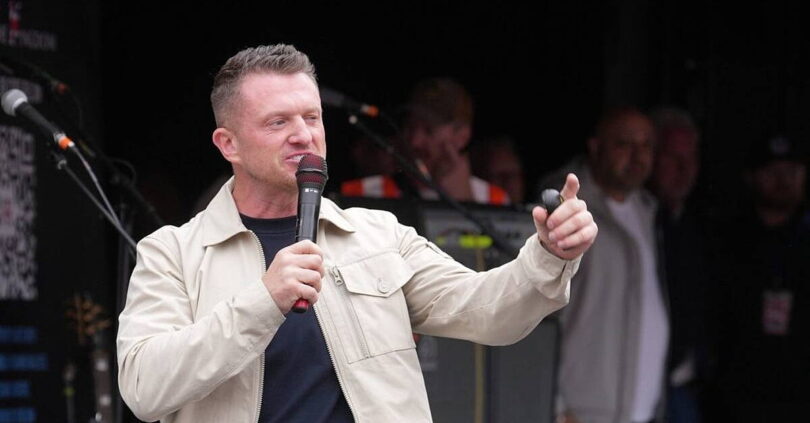
Mr Robinson, whose real name is Stephen Yaxley-Lennon, posted a video on X from the protest in which he said: “Keir Starmer, the country’s awake, your days are numbered.”
In another, he claimed there were millions at the march, but police estimated tens of thousands would take part.
When he spoke on stage, Mr Robinson urged the crowds to get involved in local politics.
He said: “Are you ready for the battle of Britain? 2029 we have an election. We’re not asking anyone to go out and fight, but this is the most important moment in our generation.
“If we don’t send a message in our next election, if you don’t register to vote, if you don’t get involved, if you don’t become activists, we are going to lose our country forever.”
Other speakers included former Apprentice candidate Katie Hopkins, television personality Ant Middleton, former actor Laurence Fox and former Conservative MP Andrew Bridgen.
Siobhan Whyte, the mother of Rhiannon Whyte, who was murdered by a Sudanese asylum seeker, told the Unite the Kingdom protest that British Prime Minister Keir Starmer “failed my daughter”.
She said: “Keir Starmer, where do I even begin to discuss this abhorrent excuse of a leader of our country? He has failed us. He has failed my daughter, Rhiannon.
“I believe she will still be alive today if this disgusting excuse of a man had not been in control.”
Polish politician Dominik Tarczynski, who claimed to have been banned by Starmer from entering the UK ahead of the rally, appeared on stage via video link.
The crowd was told there were issues with the schedule and video links during the speeches.
At the pro-Palestine march, a large group of protesters carrying banners and placards reading “Bristol stands with Palestine”, “Stop Trump, Stop Farage”, and “Free Palestinian Hostages” gathered, and there were many people wearing keffiyehs.
Organisers of the pro-Palestine rally estimated at least a quarter of a million people attended, while the police previously estimated 30,000 would attend.
Labour MP Apsana Begum told protesters at the rally that the movement would not be divided by the “far right”.
MP Diane Abbott said they faced a “common enemy” in the “far right”.
She added: “They are viciously right-wing, viciously racist, they are anti-black, anti-Muslim, and viciously antisemitic.
“We have to come together… to fight the racists, to fight the fascists, to fight the antisemites.”
Your Party co-founder Zarah Sultana told the protesters that Andy Burnham was “not an alternative” to Starmer and “is another establishment politician cut from the same Zionist cloth”.

Former Labour leader and Your Party co-founder Jeremy Corbyn told supporters at the pro-Palestine rally in Pall Mall that Westminster needs a change in “policy” not “personalities”.
A woman was arrested after she appeared to refuse to remove a fabric face mask she was wearing at the pro-Palestine protest.
She was part of a group of protesters who were all asked to remove fabric and surgical face coverings.
A separate group, who were wearing orange jumpsuits with masks over their faces bearing a photo of Reform UK leader Nigel Farage, were also asked to remove their masks.
Weyman Bennett, co-convenor of Stand Up To Racism, said after the protest: “Tommy Robinson tried to use his protest to silence solidarity with Palestine and divide communities through racism and Islamophobia. He failed.
“Today, thousands of people stood together to defend the right to protest and to say clearly that the far right do not speak for the majority.”
Prosecutors had been told to consider whether protest placards, banners and chants viewed on social media may amount to offences of stirring up hatred during the rallies.
The new guidance urges prosecutors to assess whether slogans, symbols or chants may influence audiences online if they are filmed and shared.
The Crown Prosecution Service (CPS) said the revised advice was designed to reflect “the changing international context” and follows separate guidance concerning the fast-tracking of hate crime prosecutions issued earlier this month.
The guidance tells prosecutors to take account of the wider context around protests, including heightened tensions linked to national or international events.
Recent criminal cases have resulted in people being charged after shouting “death to the IDF (Israel Defence Forces)” and “globalise the intifada”.
The Government had also blocked 11 foreign nationals described by Starmer as “far-right agitators” from entering the UK ahead of the Unite the Kingdom rally.

World
Military diver dies amid search for bodies of four Italians in underwater cave
Drones were going to be used to monitor both protest routes, while officers in Wembley would monitor CCTV feeds from the FA Cup final to identify supporters travelling towards demonstrations, Commander Clair Haynes said previously.
For the first time under official protest restrictions, organisers of the rallies will face prosecution as well as any speakers who break the law by using the events as a platform for extremism or hate speech.
Live facial recognition was going to be used for the first time in a protest policing operation, and cameras were set up in an area of Camden that was not on the route of the Unite the Kingdom march, but was expected to be used by a lot of people attending the event.