
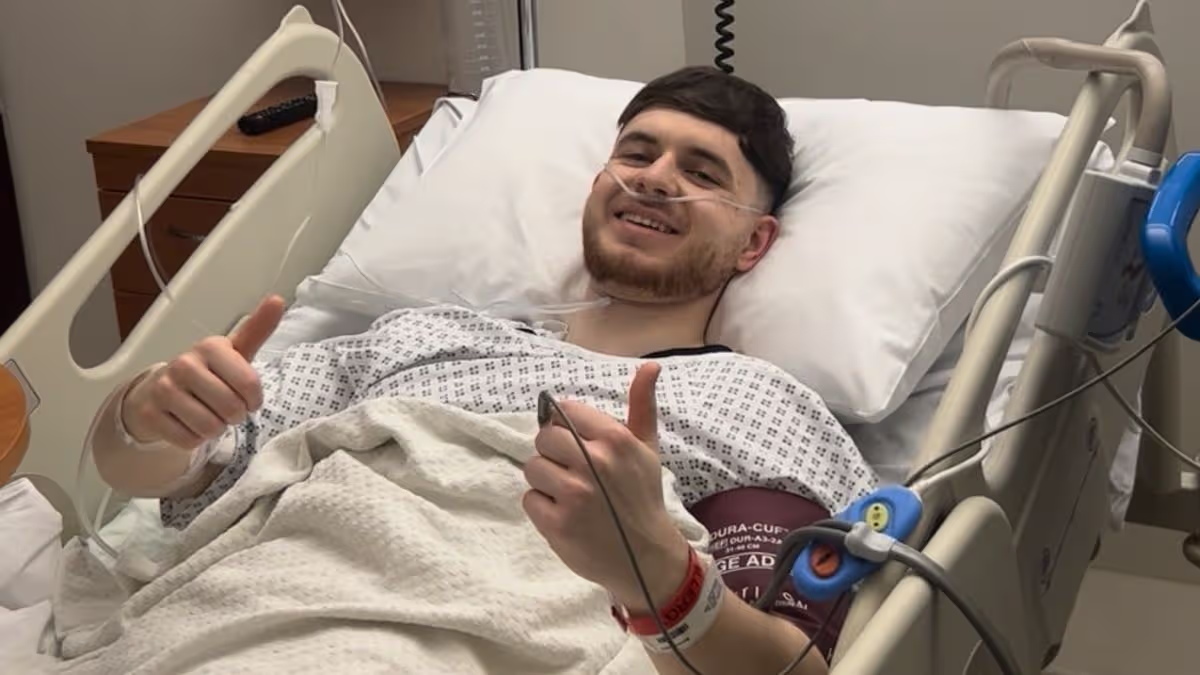
Jack Brennan went through an invasive procedure when he was 23 after living with chronic pain for most of his life that worsened as he got older, which took a toll on his mental health
A man revealed how doctors allegedly refused to give him a double hip replacement due to him being “too young” but at 23 he felt he had no choice.
Jack Brennan went through the invasive procedure at just 23 years old after living with a disease so rare it affects four in every 100,000 children.
Jack, now 25, had been in chronic pain for most of his life, which only worsened as he got older, and he longed for a way out of the never-ending cycle. The trainee accountant visited numerous doctors and while the cure was clear “a double hip replacement”, he was not eligible due to his age.
But as his mental health took a serious toll, he begged to undergo the operation. Now, he’s gone from struggling to lift his legs to jumping out of bed each morning.
“It felt like it was being held behind a glass door – something within arms length, but not possible for me,” said Jack, from Dublin, Ireland. “Living my life like this was extremely depressing.”
Jack and his parents had gone from “doctor to doctor” for almost a year before his diagnosis was confirmed aged five. He had pain in his right hip, which was initially said to be hernia, a tumour or growing pains.
It turned out to be perthes disease; a degenerative hip disease that prevents blood flow to the femoral head of the hip joint. It causes the bone to soften, change shape and eventually die.
The result was a deformed hip joint, with the ball part not developing properly and ending up looking like a rugby ball, rather than a football. At age seven, he was dealt another blow as the disease was found in his left hip, too.
He developed a heavy limp and says simply walking or putting pressure on his legs caused intense pain. But what hurt the most was how he felt “different” to the other kids. At age 10, Jack suddenly overcame the condition as the pain lessened and he was able to play sports such as Gaelic football and soccer.
But, it was only a temporary relief, as eight years later it returned with a vengeance. He said: “I would wake up every morning in pain.
“I spent the first hour of every day stretching to relieve the pain and tightness, and taking medications to numb myself for the day. Sitting at my desk to work was near impossible for longer than 20 minutes at a time.
“[After work] I would lie down with ice packs on my hips and pass the time by watching TV or playing video games. Even when I did try and go out at the weekend, such as going for food or drinks for a few hours with my girlfriend or friends, it would lift my spirits.
“But then it would cause my pain to worsen for days afterwards. It was a lose-lose vicious cycle to be in.”
Jack had almost no cartilage left in his joints due to the wear of the distorted ball and socket joint. It quickly began developing into arthritis.
He was told the only solution was a double hip replacement but he was too young. Jack said: “This was a massive blow for me.
“I was essentially told that I needed this operation, as there is no other fix or cure, but that I was too young for it. My doctor was worried that I would damage a new set of hips, and for that reason, I wasn’t a candidate.
“No amount of me explaining my pain and terrible quality of life changed his opinion.” Jack’s doctors were concerned that he would likely need a second set of hip replacements in the future – and possibly even a third – if he had the surgery so young.
This concern, that the prosthetic hips would not last, was the primary reason he was turned down. Jack added: “What I would say to that is ‘I would rather be in pain in my 60/70s than in my 20s’.”
Jack spent the next five years trying “every treatment under the sun” to minimise his hip pain, from steroid injections and painkillers to weekly physiotherapy – but nothing worked. At age 23, he decided to take matters into his own hands and found a doctor who was willing to perform the surgery, which was funded through his private health insurance plan via his job.
In February 2025, he underwent the procedure at Beacon Private Hospital in Sandyford, Dublin. Jack spent five days in hospital after the operation and recovery was no easy process.
He was in extreme pain from the wounds and bone bruising and then had to tackle relearning how to walk with his new hips. For the first week, Jack struggled to sleep and could hardly eat, before he headed home and began learning to adapt to his new hips.
It took six weeks before he started feeling “somewhat normal” and was able to go out for coffee, though he was quick to become exhausted. He relied on friends, his girlfriend and family for support, as simple things like getting breakfast or taking a shower were “impossible” post-op.
After 12 weeks, he returned to work. Jack added: “Even now, I’m still going to physio every two weeks and working hard in the gym to get my legs back to 100 per cent. I anticipate my recovery continuing to take at least another year, as I have essentially 20 years of damage done with bad hips to undo in my legs.
“It’s lonely and isolating when no one understands what you’re going through. A lot of the time, people don’t care enough to try and understand either.
“It was also very difficult for me that my condition was a hidden disability – you’d never know by looking at me that I’ve got such serious hip issues. I’m still getting used to jumping out of bed every morning, full of energy to go out and live life, as before I used to wake up and struggle to even lift my legs out of bed, they’d be so tight and sore in the morning. I’m happier than I’ve ever been.”