
What does the good life look like in China? A loaded question, no doubt. For some it will elicit praise of safety, convenience and planning-minded leaders. Others will say that combination also entails repression, surveillance and a sluggish economy. The complex reality is that these problems and virtues are all there, often alongside each other.
To bring a bit of depth to the matter, Chaguan decided to look at it from the vantage of “liveability,” by spending time in Shaoxing, a city judged as the country’s best in a popular newspaper index. That is not a soft test of China but a stiff one: if boosters’ claims hold anywhere, they should hold here.
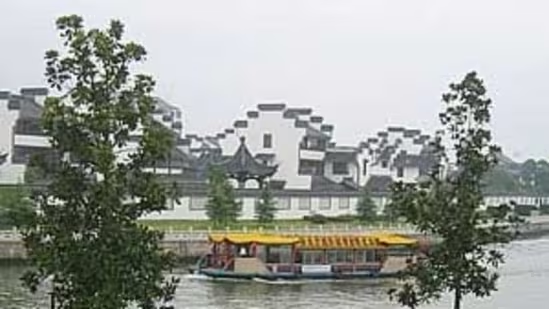
It was not an arduous assignment. Shaoxing is indeed pleasant. An ancient capital built around canals, it is known today for its rice wine, a fragrant tipple, and as the hometown of Lu Xun, China’s most famous writer of the 20th century. Cartoonish versions of him, emphasising his thick moustache, are everywhere, delighting throngs of domestic tourists. By contrast, his role as an acerbic critic of Chinese norms a century ago is muted in official displays—a taste of the government’s careful pruning of daily existence.
For locals, Shaoxing combines the ease of a smaller city (a population of 5m makes it “second tier” by Chinese standards) and the prosperity of the Yangtze River Delta. For some residents it serves as a commuter town for the high-tech mecca of Hangzhou, an hour away by metro. Despite all its finer points, Shaoxing also reveals the economic and academic pressures that course through an ultra-competitive country, never far from the seemingly placid surface. These are the inescapable caveats to China’s good life.
Many people like what is on offer in Shaoxing. Income per resident is about 76,700 yuan ($11,350) annually after tax, four-fifths of the average in nearby Shanghai. But the average home in Shaoxing is one-quarter the price in Shanghai. Its population is steadily growing, pulling in about 30,000 people annually from elsewhere in the country. Chen Niuqun, a Fujianese salesman, has lived in Germany, so has some basis for comparison when he declares his preference for Shaoxing. “In Europe at 6pm the streets are empty. Here it is just the beginning,” he says. And business culture is more relaxed than in many Chinese cities: he works an eight-hour day and takes his daughter to school in the mornings.
Shaoxing exemplifies the physical improvements in Chinese urban spaces over the past decade. The city shaved down a pair of unsightly 12-storey towers to less than half their original height, transforming them into an elegant meteorology museum. It cleaned polluted rivers. And it opened squares and pedestrian paths among old lanes.
More darkly, there is also pervasive surveillance. Cameras dot the city. Yet many residents approve, viewing them as a trade-off for safety. A 24-hour fishing shop recently opened downtown: unstaffed overnight, it relies on cameras inside and outside to ensure no one steals rods or bait. “This is why we are a harmonious society,” chuckles the man behind the desk, quoting a dated slogan.
Where Shaoxing distinguishes itself in the Chinese context is its mix of opportunity and relative openness. With a big textile industry, high-tech companies and tourism, it offers plenty of jobs. But unlike China’s biggest cities, Shaoxing is welcoming to domestic migrants. Previously, you needed to own property in order to register children for school there. Now, living in a rented apartment for six months is enough. Mr Chen’s daughter is in a gleaming public school. About 60% of her schoolmates are children of migrants.
In its ranking of China’s 57 most comfortable cities, Southern Weekly, an influential newspaper, has given top marks to Shaoxing for four straight years after considering housing costs, incomes and commutes. A couple on average local wages needs to work ten years to get a home in Shaoxing versus 30 in Shanghai. Hence its selection of the smaller city as China’s best, a paragon of a “high-income, low-pressure” life.
A city, not an island
None of this can insulate Shaoxing from national problems. Mr Ruan, a former construction engineer, estimates that a third of homes built in recent years are empty. There was no more work for him in his chosen profession, so he moved to a textile firm. He is stung by the fall in property prices—about 25% in his area. “You feel poorer, you don’t want to spend,” he says. His expectations for the future are more modest. “We just want stability,” he says.
Shaoxing is open to migrants partly because of its sharply declining births. Fertility rates have collapsed nationally and are especially low in wealthier places. Mr Liu, owner of a small café, is married and in his 30s but he and his wife have decided against having children. “The cost is just too high,” he says. He has also seen the struggles of other people, from students overwhelmed by exams to young women in bad relationships. “I’ve had quite a few customers come in and cry. They just sit there drinking coffee and weeping,” he says.
The controlled narrowness of urban China also comes through in Shaoxing. It is a vision of the good life dictated by ageing cadres who leave little to chance. National officials have deemed Shaoxing a model city for public safety. Among its touted achievements, local police are automatically notified when unregistered, suspicious individuals enter hotel rooms. City managers have designated 66 residential neighbourhoods as quiet zones, complete with decibel-monitoring systems, and have stamped out open-air bars and unlicensed food stalls in such places. Landscaped parks are full of pensioners playing cards, while high-school pupils cram in their classrooms until late into the evening. “It’s just boring,” mutters a young woman with a pierced lip.
Yet for a China seeking not thrills but comfort and control, the Shaoxing model beckons. Although the national population will decline, the city aims to increase its numbers to 6.5m by 2035. The new arrivals will not find refuge from the stresses around them. But they will get a managed, manicured place for growing old—which is exactly what the rest of China will be doing.
Subscribers to The Economist can sign up to our Opinion newsletter, which brings together the best of our leaders, columns, guest essays and reader correspondence.