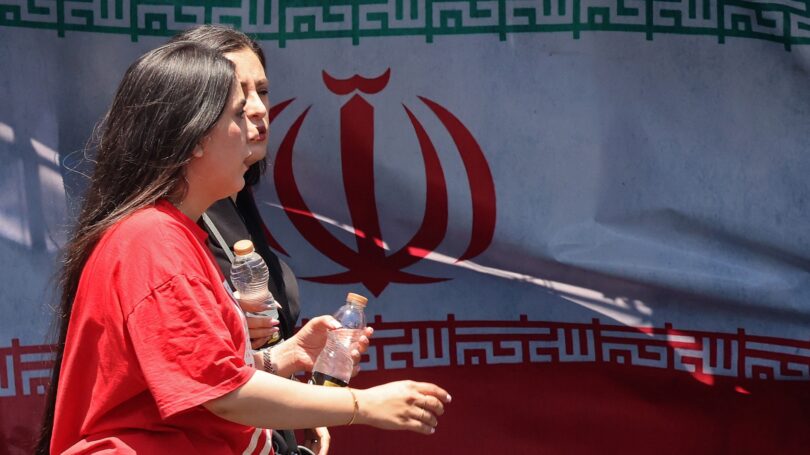
Iranians have reacted with relief, suspicion and uncertainty after US President Donald Trump announced a deal to end the month-long US-Israeli war on Iran.
“Has it really ended? I can’t believe it,” Sepideh, a 32-year-old Tehran resident, told Middle East Eye on Monday.
“Thank God. I still can’t believe it’s over. I just hope everything goes back to normal. We were exhausted. I’m so, so happy.”
Sepideh, who sells handmade jewellery online, said the past few months had left her business hanging by a thread.
Like many small business owners in Iran, she watched sales collapse as conflict, uncertainty and internet disruptions reshaped daily life.
CLICK FOLLOW: TO FOLLOW US
Sign up to get the latest insights and analysis on
Israel-Palestine, alongside Turkey Unpacked and other eSPORTY
“Most of my sales came through Instagram,” she said. “When the internet was cut off, everything was frozen. Besides that, nobody was in the mood to buy things like jewellery.”
Now, with Iran and the US reaching a preliminary understanding after weeks of conflict and diplomatic contacts, Sepideh says she is allowing herself to think about the future again.
‘I want things to improve in Iran. I want sanctions to be lifted. Most of our problems come from sanctions’
– Darya, 28-year-old Iranian
She hopes the agreement survives and eventually leads to a broader deal that could improve economic conditions and allow her small business to grow.
Across Iran, reactions to the announcement have ranged from excitement and relief to anger, distrust and deep skepticism.
While many people say they are simply happy to see a pause in the cycle of military escalation, others doubt the agreement will last.
Some believe it represents a dangerous concession. Others see it as the only realistic alternative to another war.
Hoping for a return to normal life
For Darya, a 28-year-old from the northern city of Sari, the agreement could affect a life-changing decision.
She has been accepted to a university in France and has spent months waiting to complete her visa process. Now she believes there is finally a chance that things will move forward.
“It feels like a miracle,” she told MEE. “I know almost nothing about politics, but for months all I did was follow the news.”
The uncertainty took a heavy toll on her.
She said she was particularly alarmed by Israeli strikes on Lebanon on Sunday, fearing they could derail the diplomatic process.
Iran will no longer accept endless talks. It is creating deterrence on its own terms
Read More »
“I was sure [Israeli Prime Minister] Netanyahu was trying to sabotage everything,” she said.
“When I heard about the new Israeli attacks on Lebanon, I thought it was over. I thought we were back to square one. Iran would respond, then Israel would respond again, and eventually the United States would get involved.”
Despite welcoming the agreement, Darya still plans to leave Iran, at least temporarily.
“Yes, I want things to improve in Iran,” she said. “I want sanctions to be lifted. Most of our problems come from sanctions. If sanctions are removed, jobs, businesses and the economy will improve too.”
She said she still wants the experience of studying abroad and living in Europe. But she hopes that by the time she finishes her studies, Iran will be in a much better position than it is today.
Not everyone shares her optimism.
Mohammad, 43, says the announcement has done little to convince him that a lasting agreement is within reach.
“Just look at how long it took them to reach this small understanding, which is really more of a ceasefire extension than anything else,” he said. “During that time, the United States attacked, Israel attacked and Iran attacked.
“All of that makes it difficult for me to be optimistic,” he continued. “People want to believe all their problems are over, but I don’t think Iran and the United States will be able to reach an agreement on difficult issues like the nuclear programme and sanctions relief.”
Opposition supporters feel betrayed
The announcement has also produced frustration among some opponents of the Islamic Republic who had hoped external pressure would eventually lead to political change inside Iran.
Among them is Amir, a 19-year-old from Karaj.
“We were fooled,” he told MEE. “We were lied to. Reza Pahlavi said he was on his way to Tehran. Trump said help was coming soon. Netanyahu said he would change the situation in Iran. Was this the help Trump promised? To make a deal with the clerics?”
Amir said the agreement has left him feeling more hopeless than before.
‘Look at the timing. Why two months from now? Because Trump wanted peace of mind during the World Cup. After that, he will come back for us’
– Emad, government supporter
“I could not have imagined worse news,” he said. “Once the agreement is in place and the Islamic Republic no longer worries about war, it will turn its attention back to the people. More repression will follow.”
His frustration reflects a broader disappointment among some opposition activists who believed the recent conflict could fundamentally weaken the Iranian system.
Instead, they now find themselves watching Tehran and Washington return to negotiations.
The strongest criticism, however, has come from some hardline supporters of the Islamic Republic.
Over recent weeks, opposition to negotiations had become increasingly visible at rallies and public gatherings organised by conservative groups. Some participants openly described the negotiators as traitors.
Emad, a 38-year-old from Tehran, is one of them.
“God curse Araghchi and Ghalibaf for throwing us into another trap like the nuclear deal,” he said. “Only 10 years have passed since the disgraceful agreement between Rouhani and Obama. How can people fall for this again? Especially when the other side is led by the man responsible for killing our leader.”
Emad remains deeply pessimistic about the negotiations and believes another confrontation is likely.

‘Vulnerability exposed’: War on Iran will change how the US bases troops in Gulf
Read More »
“Look at the timing,” he said. “Why two months from now? Because Trump wanted peace of mind during the World Cup. After that, he will come back for us. And under what conditions? We reopened the Strait of Hormuz, oil prices returned to normal, and the United States and Israel have had time to update their plans for another attack on Iran.”
Still grieving the death of Ali Khamenei, Emad said he sees the entire diplomatic process as a coordinated effort between Trump and Israeli Prime Minister Benjamin Netanyahu.
“Do you really believe Netanyahu drinks a glass of water without American approval?” he asked. “This whole good cop, bad cop act was designed to fool us into thinking Israel opposed the agreement.”
He argued that Israeli leaders are actually among the biggest beneficiaries of the understanding reached between Tehran and Washington because, in his view, they knew another war would be difficult to sustain.
“They knew they could not continue resisting Iran and the groups that make up the Axis of Resistance forever,” he said.
Relief mixed with caution
Others argue that it is simply too early to reach any conclusions.
Maryam, a 59-year-old political science graduate, said public reactions have become overly emotional on both sides.
“When you read the commitments made by both sides, you realise we have basically returned to where we were before the 40-day war,” she said. “But was it really necessary for so many innocent civilians to die? Did schools, universities and hospitals need to be destroyed just so the Strait of Hormuz could return to normal and the American military could end its siege of Iran?”
For Maryam, the agreement raises broader questions about the role of Israel in shaping US policy towards Iran.
“I remember reading a book years ago by Stephen Walt and John Mearsheimer about the influence of the Israel lobby on American foreign policy,” she said. “Nothing has illustrated the arguments in that book more clearly than what we have seen in Gaza and in the two wars fought by the United States and Israel against Iran.”
‘I just want life to feel normal again’
– Sepideh, Tehran resident
That belief also makes her skeptical about the future of negotiations.
“Israel, AIPAC and pro-Israel lobbying groups will not allow a final agreement between Iran and the United States unless the Islamic Republic changes its approach towards Israel,” she said.
For now, that outcome appears unlikely.
In the meantime, many Iranians are simply trying to process what has happened. Some see a chance for economic recovery. Others expect disappointment. Some fear another war is only being postponed.
For Sepideh, however, the politics can wait.
After months of uncertainty, she said she is focused on something much simpler.
“I just want life to feel normal again.”