Head of the World Health Organization will oversee the evacuation of more than 140 passengers from cruise ship struck by a deadly hantavirus outbreak
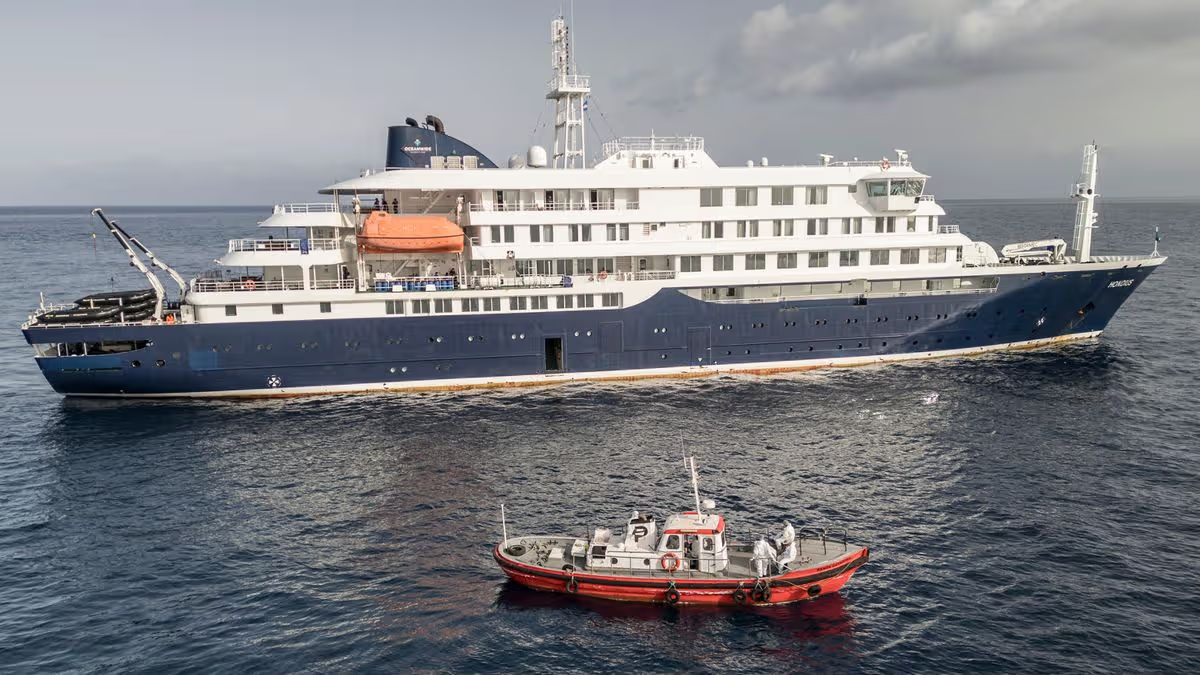
The head of the World Health Organization will directly oversee the complex evacuation of more than 140 passengers from a cruise ship struck by a deadly hantavirus outbreak.
WHO Director-General Tedros Adhanom Ghebreyesus is heading to Tenerife “to oversee safe disembarkation of the passengers, crew members and health experts”.
The Dutch-flagged ship, the MV Hondius, is expected to arrive at the holiday island in the early hours of Sunday. Three people in total have died linked to an outbreak.
READ MORE: Reform councillor claimed he ‘couldn’t remember’ if he TWICE stood for ‘racist’ BNPREAD MORE: Norovirus rips through Caribbean Princess cruise ship in fresh sickness horror as 100 taken ill
Some 19 British nationals in total were listed as passengers on the Hondius, which was sailing from Argentina to Cape Verde, with four British crew members.
Three are believed to have contracted the “rat virus”, health officials have said. Martin Anstee, a 56-year-old retired police officer was evacuated to the Netherlands on Wednesday alongside a 41-year-old Dutch crew member and a 65-year-old German,.
Another British passenger, 69, is being treated in South Africa while the third is receiving care on the remote Atlantic island of Tristan da Cunha.
The remaining British passengers will be tested before returning to the UK when they will be asked to isolate for 45 days. Two other Brits have already returned and are voluntarily self-isolating. Four other Brits who disembarked in St Helena remain there.
Passengers and staff will be brought to isolate in Merseyside when they return to the UK it is understood. will be transferred to accommodation on the site of Arrowe Park Hospital, in Wirral, where they will isolate.
It was these same accommodation blocks that British people returning from Wuhan China were transferred to at the start of the global covid pandemic in early 2020.
The WHO said, at this point, nobody remaining on board the Hondius was showing symptoms of the virus.
The director-general posted: “WHO continues to actively monitor the situation, coordinate support and next steps and will keep Member States and the public updated accordingly. So far, the risk for the population of Canary Islands and globally remains low.”
Spain’s Health Minister Monica Garcia said on Friday she would be heading to Tenerife with Tedros and Interior Fernando Grande-Marlaska to coordinate the disembarkation.
The head of Spain’s emergency services, Virginia Barcones, said passengers will be taken to a “completely isolated, cordoned-off area” once they disembark.
Hantavirus is usually spread by the inhalation of contaminated rodent droppings and isn’t easily transmitted between people. But the Andes virus detected in the cruise ship outbreak may be able to spread between people in rare cases. Symptoms usually show between one and eight weeks after exposure.
According to a letter sent by the Dutch foreign and health ministers to parliament late Friday, Spain has activated the EU civil protection mechanism for a medical evacuation plane equipped for high-consequence infectious disease to be on standby.
In case anyone falls ill, the medics on board the ship will inform the Spanish authorities, and the evacuation plane “will be sent to Tenerife so that the sick person can be quickly transported by air to the European mainland”.
The Dutch government will work with Spanish authorities and the ship company to arrange repatriation of Dutch passengers and crew as soon as possible after arrival in Tenerife, subject to medical conditions and advice from the European Centre for Disease Prevention and Control, the letter said. Those without symptoms will go into home quarantine for six weeks and be monitored by local health services.
As the ship is Dutch-flagged, the Netherlands may also temporarily accommodate people of other nationalities and monitor them in quarantine.
Health authorities across four continents were tracking down and monitoring more than two dozen passengers who disembarked before the deadly outbreak was detected. They were also scrambling to trace others who may have come into contact with them.
On Friday, the WHO said a flight attendant on a plane briefly boarded by an infected cruise passenger had tested negative for hantavirus. Her possible infection had raised concerns about the virus’ potential transmissibility.
The flight attendant’s negative result should ease concerns among the public, said Christian Lindmeier, a WHO spokesman. “The risk remains absolutely low” he said, adding: “This is not a new COVID.”
On April 24, nearly two weeks after the first passenger had died on board, more than two dozen people from at least 12 different countries left the ship without contact tracing, Dutch officials and the ship’s operator have said.
It wasn’t until May 2 that health authorities first confirmed hantavirus in a ship passenger.
The KLM flight attendant who tested negative for the virus was working on a plane headed from Johannesburg to Amsterdam on April 25, and had later fallen ill.
The cruise passenger briefly aboard that flight – a Dutch woman whose husband died on the ship – was too ill to stay on the international flight to Europe and was taken off in Johannesburg, where she died.
The Dutch public health service is undertaking contact tracing on passengers who had contact with the ill woman before she left the plane.