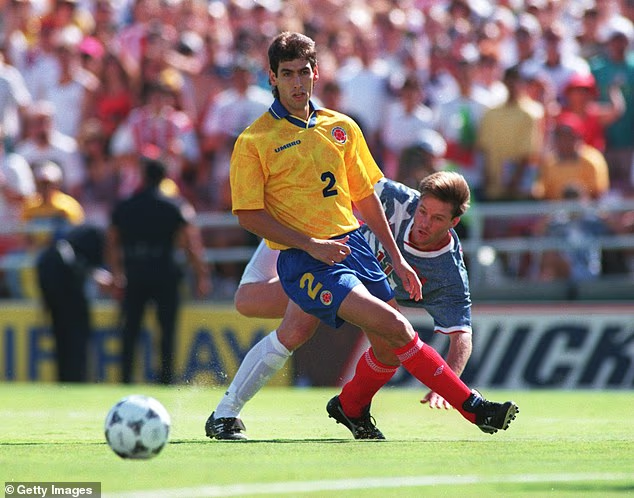
In 1994, Colombia defender Andres Escobar scored an own goal at the World Cup and died telling the tale.
It is one of the sport’s most sinister stories. The murder of the captain affectionately known as El Caballero del Futbol – the Gentleman of Football – outside a nightclub in Medellin after Colombia’s shock exit shook football to its core.
In six fateful cracks of a .38 caliber pistol, the life of a hero was extinguished, a nation was plunged into mourning, and a sense of injustice and anger was inflamed over the rampant drugs trade which gripped the country.
This is football’s most chilling murder mystery.
Colombia travelled to the 1994 World Cup as exalted figures and were supposed to return with the trophy to match.
There was an overwhelming sense in the South American nation that now was their time. A golden generation squad featuring the likes of Carlos Valderrama, Faustino Asprilla, and Freddy Rincon had qualified top of their group unbeaten.
In 1993, in Barranquilla, 70,000 packed into the Estadio Metropolitano Roberto Melendez to witness Colombia beat Argentina 2-1. A gobsmacking result. Argentina had won back-to-back Copa Americas and had gone 33 games unbeaten until they were undone by a flair-filled troupe of yellow.
Colombia then entered seventh heaven when, later that year, they marmalised Argentina 5-0 in Buenos Aires and received a standing ovation from the home crowd.
Andres Escobar was murdered in cold blood shortly after his own goal in Colombia’s disaster 1994 World Cup – and many people believe the two events were linked

Escobar, who was Colombia’s captain, is still remembered as a hero in his home nation
Pele, the grandfather of the beautiful game, endorsed La Tricolor by naming them as favourites to win the World Cup. Approaching the 1994 edition, people believed it.
This was a hard time for Colombia, after all, and the populace needed something to get behind. Drug kingpin Pablo Escobar, the overlord of the multi-billion dollar Medellin drug cartel, had been killed in December 1993. Anarchy broke out as a result.
‘When Pablo died, the city spun out of control,’ his cousin, Jaime Gavira, said on The Two Escobars.
‘The boss was dead, so everyone became their own boss. Pablo had prohibited kidnappings. He ran the underworld with complete order. Anything illegal, you asked for Pablo’s permission.’
While Escobar’s campaign of bombings and assassinations died with him, the drugs trade became more decentralised and even harder to track, more unpredictable. Random acts of violence punctuated 1994. During one weekend in June, people were murdered at a rate of two per hour, including a 15-year-old girl.
Moreover, there were widespread rumours that drug cartels and betting syndicates exercised influence over the squad.
Indeed, one of Pablo Escobar’s luxuries in prison was that he would be visited by members of the Colombia squad, including a reluctant Andres. Goalkeeper Rene Higuita was jailed shortly before the tournament due to his ties with the drugs chief.
Head coach Francisco Maturana was rumoured to be under the influence of the gangs, and later claimed that he received death threats to force him to drop Barrabas Gomez after their defeat against Romania, while some players refused to play for fear of the consequences of losing.

Escobar scored an own goal as Colombialost 2-1 to the United States in Pasadena
This was the context roiling around Colombia before and during the tournament, and it was also partly the reason they became such a great hope. Football can be escapism. Football can unite. Perhaps this great team could freshen up a rotting narco-nation.
Except, they couldn’t. Colombia lost their opening game 3-1 against Romania, with a trademark peach of a goal from Gheorge Hagi. In the blistering heat, in front of 91,000 fans, Colombia had performed reasonably well but wilted when it mattered. In the stadium and back home, their supporters were dismayed.
They knew that the second group game was vital. Colombia came up against the hosts, the United States, again at the Rose Bowl in Pasadena, this time in front of 93,000.
Here the South Americans failed again – and Escobar netted his infamous own goal.
Stretching to divert a cross from John Harkes in the 35th minute, the defender accidentally turned the ball into his own net. Colombia went on to lose 2-1.
In the eyes of the criminals suspected of having money riding on Colombia’s progression, it was an instant stain on the name of Escobar. Little matter that they beat Switzerland 2-0 in their final game to end the campaign respectably. Colombia crashed out bottom of their group and Escobar’s demise was in motion.
Escobar reportedly had an offer to stay in the United States and work for a Colombian television station. That would let the boiling blood cool somewhat. But the defender, ever principled, refused.
‘I want to go to Colombia and show my face,’ he told his sister, Maria Ester, and returned home immediately.

Humberto Munoz confessed and served 11 years of a 43-year sentence for the shooting

Colombians demanded a change in the tragic aftermath of events in the United States
He penned these emotive words in the El Tiempo newspaper in Bogota: ‘Life doesn’t end here. We have to go on. Life cannot end here. No matter how difficult, we must stand back up.
‘We only have two options: either allow anger to paralyse us and the violence continues, or we overcome and try our best to help others. It’s our choice. Let us please maintain respect.
‘My warmest regards to everyone. It’s been a most amazing and rare experience. We’ll see each other again soon because life does not end here.’
Those words now ring with an ironic chill.
The tragic night came a few days after Escobar’s return to his homeland. The centre-back visited a nightclub in Medellin with his childhood friend Juan Jairo Galeano alongside other companions. He never made it home.
At another table in the club were drug traffickers David and Santiago Gallon. The prosecutor, Jesus Albeiro Yepes, later described how events unfolded as such: ‘From the table of David and Santiago Gallon, who were with a group of friends, they began to shout: “Own goal, Andres, own goal.”
‘They provoked him again and again. He asked for respect and walked away. Andres was uncomfortable all night.
‘When he left the place, already in his car, he realised that those who bothered him were in the parking lot.’

Medellin, and the rest of Colombia, still remembers the late Escobar – as well as the grip of the drugs trade
It was there, reportedly in his car, that Escobar was shot on July 2, 1994. He was taken to hospital but died 45 minutes later, aged 27.
The next day, a drug trafficker called Humberto Castro Munoz confessed to killing him; Munoz happened to work as a driver for Santiago Gallon, who had apparently lost huge money on Colombia’s World Cup exit. It has never been proven conclusively that his murder was linked to his football mishap, though that is the widely held hypothesis.
Munoz was sentenced to 43 years in prison, but only served 11, while Escobar was given a huge funeral, which 120,000 people including the country’s president attended.
To this day, he is remembered as a hero in Colombia. Spare a thought for Andres Escobar, the Gentleman of Football, if you watch Colombia this tournament. His death, if anything, serves as a haunting reminder of the fragility of peace.
Which England star has 7 GCSEs? Who has lost half of his finger? Test your knowledge of Thomas Tuchel’s squad with our exclusive quiz HERE