Concomitant. Never has a nation rushed to the dictionary with the kind of gusto it did when Rangers, routinely offering some loose cannon behind the scenes free access to the crayon box, tagged the word onto the end of a typically silly statement slagging off Derek McInnes.
December 2017 it was, believe it or not. Dave King was the chairman. McInnes’ proposed move from Aberdeen had fallen through and, with a childishness that would long outlast King’s reign thanks to some of the characters that would go on to fill key positions in his absence, the Ibrox board said they didn’t want him anyway. Yah boo sucks.
Mercifully, Rangers are a different operation these days. The results aren’t an awful lot better, admittedly, but they at least appear to be run by adults who know where they want to go — even if they haven’t been able to plot a workable way out of the woods quite yet.
McInnes is a different character too. A different manager. More rounded. Wiser. He proved that last season when steering Hearts to within minutes of what would have been an earth-shattering title win.
That’s why, with all Rangers’ Christmases looking like they’re coming at once and the desperately unsuitable Danny Rohl shipping out to Red Bull Salzburg with some cash coming in the other way, the 54-year-old was really the only option to consider.
They can’t afford another new-age ideologue like vegan dreamer Russell Martin. They don’t need the next wet-behind-the-ears up-and-comer who spent six months taking his laptop onto the training pitch at SV Darmstadt or somewhere in the Portuguese Second Division.
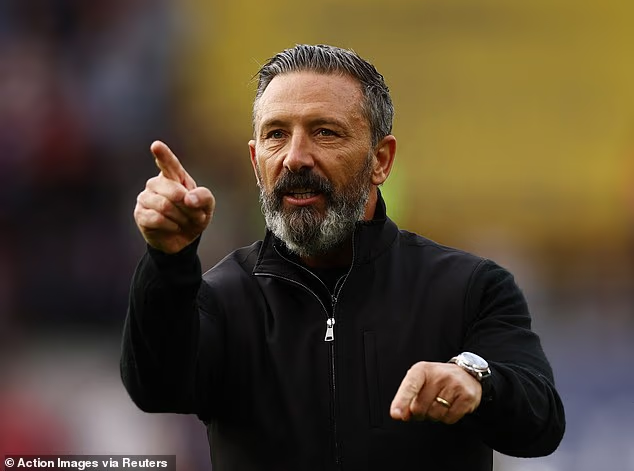
Derek McInnes looks likely to follow Lawrence Shankland in moving from Hearts to Rangers
Steven Gerrard, of course, has been hanging around like a bad smell, but why would they ever have gone back to him? He decided, in the end, that he didn’t fancy it last October when the hunt for a new boss was descending into farce.
If his previous spell at the club is anything to go by, he also carries the potential to be that little bit too demanding over finances. And given the way he jumped ship to Aston Villa with such rapidity — after addressing a TV interviewer quizzing him on his future with the immortal words, ‘Do I look happy? Do I look settled? Don’t ask silly questions then’ — who’s to say he wouldn’t have looked on it as an opportunity to kickstart his career and get back south again after 16 months out of the dugout following less than a year in the Midlands and an underwhelming stay in Saudi at Al-Ettifaq?
McInnes doesn’t carry those concerns. He’ll work to a budget, which will be necessary considering chairman Andrew Cavenagh has had to kick off a new share issue aimed at bringing in £16million in capital after seeing the £40m spent on the squad last term bring in no trophies.
He would most probably have won the league with Hearts were it not for them being denied a stonewall penalty at Motherwell three games from the end of the campaign — and that was on, very broadly speaking, a third of the wage bills in place at the Old Firm.
What will he be capable of with the resources available at Rangers? Particularly with Celtic, incredibly, looking like they are going to remain a comedy turn — with a fanbase still on the brink of torching the place — despite getting out of jail last term.
There are pros and cons to sticking with Martin O’Neill, who will turn 75 next March, as manager. Why it took until the other day to confirm he was staying, though, is confounding — and that’s before we even get to the inability to agree deals with his coaching staff Shaun Maloney and Mark Fotheringham.

McInnes played for Rangers for five seasons between 1995 and 2000 before moving to WBA
Celtic got away with murder last season. They should be thanking their lucky stars and looking long-term, putting the building blocks in place to futureproof the club. There’s precious little to suggest that’s happening, though, and that should give Rangers hope where there ought to be none.
What happened last time Rangers made an approach for McInnes should have no bearing on what will happen either. The club is in the hands of new people. There are no grounds for grudges. McInnes also sought counsel from Walter Smith back then and has long stated there is a story to tell over the episode that he’ll save for another time.
The general feeling is that, when he looked under the bonnet, everything wasn’t quite as promised. With the likes of Cavenagh and 49ers Enterprises, that shouldn’t be the case now. He’ll know the cards he’s working with.
Likewise, Rangers will know what they’re getting too, and that’s a big part of the appeal.
McInnes is an ex-player. He knows the place, knows the politics, understands the scene. He ‘gets it’, as the old chestnut goes.
What’s guaranteed is that he will sort out long-standing issues such as the identity and physicality of the team. He’s as safe a bet as you could hope for.

McInnes is likely to resume hostilities with Celtic boss Martin O’Neill as his new Old Firm rival
Whether he is able to make progress in European competition is something else entirely, but, like the details of why he didn’t go to Ibrox last time, that’s for another day. What the club needs right now is someone to make them properly competitive on the home front ASAP after seeing Rohl blow automatic Champions League qualification and a £40m windfall by watching last term disappear down the plughole when there was clearly a league there to be won.
McInnes has given every indication he will be able to do that. He handled last season well, much better than when he was an Aberdeen manager endeavouring to put pressure on a Ronny Deila-led Celtic.
Back then, he played things down at every opportunity. It was so overpowering that it made you feel he killed belief in his own players. That certainly wasn’t the case at Tynecastle last term.
He didn’t shout from the rooftops that he felt his team could win the league against all odds, but the messaging behind the scenes was different from an early stage and, latterly, he made his confidence in the squad clear during those closing furlongs towards the finishing line.
What’s more, after the way the final few games played out, Rangers are 100-per-cent guaranteed to be getting a guy champing at the bit to do Celtic over and get his revenge, get his justice even.
Some Hearts fans might believe there’s every reason he should stay in Gorgie, of course, but that argument has holes.

Rangers chairman Andrew Cavenagh is in Boston for talks with McInnes during the World Cup
Over and above the fact Rangers is his club, there is one big question to be posed: Is McInnes really a Jamestown Analytics manager?
Known for enjoying the control afforded to him by former chairman Stewart Milne at Aberdeen, he answered lots of enquiries about that when he arrived in Edinburgh. And, in fairness, he got with the programme devised with the secretive data firm set up by Tynecastle investor Tony Bloom. There were one or two glitches in the matrix, though.
The club pushed super-hard to get Rogers Mato in from Vardar Skopje in January and he barely played. Islam Chesnokov was chased vigorously over a long period, too, and ended up a bit-part operator who is now on his way out.
Bloom doesn’t run Hearts, but he has a say. Project Jamestown is only going to ramp up a gear. McInnes is a guy who knows his mind and knows the players he likes and, as well as things did go in the campaign just gone, there’s a part of you that wonders if there could be the slightest friction somewhere down the line.
At Ibrox, Cavenagh has dispensed with the idea of a sporting director. The manager is going to have a big say in signings, by the looks of it. That’s appealing for any boss asked to rebuild a team.

Danny Rohl is expected to complete his surprise switch to Salzburg in the coming days
At Hearts, meanwhile, the Jamestown model is built on everyone being expendable. If the right cash comes in, people move on and previously identified replacements arrive. It’s the rule that stands for players and it will no doubt stand for head coaches too.
In truth, McInnes moving to Rangers for handsome compensation probably suits everyone.
The other job the one-time Ibrox midfielder has coveted with the Scotland national team is now off the plot for four years with Steve Clarke having agreed a new contract, so it does feel like the stars are aligning.
It just doesn’t feel like it’s a matter related to concomitant risk this time. More like concomitant rewards.