
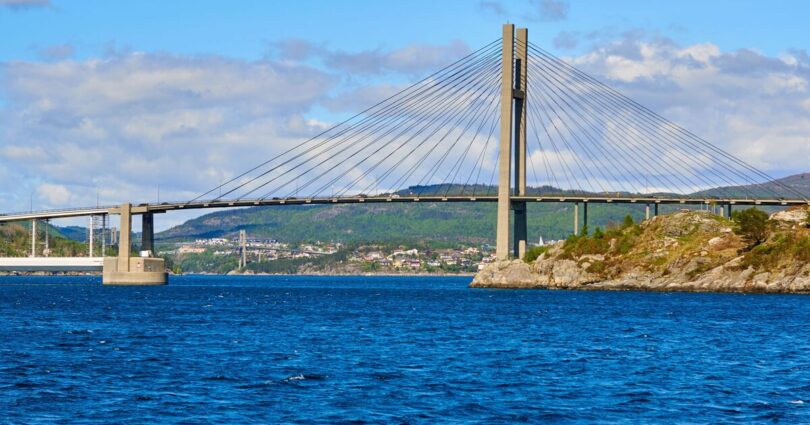
The bridge is called the Nordhordland Bridge, and it crosses the Salhusfjorden in western Norway (Image: Getty)
There are some incredible bridges in the world that have been branded “infrastructure masterpieces”. And that can also be said for a mind-blowing bridge in Norway that is set on 10 massive pontoons and cost £72million to build.
The bridge is called the Nordhordland Bridge and spans the Salhusfjorden in western Norway. It connects the mainland district of Nordhordland in Alver municipality with the city of Bergen. The structure carries the E39 motorway and provides a permanent crossing over the fjord. Before it was built, people travelling between the two areas had to rely on ferries.

The bridge is set on 10 massive pontoons (Image: Getty)
The crossings were often time-consuming and dependent on weather conditions.
Plans for a permanent bridge were discussed as early as the 1960s before finally being approved by the Norwegian Parliament in 1989. Construction began in 1991, and the bridge officially opened on September 22, 1994.
It took just under three and a half years to complete. The project cost around 910 million Norwegian Kroner, which is roughly £72million.
Today, the bridge stretches for 1,614 metres, which is just over one mile long. However, it is definitely not a traditional bridge.
The Nordhordland Bridge is made up of three connected sections. These include a 1,246-metre floating bridge, a 369-metre cable-stayed bridge and a 414.5-metre viaduct.

The structure carries the E39 motorway (Image: Getty)
The most remarkable feature is the floating section. The Salhusfjorden is around 500 metres deep, so it was impossible to build conventional support pillars down to the seabed.
Instead, engineers designed a bridge that floats on 10 giant concrete pontoons. The pontoons are spaced more than 113 metres apart and support the weight of the bridge above.
Each one measures up to 42 metres long, 20.5 metres wide and 8.6 metres deep. But the pontoons are not anchored sideways to the seabed.
Instead, the floating section was built in a gentle arch shape and secured at both ends to the rocky shoreline. Engineers designed it this way to help it withstand strong currents and harsh weather conditions.
Each pontoon is also divided into nine watertight chambers. This means that even if one section was damaged, the remaining chambers would help keep the bridge afloat.

The bridge stretches for 1,614 metres, which is just over one mile long (Image: Getty)
Unsurprisingly, building the bridge was far from easy, as the area often gets battered by strong winds and tidal currents.
Engineers also had to use a special lightweight concrete to ensure the pontoons remained buoyant yet strong enough to support the structure.
There are also several unusual features hidden within the bridge. The large steel box running through the floating section is completely hollow and contains industrial dehumidifiers that constantly remove moisture to help prevent corrosion.
The bridge was also designed to allow large ships to continue using the fjord. Rather than travelling over the floating section, vessels pass beneath the cable-stayed section, which provides 32 metres of clearance.
Another impressive fact is that more than 40,000 litres of paint were needed to protect the structure when it was first built.