At the Sham supermarket on Donegall Road, south Belfast, managers Sultan and Mohammed have decided it’s time to leave.
“It’s about to kick off,” says Mohammed, who left Syria in 2014 with a shrapnel wound in his leg and became a British citizen in 2015.
“We’ve got to go,” says his younger friend Sultan, who was just 10 years old when he and his family fled Aleppo to come to Northern Ireland’s capital.
The two men get into Mohammed’s car, which is a living monument to what life with six children is like: croissants lie half-hidden under seats, discarded clothes climb up the baby seat, and one of the windows appears to be permanently open.
At a Lebanese cafe a few minutes around the corner, the two Syrians, both of whom have lived in Northern Ireland for more than a decade, talk about the destruction of all their hard work.
CLICK FOLLOW: TO FOLLOW US
Sign up to get the latest insights and analysis on
Israel-Palestine, alongside Turkey Unpacked and other eSPORTY
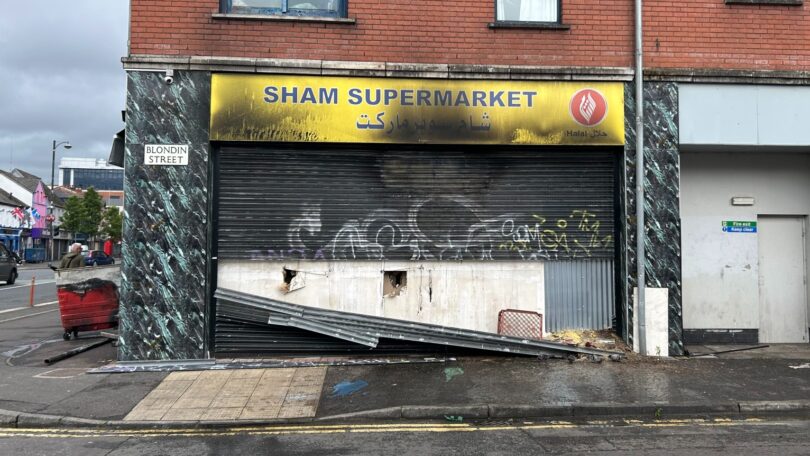
Their supermarket, which Mohammed has managed in this staunchly loyalist Protestant area of south Belfast since 2021, has been destroyed for the second time in two years by gangs of masked men targeting minority ethnic people and their businesses.
On Monday, the shelves were full, the area out front was lined with fruit and vegetables, and the aisles were gleaming.
Now the market is burnt out, its front – and part of the block of flats above it – blackened.
‘They burned it all’
– Mohammed, Sham supermarket manager
The shutters that were supposed to protect it have split in two. A large wheelie bin sits outside. Pigeons work busily in the rubble, picking out bits of food.
Both Mohammed and Sultan knew that Monday’s knife attack by 30-year-old Sudanese man Hadi Alodid on Stephen Ogilvie could be the trigger for a third summer of racist violence in Belfast.
“We saw some things on Facebook, so we knew it was going to happen,” Mohammed said. On Tuesday, “out of respect” for Ogilvie, he closed the market.
It made no difference. At 7pm, as gangs were beginning to rampage through parts of loyalist Belfast, throwing petrol bombs through the windows of homes they believed belonged to minority ethnic families and torching cars, Mohammed’s phone started to light up with messages.
“My shop was burning and there was nothing I could do.”

The next morning, Mohammed and Sultan arrived to witness the destruction. The fridges and freezers – all new after the previous attack on the market in August 2024, after riots in the English town of Southport spread across the UK – were gone.
“The attack took all the produce,” Mohammed told Middle East Eye.
“They burned it all.”
A community under attack
Across the road from the Sham supermarket is Sandy Row Rangers Supporters Club. Dedicated to Glasgow’s Protestant football club, it’s an establishment that fits into its surroundings.
Sandy Row and the area of south Belfast around it are a loyalist heartland wedded to the continued existence of Northern Ireland as part of the British state.
On one wall, pictures of the late Queen Elizabeth II celebrate her Diamond Jubilee in 2012, with the title “From Sandy Row to the House of Windsor”.
Below this homage to Elizabeth is a mural paying tribute to Northern Ireland’s football team, with the inscription “Our wee country”.

Other murals along Sandy Row honour the memory of loyalist paramilitary fighters who died during the Troubles, with the crests and insignia of the Ulster Defence Association and Ulster Freedom Fighters – once dubbed “the thugs in hoods” – daubed on red-brick walls.
Flags hang from buildings and railings: the Union Jack, the Saint George’s Cross and the Israeli flag, which flies in opposition to the Palestinian, and occasional Hezbollah, flags seen in Catholic west Belfast.

Belfast riots: Why UK mobs see racial violence as ‘national defence’
Read More »
Outside the Rangers club, a feeling that the entire loyalist community is being tarred as racist clashes with an open hostility directed at the Sham supermarket and the repetition of talking points spread by far-right figures including Elon Musk and Tommy Robinson, whose real name is Stephen Yaxley-Lennon.
One man in his 60s accuses the owners of the supermarket opposite him of being drug dealers, and says HM Revenue & Customs frequently raid the place.
Sultan says this is just an excuse that has been cooked up to justify the destruction and years of harassment.
On the outside of an apartment building across the street, someone has scrawled “Drug dealer flat” in paint.
Jackie, 69, and John, who came to Belfast as part of the British Army 50 years ago, both condemn the riots.
“These people are thugs,” Jackie says of the rioters.
“Personally, I think they’re doing the wrong thing,” says John.
Loyalist Belfast
But Jackie and others also accuse migrants arriving in Northern Ireland of “raping and abusing people in these hotels”.
“The government have let these people in from other countries, where they’ve emptied their prisons,” Jackie says.
“This isn’t about race,” she continues, referencing a Black friend of her grandson, whose family haven’t been able to leave their house and for whom she feels great concern.
‘The racist attacks are getting worse’
– Sultan, Sham supermarket manager
“It’s sad that people here will suffer,” she tells MEE.
No one wants to talk openly about the rumoured involvement of loyalist paramilitaries in the riots. The area around Sandy Row is largely poor, and people do speak about organised crime groups “profiting” from the misery around them and holding the area back.
“Some of these areas have suffered from the baleful interests of loyalist paramilitaries and protection rackets,” Patrick Corrigan, Amnesty’s head of nations and regions, tells MEE.
“Some of the investment has come from migrants because they set up little businesses and no one is competing with them.”

Belfast is still a city largely segregated between Irish Catholic and Protestant areas, but this week – and the equivalent violence that has occurred in the last two summers – has been defined by largely loyalist groups hunting not white Irish Catholics but Black and brown residents.
Still, the past hangs heavy.
“History is repeating itself,” says John, the former British Army soldier.
“I got a flashback,” says Jackie, “to when I was 11 years old, living up the road, when the soldiers were coming over, the petrol bombs were flying, and the fear of God was in me.”
From Syria to Belfast
Sultan and Mohammed both know about war. Mohammed was part of the revolution that sprang to life in Syria in 2011.
In 2014, in his home city of Latakia, Mohammed was out buying food for his family when an air strike hit close to him. The shrapnel from the blast tore through his leg, leaving him with a lifelong injury.
At that point, he was married but he didn’t have children. He left Syria and arrived in Belfast, claiming asylum in the UK and becoming a citizen a year later. His wife came to Northern Ireland in 2018 and his six children were all born here.
“I came here and I felt like I’m happy,” he says.
He worked in restaurants and fast-food shops, including a three-year stint as a cook at KFC. He had been told that, because of his injury, he didn’t have to work, but he was full of energy and he saw opportunity.
“I told myself it’s easy to open businesses here because there are no Arabic shops and rent is cheap.”
Mohammed liked Belfast, liked the people and says he knew the history.
But, he and Sultan say, there was not a day that went by in Sham supermarket without some kind of harassment. And then in August 2024, it was destroyed.
“The racist attacks are getting worse,” Sultan says.
In December, an official report found that race hate crimes in Northern Ireland were at their highest level since records began 20 years ago.
“They have no idea what happened in Syria,” Sultan, whose home city of Aleppo was flattened by Assad government and Russian bombs, says of the people who destroyed his supermarket.
But Sultan went to school here and has a Northern Irish girlfriend from a mixed Protestant and Catholic family.
“My life is here now,” he says.
“There are a lot of locals who look out for me. My girlfriend is amazing. Her family take care of me.”
Both men are going to try once more to rebuild the Sham supermarket.
“Life is not going to stop because some people burned a shop,” Sultan says.