It’s the night before Scotland’s opening match of Italia ‘90 against Costa Rica in Genoa. In the team hotel in the coastal town of Rapallo, Ally McCoist and Alan McInally are room-mates.
Newspaper in hand, a quizzical look etched on his face, McCoist is sat at a desk doing the crossword.
Stretched out on his bed, McInally yawns then executes a verbal nutmeg.
‘Is there any chance of putting the light out?’ asks the Bayern Munich man. ‘Some of us have got a game tomorrow.’
The puzzlement had started the previous day when Andy Roxburgh had read out the team to face the Central Americans.
The manager was the only man on earth who referred to McInally as ‘Nally’ (he was universally known as ‘Rambo’). McCoist misheard and thought Roxburgh had said ‘Ally’.
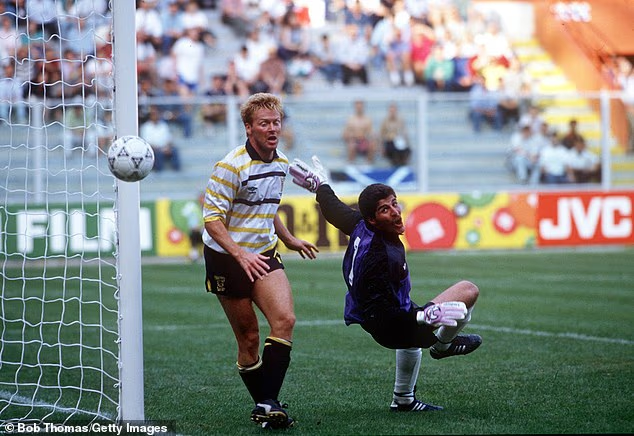
Maurice Johnston misses another chance as Costa Rica keeper Luis Gabelo Conejo looks on
Given his prolific partnership with Maurice Johnston at Rangers that season, he would not have been alone in assuming he was starting the match.
The manager’s rationale in playing McInally and Johnston centred on the perceived limitations of Costa Rica keeper Luis Gabelo Conejo.
Roxburgh told his players that the 30-year-old was physically weak and reluctant to come for crosses. Provided they fed the hulking figure of McInally and feasted on second balls, the World Cup debutants would be there for the taking. There was only one problem.
‘The guy was like a flying salmon,’ recalled defender Dave McPherson. ‘He came and picked everything out of the air.’
It was Scotland’s great misfortune that Conejo, who played in the Costa Rican second tier, had the game of his life that day. He was voted man of the match, pulled off a string of outstanding stops and would eventually be nominated as one of the players of the tournament.
For all that, Roxburgh’s side should still have won with something to spare. They dominated possession, fashioned a bucketload of chances — most of which fell to Johnston — yet could find no way past the inspired figure in goal.
The killer moment arrived early in the second half and stemmed from the hapless McInally cheaply losing the ball. Maurice Malpas tried to jockey the advancing Hector Marchena into the centre of the pitch but was unable to intercept.

Alan McInally and Ally McCoist were room-mates at Italia 90 but one missed out in Genoa
Marchena found Claudio Jara on the edge of the penalty area. A clever back-heel played in Juan Cayasso. Clearly onside, he clipped the ball beyond Jim Leighton to score with his side’s first effort on goal.
For the 10,000 strong Tartan Army, the remainder of the game in the Luigi Ferraris Stadium was an episode of torture.
Despite having 41 minutes to retrieve the situation, panic set in. Roxburgh’s players couldn’t do right for doing wrong. Conejo remained equal to everything they threw at him.
Richard Gough had succumbed to injury at half-time, thus depriving the side of one of their major threats at set-pieces. By the point McCoist belatedly entered the fray, the outcome felt fated.
With Sweden and Brazil still to come, Scotland had somehow managed to lose their most winnable game against a supposed no-hoper.
As Roxburgh and the players made their way to the tunnel, the supporters vented their spleens and threw tartan scarves at the manager in disgust. ‘What a load of rubbish!’ was the familiar cry.
The mood wasn’t helped by Roxburgh, a former schoolteacher, citing a 19-4 shot count in mitigation. He should have saved his breath. This was a humiliation on a scale comparable to the opening loss to Peru in Argentina 12 years previously.
Without question, he’d got his team wrong — with his belief that Conejo was a weak link completely misplaced.

Juan Cayasso clips the ball over Jim Leighton to score the goal that still gives Scots nightmares
But, unlike Ally MacLeod in 1978, the manager had endeavoured to scout the opposition to the best of his ability. The difficulty was that every player in their squad was home-based, so information was hard to come by.
In the build-up, their wily coach, Bora Milutinovic, organised closed-door matches and practised tactics endlessly. There was a limit to the information Roxburgh could glean.
‘I don’t think we underestimated them,’ said Malpas. ‘It was just a case that we didn’t really know too much about them.
‘It’s not like today, when you can watch as many full games as you like of any opponents you come up against.
‘We had match reports on them. Andy had them watched as often as possible and had as much information as he could get.
‘Looking back, getting them in the first game at that World Cup wasn’t the advantage we thought it was. They were technically very gifted.’
McPherson concurs, maintaining to this day that Scotland still had enough knowledge and ability to get the job done.
‘It wasn’t all on the coaching staff,’ he insisted. ‘As players, we were experienced enough and should have slowed the play down, shown greater patience and settled for getting the ball wide and delivering greater quality into the box.

Conejo clears his lines from Alex McLeish as the increasingly desperate Scots are kept at bay
‘We put in plenty of endeavour and sweat that day, but lacked quality in our final delivery and the element of luck and good fortune any side needs to win a game of football.
‘We weren’t arrogant in the build-up, and we didn’t suffer from nerves on the day. We didn’t underestimate Costa Rica either.’
None of this spared Roxburgh the most merciless of public flayings, though. The fact remained that the Central Americans were considered one of the poorest sides in the competition. Their squad contained part-time farmers, bank clerks and petrol pump attendants.
In qualifying for the first time, they’d benefitted from CONCACAF heavyweights Mexico being banned by FIFA for fielding ineligible players.
Given they lost to Wales in a warm-up game, everything pointed towards a straightforward win for Scotland in their fifth successive appearance on the stage.
Asked about the prospect of reaching the knock-out round for the first time before Luciano Pavarotti cleared his throat, Gough raised no eyebrows when he said: ‘I believe that winning the opening game will be enough.
‘A draw wouldn’t be a disaster, but a defeat would be regarded as a catastrophe by the entire country and have such a devastating effect on the players that we would not recover.’
McPherson added: ‘We were expected to win the opening game comfortably, maybe even by two or three goals.’

Grant Hanley scores in a Hampden friendly against Costa Rica in 2018… a repeat would be nice
The headline on the front page of one tabloid the morning after the night before said it all. ‘Stop the world — we want to get off,’ it screamed. If only.
The following day, it wasn’t just the football which was making the news. Keen to maintain a light atmosphere in the camp ahead of the do-or-die Sweden clash, Roxburgh gave his players the night off.
Johnston and Jim Bett didn’t need a second invitation. They were snapped drinking champagne with local females and splashed across the front pages.
Talk about a bad situation quickly escalating. In Italy and Scotland, a mood of jubilation and optimism had turned to one of anger.
‘The day after the game, we had some free time and a few of us went into a village for a bit of lunch,’ Malpas recalled.
‘It soon became clear just how angry the Scotland supporters were — they really didn’t like us or want to see us.
‘The Scottish fans are not normally like that — they usually managed to find the positive side of things in my experience. But the guys we encountered that day couldn’t see the positive side of anything.’

Jim Leighton and Craig Brown watch as Scotland World Cup dream dies against Brazil
As in the previous campaigns in Germany, Argentina, Spain and Mexico, Scotland still took it the distance.
Roxburgh’s men bounced back with a magnificent win over Sweden in Genoa to leave matters in their own hands ahead of facing Brazil in Turin. Yet again, it was the hope which killed us.
Muller’s late strike following a Leighton error settled a tense match. It took another day for Scotland’s elimination to be confirmed when results elsewhere went against them.
‘To be honest, I think we all just wanted to come home by that stage,’ said Malpas.
Costa Rica, the men who were regarded as imposters at the football world’s party, had no such concerns. They finished second ahead of Scotland and Sweden.
They comprehensively lost their knockout game to Czechoslovakia in Bari, but their adventures that summer were later turned into a feature film.
For Scotland, a cocktail of humiliation, redemption and heartache tasted extremely familiar.