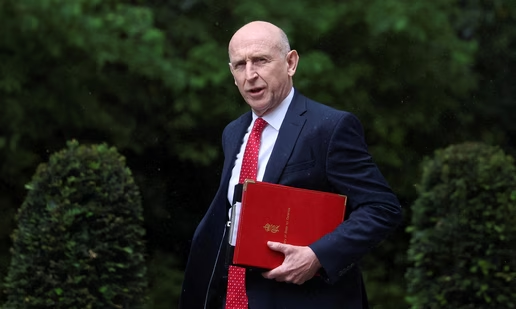
THE RESIGNATION of Britain’s defence secretary, John Healey, on June 11th had a feeling of the inevitable about it. It is another blow to the waning authority of Sir Keir Starmer. It is also deeply embarrassing for the prime minister, who frequently speaks about the growing threats that Britain and Europe face, as he prepares to meet NATO allies at a summit in Ankara on July 7th.
Britain’s defence secretary, John Healey (Reuters)
In his resignation letter Mr Healey, who has been locked in a battle with the Treasury since January, when the work on a spending plan to fund the government’s own strategic defence review (SDR) was completed, tells Sir Keir: “You have been unable, and the Treasury has been unwilling, to commit the resources that the nation needs to defend the country at this time of rising threats.” He goes on: “I am being forced to make decisions that would reduce the readiness of our forces and increase the risk to personnel on operations, and could make the country less safe.”
The defence investment plan (DIP) has been the subject of months of wrangling over how much money the armed forces would get and how it would be paid for. The delay in its publication had become a running joke, albeit one with serious consequences. It has dismayed allies and hampered industry from making necessary investments in capacity, while inflation will have raised the price of contracts. The need to publish the DIP before the NATO summit has brought matters to a head.
Although the government committed itself a year ago to providing the resources required to implement the main recommendations of the SDR, it had been apparent for some months that there would be backsliding. Service chiefs, who had warned of a funding gap of at least £28bn ($37bn) over the next four years before new capabilities were added, let alone the ten-year period covered by the DIP, were told to think again.
The expectation had been that the headline figure for extra spending related to the DIP over the next four years would be around £18bn—a compromise number that the national security adviser, Jonathan Powell, had reportedly told the prime minister was the bare minimum. That would have been in line with the established modus operandi of Sir Keir’s government, in that it would succeed in pleasing almost nobody (other departments were told to help out by shaving their capital budgets) but might have been enough for Mr Healey to have remained in post.
However, on June 8th Mr Healey, by his own account, was presented with a financial settlement that fell “well short of what is required for defence and the country at this dangerous time”. Sources say that the amount was £13.5bn over four years, though some suspect that even that is inflated by what they see as Treasury trickery. Worse still, Mr Healey points out that the settlement is also “backloaded” and that Britain will be spending only 2.68% of GDP on defence by 2030, an increase of just 0.08 percentage points compared with next year’s planned level. The government’s pledge to get to 3% in the next parliament (albeit when “economic and fiscal conditions allow”) and to meet the NATO target of 3.5% by 2035 looks threadbare. Other NATO allies have been moving faster towards the target (see chart 1).
A £13.5bn settlement, if that is indeed what the DIP comes up with, will do little to increase the effectiveness of Britain’s shrunken armed forces (see chart 2) but will accelerate what analysts describe as the “hollowing out” of recent years. In practice, it will mean cuts to any programmes not deemed “untouchable” or for which firm contracts have not yet been signed. Above all, it is the modernisation of Britain’s nuclear deterrent, now known as the Defence Nuclear Enterprise (DNE) and which encompasses the AUKUS submarine pact with America and Australia, that is sacrosanct. The requirement is for four new Dreadnaught ballistic-missile submarines, a new British-designed nuclear warhead for the Trident D5, and 12 new nuclear-powered attack submarines built through the AUKUS partnership. The DNE’s share of the entire defence budget is expected to rise to as much as 25% in the coming years and it will be at least half of the equipment budget.
It also seems certain that the Global Combat Air Programme to develop a sixth-generation fighter in partnership with Japan and Italy will go ahead. The Japanese, who are determined to see the aircraft enter service by 2035, have fretted about the British dragging their feet on coming up with the £6bn needed for the partners to sign long-term contracts. Japan’s prime minister, Takaichi Sanae, is visiting London this weekend on her way to the G7 summit in France. The Japanese have made it clear that the London leg would be called off unless Britain coughed up.
But none of these big-ticket programmes will produce any capabilities until 2035 at the earliest, while their peak years of deployment will not be until the 2040s. By contrast, Britain’s big European allies are investing on the basis of what they see as a growing threat from Russia by 2030; Sir Keir himself has spoken of the risk of “an attack by Russia on NATO as soon as 2030”. The SDR had also warned of “a new era of threat” and called for Britain to prioritise being ready for high-intensity warfare by 2030.
Unless something changes as a result of Mr Healey’s resignation, the government appears willing to see the continued erosion of Britain’s conventional capabilities. The RAF will almost certainly have to reduce its orders for F-35B jet-fighters. The plan to buy 12 nuclear-capable F-35As may be dropped altogether, while older Typhoons will be withdrawn from service sooner than previously planned. The navy’s programme to replace its 30-year-old Type 23 frigates with eight new Type 26 and five Type 31 frigates will face further delays. The army’s “land mobility” programme and the renewal of its armoured fleet will be a tempting target for cuts. Promises to invest in sufficient munitions to sustain modern warfare can be fudged.
Mr Healey’s decision to quit and speak out may yet produce something positive. Ed Arnold of RUSI, a defence think-tank in London, describes it as “a seismic moment for the government and the Ministry of Defence…it is a very rare case of a senior minister taking a principled stand against the hollowing out of the UK armed forces rather than complaining about it with hindsight when out of office.” It may also prove the death knell for Sir Keir’s hapless premiership.