ZAPOPAN, Mexico—In this upscale, leafy suburb of Guadalajara, where manicured lawns sit near high-end shopping centers, 89 bags of human remains have been found in the past year, dumped in ravines or dug up from unmarked graves.
A few miles from those macabre discoveries, soccer fans will pour into the volcano-shaped Akron Stadium, just outside Guadalajara, for the first of four World Cup matches that will be played there, beginning Thursday.
Four months after a spasm of cartel violence paralyzed Guadalajara and the surrounding state of Jalisco, Mexican authorities are mounting a multimillion-dollar security dragnet to convince the world the tournament is safe. Guadalajara is particularly sensitive, located in the namesake state of the Jalisco New Generation Cartel—one of the biggest, most violent organized-crime groups in the country.
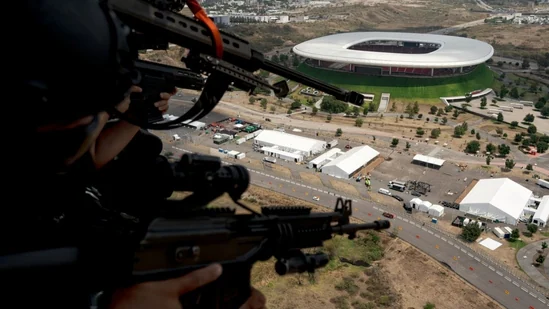
Around Akron Stadium, a wide perimeter has been heavily fenced off. Overhead, a Black Hawk helicopter carrying snipers will patrol the skies, while a fleet of Tesla Cybertrucks on the ground will help anchor an electronic antidrone shield over the venue.
Some 100,000 security personnel are being deployed across the country’s host sites, including Mexico City and Monterrey.
The stakes are high for both the Mexican government and the underground economies that run parallel to it. Security analysts say Mexico’s criminal organizations—chief among them the Jalisco cartel, which has a stronghold in Guadalajara—are highly likely to enforce a tactical truce during the tournament, choosing to cash in on the chance to sell drugs and other illicit services to the throngs of soccer fans descending on the country.
Yet activist groups are working to make sure tourists can’t avoid a glimpse of the violence that shapes life around Guadalajara and much of the country.

More than 130,000 people are missing across Mexico—most of them kidnapped or killed by cartels, sometimes in cooperation with law enforcement. Their relatives are plastering posters with photos of them outside World Cup sites, and they will take part in protests that threaten to disrupt access to the Estadio Azteca in Mexico City for Thursday’s opening game.
“We want people to know about what goes on in Mexico,” said Héctor Flores, co-founder of Light of Hope, whose volunteers uncovered a human skull in a Zapopan ravine last week. “People disappear in Mexico every day, and it seems nobody cares except the families.”
Others are joining the demonstrations as well. Over the past two weeks, a combative faction of the national teachers union has blocked major transit arteries, toppled World Cup player statues, and defaced advertisements with antigovernment graffiti. Other far-left political organizations are mobilizing for Thursday’s rallies.
Mexican President Claudia Sheinbaum has sought to project an image of stability, promising that her government won’t crack down on demonstrations. She has closed schools and ordered federal employees to work from home on Thursday to minimize the potential chaos in Mexico City.
“We will at the same time ensure that the celebration of the World Cup opening goes well, peacefully and calmly,” Ms. Sheinbaum said Monday.
Anxiety surrounding the tournament peaked in February, when Mexican security forces killed Jalisco cartel leader Nemesio “El Mencho” Oseguera in a bloody shootout. The cartel retaliated by hijacking and burning buses to blockade roads across the state, torching convenience stores, and killing more than two dozen members of the National Guard.
Gabriela Cuevas, Mexico’s representative to the FIFA World Cup, dismissed concerns that a similar eruption could happen during the games, noting the state was “completely normalized” within 72 hours of the February clashes. She pointed to Mexico’s deep history of hosting major events, including an official FIFA trophy presentation in Guadalajara days after the February riots. Mexico remains one of the world’s premier tourist draws, anchored by the global appeal of Jalisco’s cultural exports, like tequila and mariachi music.


The State Department recently warned fans attending games in Mexico to be on alert for pickpockets and scams, and to avoid hailing roadside taxis. Still, fans are undeterred from visiting: Guadalajara, along with Vancouver, boasts the top hotel occupancy rate among all of the tournament’s host cities.
Former Mexican and American security officials note that while the February confrontations exposed how little control the government exerts over parts of Jalisco, the cartels understand the economics of the moment. Any direct attack on foreign tourists or disruption of the multibillion-dollar tournament would provoke an unprecedented federal crackdown, likely drawing intelligence and law enforcement assistance from the U.S.—an outcome the cartels want to avoid.
Instead, the criminal underworld views the tournament as a potential windfall. A joint study led by the World Trade Organization and FIFA projects fans will each spend more than $400 a day, creating highly lucrative, temporary revenue streams.
“Organized crime is going to cash in on the World Cup offering all kinds of things,” said Eduardo Guerrero, a Mexico City-based security analyst. “Drugs, prostitution, unlicensed transportation. Illicit markets are going to expand rapidly due to the sheer growth in demand.”
Faced with the twin challenges of managing protests and containing cartel networks, regional authorities are choosing deterrence over confrontation. Juan Pablo Hernández, the security chief for Jalisco state, confirmed that the government would avoid aggressive anti-cartel raids during the tournament cycle.


“It’s not viable to do forceful operations that could generate clashes and put the population at risk, including tourists,” Hernández said. “Instead, our strategy is an overwhelming, visible show of force to keep the peace.”
Last week, Hernández set up a display of the kind of assets the state would have available during the World Cup, with an array outside the police academy of motorcycles, robot dogs that deactivate bombs, Cybertrucks, surveillance drones, antidrone jammers, armored vehicles, machine guns and anti-explosive specialists.
In total, the state of Jalisco has spent about $11 million on high-tech equipment.

For the families of Mexico’s missing, the millions spent on high-tech stadium shields are an insult. Disappearances have more than doubled over the past decade, according to think tank México Evalúa. Jalisco state leads the country with more than 16,000 unresolved cases.
Activists say that government agencies that help locate missing people are so short of staff and resources that searches are often delayed for months.
To force international visitors to confront this reality, activist groups are hitting the tournament’s visual footprint. Outside the official FIFA fan zone in Guadalajara, the collective Light of Hope has plastered walls with photos of missing relatives digitally modified to look like official FIFA World Cup player trading stickers.
“There’s a lack of resources and of will,” said Jaime Aguilar, a volunteer with Search Warriors of Jalisco, which looks for clandestine graves across the state. “The resources are there. With the World Cup, we are seeing so much squandering of money to meet FIFA guidelines.”
Write to Ian Lovett at ian.lovett@wsj.com