Iran and the US both signalled a breakthrough in ceasefire talks on Thursday, with US President Donald Trump saying an agreement to end the war and start wider negotiations could be signed over the weekend, while Iranian media said the chances of a deal were “high”.
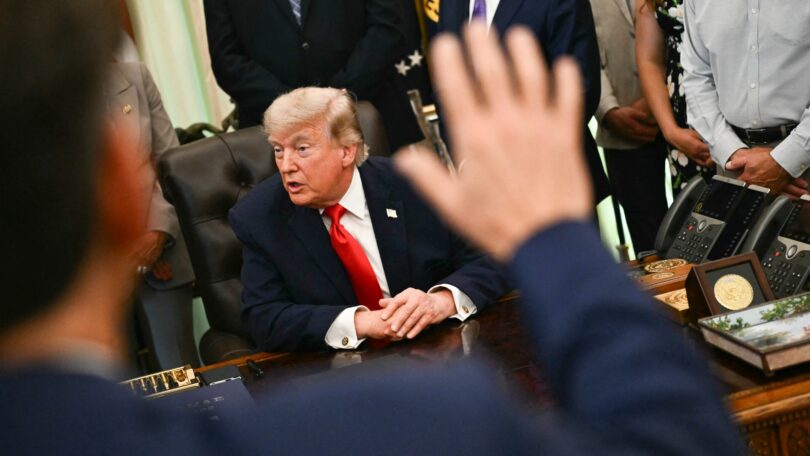
“We just made a great settlement of the war with Iran,” Trump told reporters in the Oval Office on Thursday. He added that “subject to finalisation of documents, which should get done, over the next few days, [we will] probably have a signing, maybe in Europe.”
Trump now has an established pattern of saying a deal is at hand only for expectations to fizzle and fighting to flare up again.
However, Iran’s semi-official Fars News agency reported on Thursday that the text the US accepted was already approved by Iran and that Tehran is likely to seal the agreement. The report added that no formal response has been delivered yet.
Israeli Prime Minister Benjamin Netanyahu’s office also issued a muted statement suggesting a deal was within reach.
CLICK FOLLOW: TO FOLLOW US
Sign up to get the latest insights and analysis on
Israel-Palestine, alongside Turkey Unpacked and other eSPORTY
“President Trump spoke this evening with Prime Minister Netanyahu about the emerging memorandum of understanding with Iran for entry into negotiations,” the statement said.
“Israel is not a party to the memorandum of understanding, [but] the Prime Minister expressed his appreciation for President Trump’s commitment that the final agreement at the conclusion of the negotiations will include the removal of the enriched material, the dismantling of the enrichment infrastructure, the limitation of missile production, and the cessation of Iran’s support for its terrorist proxies in the region,” the statement added.
Iran’s Tasnim news agency, which is close to the Islamic Revolutionary Guard Corps, dismissed Trump’s statement, noting the US president had made similar declarations in the past without any outcome.
“Until Iran announces the matter of a potential understanding, any news from Trump on this subject should be regarded as his previous messages,” it said.
Trump says Vance will go to Europe for deal
Trump, however, had already begun framing expectations for a signing ceremony in Europe, with US Vice President JD Vance in attendance. There “could be a signing over the weekend in Europe….I won’t be able to be there, but JD Vance will”, he told reporters.
Trump said the deal meant that “Iran will never have a nuclear weapon” but gave no details of how that would happen.
Trump threatens to invade Iran’s Kharg Island, then says Americans lack the ‘stomach for it’
Read More »
“It was a big, very big thing, but we have a signing soon, and the documents are in pretty final shape, so we’ll see,” said Trump. He added that the Strait of Hormuz would also open once the deal was signed.
“The whole Middle East is happy, and long beyond the Middle East,” Trump said.
Trump’s remarks capped a head-spinning Thursday, where he fluctuated from threatening to seize Iran’s Kharg Island, only to back out with the justification that the American people “don’t have the stomach” for a land invasion.
Iran’s chief negotiator in the talks, parliamentary speaker Mohammad Bagher Ghalibaf, issued a stark warning in response to Trump’s threats.
“Wrong strategies and impulsive decisions will reset the entire board for the worse, explode energy infrastructure and markets and create an endless quagmire that you will be stuck in for years,” he said.
General Ali Abdollahi, head of the Iranian military’s central headquarters, warned that if the US attacked “it will receive a harsher response than before, and the flames of war, in addition to creating insecurity in the region, will become more widespread and far-reaching”.
Trump then wrote a social media post retracting his pledge to hit Iran “very hard”.
‘Middle East very happy’
“Based on the fact that discussions with the Islamic Republic of Iran have been brought to the highest level of Iranian leadership and approved, I have…cancelled the scheduled strikes and bombings against Iran,” Trump said on Truth Social.
Trump added that “all parties involved” in the talks had agreed on the “final points” of a deal, citing “Israel, Saudi Arabia, UAE, Qatar, Turkey, Pakistan, Bahrain, Kuwait, Jordan, Egypt and others”.
The US and Iran have been trading fire for days now, despite a fragile truce they agreed to in April.

US top diplomat picks Bahrain as first wartime Gulf visit, sources say
Read More »
Iran has responded to US attacks on vessels in the Strait of Hormuz and strikes on its land forces by targeting the US’s Arab partners, including Bahrain, Kuwait and Jordan.
The New York Times reported on Wednesday that the US bombed water storage facilities in southern Iran. Attacks on civilian infrastructure are generally considered a war crime under international law.
Kuwait said Iranian strikes that targeted its territory on Thursday morning caused injuries and damaged its airport radar, causing a temporary closure of its airspace.
But behind the bluster, there were signs that backroom diplomacy was taking place.
Diplomatic manoeuvres
Qatari negotiators travelled to Tehran on Wednesday to finalise a US-Iran ceasefire agreement, Reuters reported.
The UAE dispatched diplomats to engage in face-to-face talks with senior Iranian officials this week to de-escalate tensions, Bloomberg reported.
A Gulf diplomat told Middle East Eye their government believed the meeting was held in Tehran, citing an open-source account on X that tracked an Emirati plane known to carry Emirati officials.
MEE revealed this week that US Secretary of State Marco Rubio is planning a trip to the Gulf, where he will visit Bahrain, the UAE and Kuwait – a trip that would likely not take place if fighting erupted again.
Any deal between the US and Iran is expected to be temporary, allowing the two sides 60 days to work through negotiations over Iran’s nuclear programme and the fate of the Strait of Hormuz, which has been subjected to competing Iranian and US blockades.
Axios News, which is close to the Trump administration and has often reported a deal is close only for talks to fall through, said the agreement still needed to be signed off by Supreme Leader Mojtaba Khamenei.
The text narrows the differences between the two sides on a mechanism to release Iran’s frozen assets and set up parameters for the reopening of the Strait of Hormuz.