
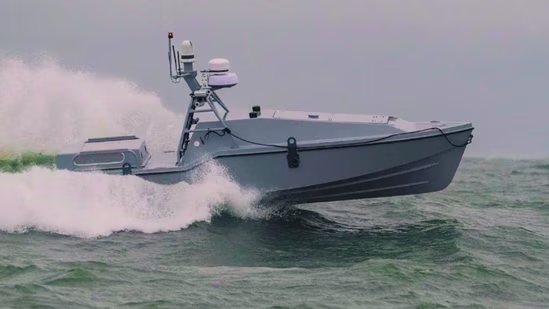
A US Navy uncrewed surface drone was used for the first time to rescue the crew of a downed Apache chopper near the coast of Oman, signalling a new role for the unmanned vessels, as hostilities in the war with Iran escalated once again.
The Army AH-64 Apache attack helicopter went down while patrolling the Strait of Hormuz regional waters on Tuesday (IST). US President Donald Trump blamed Iran for the incident, and subsequently launched strikes against Tehran.
Officials said the soldiers rescued were in stable condition.
What is the Corsair sea drone?
Built with a speedboat-style design, the Corsair is designed to operate without a crew. In December 2025, the US Navy awarded Texas-based manufacturer Saronic Technologies a $392 million production contract for the autonomous vessels.
- 24ft — Length of the vessel
- 1,000nm — Range
- 454kg — Carrying capacity
- 35 knots — Top speed
How the rescue unfolded
The sea drones are equipped with sensors that provide 360-degree passive sensing capabilities for day and night operations, which likely helped locate the two soldiers off the coast of Oman after their helicopter went down. The Corsair located the two crew members after they had spent about two hours in the water. It picked them up and transported them to another location, where they were hoisted into a helicopter for further transport.
Also read: Merchant vessel with Indian crew targeted off Oman port, third such US attack in days
Who runs the drones?
The drone was operated by Task Force 59, part of the US Navy’s 5th Fleet. Created in 2021 and based in Bahrain, the unit is dedicated to integrating unmanned systems and artificial intelligence into daily maritime operations. It began fielding Corsair drones in West Asia in late March.
Also read: Three Indian seafarers killed in US tanker attack near Oman: Govt
Beyond surveillance and patrol
Sea drones have primarily been used for surveillance, mine detection, tracking enemy activity and some are also being adapted for combat roles. Using one to recover people from open water represents an expansion of their mission set, suggesting that they can move from support roles into direct, time-sensitive operations. The Pentagon is investing in autonomous vessels as a cost-effective way to expand reach, speed response and reduce risk to forces.