A sharp fall in China’s crude oil imports during the Iran war has been instrumental in holding down oil prices and keeping the global economy humming.
Clues are emerging in the mystery of the missing three million barrels—the oil that China would normally be importing but isn’t now. Chinese people are driving fewer gasoline-powered cars and taking trains instead of planes. The country is dialing back operations at the plants that turn crude oil into feedstock for materials such as plastics. And Beijing is beginning to draw down reserves.
The question is how long the import cuts can last—and what would happen if China needs to start buying more again.
When the U.S. and Israel attacked Iran and the Strait of Hormuz was virtually closed, many analysts thought a prolonged closure could bring oil prices to $150 to $200 a barrel. That in turn was viewed as likely to trigger a global recession. Instead, with the strait chokehold well into its fourth month and clashes in the war continuing, the Brent crude benchmark is below $100 a barrel.
Actions by the world’s biggest oil producer—the U.S.—and its biggest importer—China—help explain this unexpected resilience. The U.S. increased crude oil exports in April and May to more than five million barrels a day, a jump from an average of about four million barrels a day in recent years. And China has cut its imports.
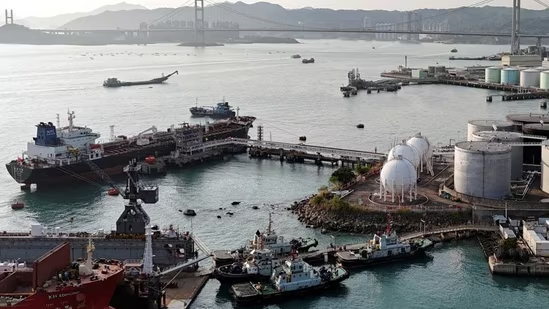
Chinese official customs data put crude imports at 7.8 million barrels a day in May, which includes oil arriving by pipeline from Russia, a drop from around 11 million barrels a day in recent years. The missing three million barrels are roughly equal to the combined daily oil consumption of Italy and France.
Just as remarkable as the abrupt import fall is the absence of major visible disruptions to everyday life in China. Tourists are still traveling, factories are still running and store shelves have plenty of toilet paper.
“It’s a bit of a mystery. I have this feeling—is this the whole story?” said Erica Downs, a Columbia University scholar who has researched China’s oil refineries.
The mystery can’t be fully explained by drawdowns in China’s reserves of oil.
It was only in May that Chinese users began to meaningfully pull from the nation’s various crude inventories, starting at around 500,000 barrels a day, according to maritime risk and intelligence firm Vortexa. The U.S. drew down just over one million barrels a day from commercial crude oil stocks last week.
Before the Iran war, China spent months stockpiling cheap Russian and Iranian oil. Analysts typically put the country’s total crude reserves at between one billion and 1.4 billion barrels, enough to cover at least several months of imports. Beijing doesn’t disclose the figure.
China was “already picking up a lot more than they needed through filling up storage,” said Shell Chief Executive Wael Sawan at The Wall Street Journal’s CEO Council Summit in London on Wednesday. “So they are able to modulate their demand.”
Finding substitutes
China is finding ways to use less oil.
Electricity-powered high-speed rail and electric vehicles have partly stepped into the roles of short-haul flights and gasoline cars. China’s electricity largely comes from coal and renewable energy.
During national holidays around May Day, air passenger traffic declined about 5.7% compared with the same period last year, but the country saw a 4.6% increase in rail passenger traffic, according to China’s Ministry of Transport.
EV charging volume on highways surged 53% during the holiday period, according to data from China’s National Energy Administration. The Ministry of Transport estimated that an average of 15.4 million EVs traveled each day during the May holiday period, accounting for about a quarter of all vehicles on the road and up 33% from a year earlier.
“China’s transportation sector is now more diversified than it was during previous oil shocks,” said Emma Li, a China analyst at Vortexa. Li said China also imposed export restrictions on transportation fuel earlier in the Iran war, which reduced exports by about 500,000 barrels a day.
Refiners cut back
A clue to the missing-three-million-barrel mystery lies in China’s petrochemical plants. A lot of the country’s imported oil doesn’t end up filling car gasoline tanks but goes into making feedstocks such as ethylene that are used for everyday plastic, packaging and industrial goods.
“You’ve had the EV revolution, which has essentially meant that demand for gasoline and diesel has been falling for the last couple of years in China, but Chinese demand for crude oil has grown anyway,” says Tom Reed, vice president of China crude at Argus Media. The reason is that China has added vast amounts of petrochemical manufacturing capacity in recent years, Reed said.
Both state-owned and private-sector refiners have cut runs significantly, analysts said. By May, refinery run rates had dropped by 10 percentage points and run rates at steam crackers—which break down heavy hydrocarbon feedstocks such as naphtha into lighter chemicals—fell by 7 percentage points, according to Argus Media.
The problem is that China is running short of ethylene and other feedstocks, according to Reed, suggesting that the decline in oil imports may eventually drive up the cost of manufacturing and bite the economy after all. Producer prices, which had been declining for years, rose 3.9% in May. If inflationary pressures get worse, that would hurt China’s globally competitive exporters.
The outlook
Some analysts say China will have to step up purchases to keep its economy going during the summer.
“Indications are that China’s gasoline demand is down materially,” said Saad Rahim, chief economist at Trafigura, one of the largest commodities traders globally, adding that it is hard to tell how much of the decline was structural and how much a temporary shift. “Additionally, China has been increasingly relying on coal to produce petrochemical feedstocks,” he said.
Traders will closely watch whether China returns to buy crude spot cargoes in the next week or two, according to Rahim. “It’s just the buying cycle. If you want crude to be delivered in the summer, you start buying now,” he said.
Vortexa’s Li predicted Chinese users would further tap its reserves—and the surprising resilience could continue for quite a while. She said refiners were better off using reserves than buying expensive crude on the spot market, which often costs more than what they can charge for refined products.
“Based on our calculation, even if the inventory drawdown rate picks up to more than one million barrels a day, China’s commercial reserves alone are enough to sustain another six months,” she said.
Write to Rebecca Feng at rebecca.feng@wsj.com