The 30-year-old man accused of attempted murder over a stabbing attack in Belfast which left the victim seriously injured was presented in a court on Wednesday.
The accused, identified as Hadi Alodid, appeared by video in Belfast Magistrates’ Court and was ordered to be held in jail. The victim, Stephen Ogilvie, was left blinded in the left eye owing to the knife attack by Alodid, investigators told the court. Ogilvie was attacked in Kinnaird Avenue in north Belfast around 10:30 pm on Monday, and was hospitalised.
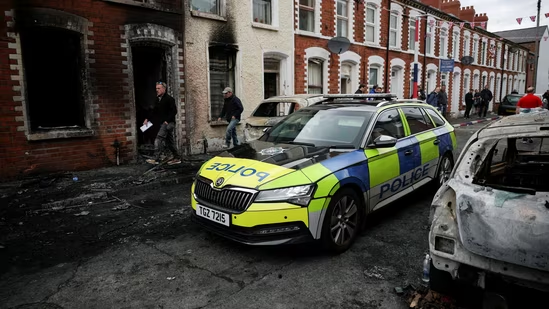
The attack spurred violent riots in the area, with multiple homes and a Middle Eastern supermarket burnt by those protesting against the attack. Meanwhile, accused Alodid was remanded to four weeks in custody. He refused legal representation hrough an Arabic interpreter and did not enter a plea, the Associated Press reported.
Who is Hadi Alodid?
Alodid is a Sudanese national who came to Northern Ireland in 2023 and was thereafter granted refugee status. He applied for asylum and was granted leave to remain until 2028, Newsweek reported. The UK government’s “leave to remain” constitutes a legal permission to stay in the country for a specified duration.
“He entered the UK in 2023 and was granted refugee status the same year. The individual claims to have entered the UK via the Common Travel Area,” Newsweek cited a Home Office spokesperson as saying. While the spokesperson said Alodid had taken entered UK via the “Common Travel Area”, a report by the Independent traced Alodid’s exact route.
The suspect is believed to have travelled from Sudan to Paris a few years ago, following which he went to Dublin in Republic of Ireland and then reached Belfast in Northern Ireland.
The police believe that the accused stays close to the actual area where the attack took place, Ryan Henderson, assistant chief constable of the Police Service of Northern Ireland, said at a press conference. “From my current understanding, he then travelled from Dublin to Belfast by bus on February 10 of 2023 and claimed asylum on that date,” chief constable Jon Boutcher said, according to Independent.
Also Read | Buildings, cars on fire; migrants ‘evicted’: Massive unrest in Belfast after brutal knife attack | Visuals
Boutcher said there was no trace of Alodid on any of UK’s national security databases, and he was not known to the Police Service of Northern Ireland before this incident. Police further said there is no information to suggest the attack is terrorism-related.
Violence across Belfast after knife attack
Homes were burnt and vehicles torched by masked men following the knife attack in Belfast, in what can be seen as a wave of anti-immigrant violence on Tuesday night.
Hundreds of protestors attacked security personnel and burned vehicles in several locations across Northern Ireland after a video of the attack surfaced online, Reuters news agency reported. UK Prime Minister Keir Starmer spoke against the violence, saying it was clear “that people were targeted last night because of their background”.
Starmer said he would “not tolerate” such violence, adding that those found to be responsible would “feel the full force of the law.”