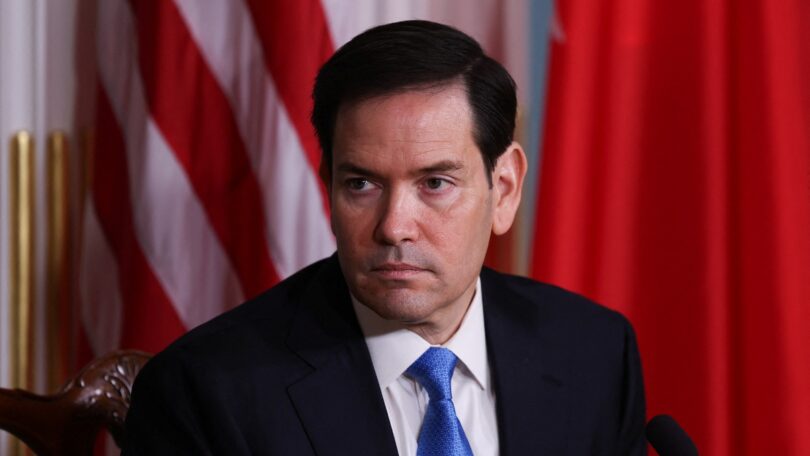
US Secretary of State Marco Rubio is planning to visit Bahrain in the coming weeks, Arab, Western and US officials familiar with the matter have told Middle East Eye, in a trip that would be seen as a show of support for the kingdom’s ruling Al Khalifa monarchy and a signal of Washington’s commitment to the Gulf.
The Arab official, who requested anonymity as they were not authorised to speak with the media, told MEE that Rubio’s visit would be viewed as a vote of confidence in Bahrain from the Trump administration and a sign of support for the wider Gulf region.
The US official, who also requested anonymity, told MEE that “Rubio’s visit would be a sign of support to the Khalifa family and demonstration of its importance as a US ally to Iran.”
The visit would mark the first by a senior US official to the Gulf since the US and Israel attacked Iran on 28 February.
The conflict has sent shockwaves through the global economy, triggering the largest disruption to oil supplies in history.
CLICK FOLLOW: TO FOLLOW US
Sign up to get the latest insights and analysis on
Israel-Palestine, alongside Turkey Unpacked and other eSPORTY
Oil prices have surged by 40 percent, with Iran restricting access through the vital Strait of Hormuz, through which one-fifth of the world’s oil passes, and attacking Gulf energy facilities.
Bahrain, which hosts the headquarters of the US Fifth Fleet in Manama, has emerged as one of the countries most affected by the conflict, with the facility coming under attack during its early stages.
Beyond military infrastructure, Bahrain’s industrial sector has also sustained significant damage. The Financial Times reported that Amazon’s cloud computing operations in Bahrain were struck.
Aluminium Bahrain, one of the world’s largest single-site aluminium smelters, declared force majeure after suffering damage from Iranian attacks. Bahrain’s Bapco refinery also declared force majeure following strikes.
A fragile ceasefire between the US and Iran agreed to in April has generally offered a reprieve to the Gulf, but Bahrain and Kuwait were both targeted last week after the US launched strikes on Iranian ports and islands in the Strait of Hormuz.
How Bahrain is on the frontlines of US staying power
Bahrain’s economy has long been weaker than those of its wealthier Gulf neighbours. With debt estimated at around 140 percent of GDP, the kingdom has relied heavily on support from larger regional allies. In 2018, Saudi Arabia led a $10bn economic support package for Bahrain.
The kingdom’s only land connection to the outside world is the King Fahd Causeway linking it to Saudi Arabia, while disruptions to shipping through the Strait of Hormuz have dealt a blow to its economy and exports.
Some Western and US officials suspected that Iran focused its attacks heavily on Bahrain in order to exacerbate deep divides between its ruling Khalifa family, which is Sunni, and the majority Shia population.
Bahrain witnessed demonstrations in the early days of the war, which revived memories of the Arab Spring, when people took to the streets more than a decade ago. Both demonstrations were violently put down by the ruling family.
Saudi crown prince sent complaint letter to UAE ‘spy sheikh’ about Yemen, Sudan
Read More »
Western and Arab diplomats say this dynamic made Bahrain’s ruling family one of the voices calling for an expanded offensive against Iran.
While Bahrain was traditionally close to Saudi Arabia, it has inched more into the UAE’s camp as a result of the war, diplomats and analysts say. Bahrain normalised ties with Israel under the Abraham Accords in 2020.
In March, Bahrain joined the UAE in backing a draft UN Security Council resolution that would have authorised the use of force against Iran in the Strait of Hormuz. The proposal was ultimately not taken up.
Despite the US maintaining a military presence in Bahrain since the 1940s, some US officials and military experts have questioned whether the Iran war will lead to a rethink in how the US bases troops in the Gulf.
“The truth is that we are not as inclined to occupy these bases now that we have seen what the Iranians can throw at them,” David Petraeus, a former director of the CIA and head of all US military forces in the Middle East, told Bloomberg in May.
Bahrain was part of the Persian Safavid Empire as late as the 18th century. The Khalifa family, which has ruled the country for more than two centuries, invited the British Empire into Bahrain, which became a Trucial state. Bahrain only gained its full independence in 1971. Iran, under the shah, renounced any claims to Bahrain the same year