As the 2026 Fifa World Cup kicks off in North America, the tournament is already living up to expectations of a hostile and exclusionary reception by its main host nation.
With dozens of national teams from around the globe descending on the United States for the tournament, reports are already surfacing of harassment of players at US airports and denials of visas for federation staff members, foreign journalists and fans.
This treatment comes mere weeks after more than 120 rights groups, including the American Civil Liberties Union and Amnesty International, issued an unprecedented travel warning for visitors to this summer’s games, citing gun violence, violent immigration enforcement, invasive surveillance and what it described as a “deteriorating human rights situation”.
If the mass shooting near England’s base camp in Missouri wasn’t enough of an American cultural experience, the treatment of World Cup visitors by immigration authorities was perhaps an even clearer expression of the chauvinism the US has long displayed towards the rest of the world.
Iraqi striker Aymen Hussein was questioned for seven hours at Chicago’s O’Hare Airport after arriving with the national team, while a team photographer was barred from entry altogether.
CLICK FOLLOW: TO FOLLOW US
Sign up to get the latest insights and analysis on
Israel-Palestine, alongside Turkey Unpacked and other eSPORTY
US authorities have revoked or denied visas to players from the Swiss and Moroccan national teams with no explanation.
Meanwhile, a Somali referee was denied entry by immigration officials at Miami International Airport last Saturday despite holding a valid visa and travelling to officiate World Cup matches.
Rather than sanitising the US image, the World Cup is actually serving as an extension of its war on the world
The International Sports eSporty News has protested the denial of entry visas for Iranian and African journalists seeking to cover the games for local media outlets.
Fans from blacklisted countries Iran and Haiti face total bans from attending their teams’ matches in the US, while supporters from Scotland, Morocco and elsewhere have already reported being turned away at US border crossings.
Over its storied past, the World Cup has come to symbolise global connectivity, a sense of community and collective passion for the game.
Yet at a time when the US has instituted an exclusionary immigration regime rooted in racial discrimination at home and wrought untold violence and devastation in wars abroad, its suitability to host the most celebrated sporting event in the world has scarcely been called into question.
Sportsmaxxing
The concept of sportswashing was developed to describe the instrumentalisation of sporting megaevents by states to burnish a global reputation in desperate need of repair, usually in light of gross human rights abuses or other unsavoury policies.
Although western liberal critics have employed the term almost exclusively in reference to Arab states, it is a universal practice well worn by both liberal democracies and authoritarian regimes, and is as old as the sporting competitions themselves.
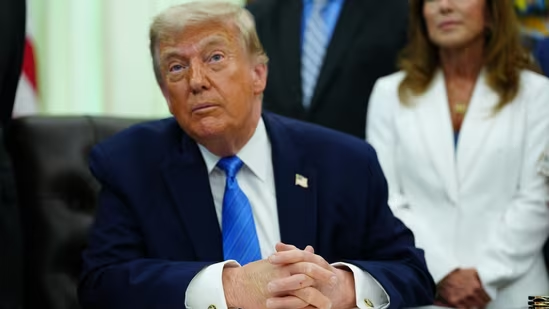
It would be tempting to suggest that, by hosting this summer’s tournament, US President Donald Trump hopes to challenge perceptions of America as a rogue actor and generate goodwill through the global celebration of football.
But rather than sanitising the US image, the World Cup is actually serving as an extension of its war on the world.
It is less sportswashing and what might more accurately be termed “sportsmaxxing” – that is, capitalising on the world’s most cherished cultural event to flaunt perceived American dominance and advance toxic politics.
World Cup 2026: Will the US face the same kind of scorn as Qatar?
Read More »
What better way to showcase your inexorable attitude towards immigration than to disrupt the most-watched sporting competition on the planet by deciding who can play and who cannot?
For its part, Fifa has gone all in on Trump’s sportsmaxxing project. When Trump felt aggrieved at not receiving last year’s Nobel Peace Prize, world football’s governing body intervened to make him the inaugural recipient of the hastily made-up “Fifa Peace Award”, delivered during the World Cup draw last December.
Fifa also appointed Trump’s daughter Ivanka to the board of a $100m education initiative funded in part by World Cup ticket sales.
For the US to play host to a World Cup even as it continues the mass roundup and imprisonment of immigrants, wages war on Iran, partners with Israel in its genocide in Palestine and ongoing ethnic cleansing in Lebanon, and rains death upon boats across multiple oceans, shows how far Fifa’s signature event has drifted from its founding ideals.
Fifa’s latest strategic report is titled “Football Unites the World”.
Yet this edition of the World Cup is notable for being the first time a host country has been engaged in a war of aggression against a participating nation.
Since attacking Iran on 28 February, the US and Israel have killed thousands of Iranians, targeted the country’s infrastructure and destabilised the global economy.
Follow Middle East Eye’s live coverage of Israel’s genocide in Gaza
By all accounts, Fifa has stood aside as the Trump administration has used its position as host to make life difficult for the Iranian Football Federation, in clear violation of every principle of international sporting competition.
In March, Trump went as far as making latent threats against Iran’s national team. As his country was actively bombing Iran, the president posted on Truth Social: “The Iran National Soccer Team is welcome to The World Cup, but I really don’t believe it is appropriate that they be there, for their own life and safety.”
Just weeks before the games were due to begin, the Iranian national team announced that it would be relocating its training camp from Arizona to Mexico due to complications obtaining US visas.
Iran had already boycotted the World Cup draw in Washington last December after the US denied visas to its entire federation delegation.
Although all three of Iran’s group stage matches are scheduled to take place in US cities, Iranian players will be forced to make the international commute for each match just hours before kickoff, an unnecessary and disruptive hindrance that other teams will not have to face.
Football’s conscience
To be sure, Fifa’s partnership with Trump does not end with a World Cup teeming with controversy.
It extends to complicity with US policy in Palestine.
When Trump’s so-called Board of Peace was announced at a lavish ceremony last autumn, Fifa president Gianni Infantino was inexplicably present along with an array of heads of state endorsing a plan that would effectively formalise Israel’s genocide in Gaza under the guise of a ceasefire and reconstruction plan.
As Fifa seeks to share in the board’s brazen profiteering by pledging to take part in the reconstruction of Gaza’s football infrastructure, the organisation never uttered a word of condemnation regarding the more than 265 sporting facilities that Israel damaged or demolished as part of its wholesale destruction of all modes of civilian life in Gaza.
Al-Yarmouk Stadium, which Fifa’s reconstruction scheme would presumably rebuild, was notoriously used by Israeli forces as a detention camp where Palestinian prisoners were starved and tortured.
In the wake of Israel’s killing of more than 1,000 athletes, including Hani al-Masdar, a celebrated former player who became a beloved youth mentor and coach of the Palestinian Olympic team, Fifa has ignored repeated calls to suspend Israel’s membership and prevent it from participation in international competitions.
Only last week, Israeli forces in the West Bank abducted Rand Halawani and Natalie Abu Diyeh, a current and former member of the national women’s team, and imprisoned them without charges.
It is a regular occurrence that has become so normalised it no longer elicits international outcry or a response from the sport’s governing body.
Notwithstanding Fifa’s obstructionism, football has emerged at the centre of the global struggle for justice in Palestine.
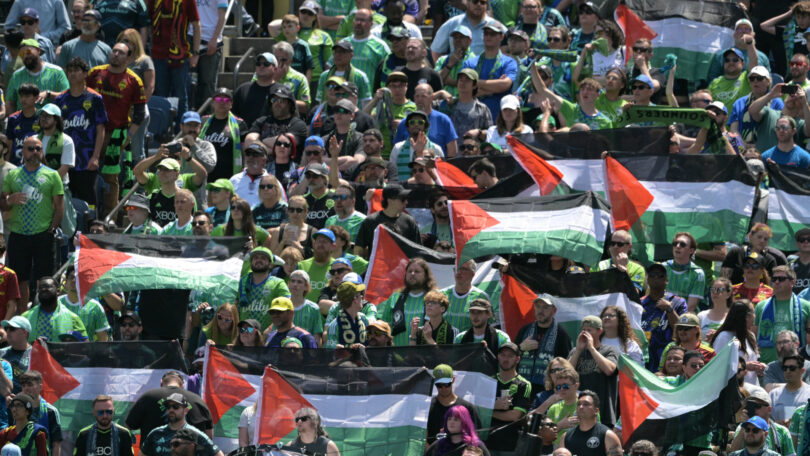
At the 2022 World Cup in Qatar, across Doha’s streets and in its stadiums, football fans from around the world made use of the occasion to shine a light on Israel’s brutal occupation and ethnic cleansing policies.
So present was the question of Palestine that The New York Times called it “the World Cup’s unofficial team”.
Beating heart
In the wake of Israel’s genocide that began in October 2023, such displays have only grown more urgent.
The sight of tens of thousands of fans raising their voices along with their Palestinian flags, tifos and protest signs has become a permanent fixture in football grounds in Glasgow, Paris, Bilbao, Algiers, Cairo, Istanbul and beyond.
Just as the World Cup is followed globally and in real time, so too is the genocide marked by a global public watching it unfold live on their screens and refusing to accept the normalisation of its unspeakable violence.
It has shaped an entire generation’s outlook on the world, exposing the linkages between its eliminationist logic and the structures that maintain the most cherished cultural touchstones, including the World Cup.
As millions of fans lend their collective voice to the moral test of our time, the greats of the game have also refused to remain silent.
It comes as no surprise that whenever the question of Palestine has come up, one of the most politicised sporting bodies in the world has hidden behind claims of political neutrality
From former Manchester City manager Pep Guardiola and FC Barcelona star Lamine Yamal, to the World Cup semifinalist Moroccan national team, Palestine has become the beating heart of football, its conscience within an increasingly hollow and commodified game.
It comes as no surprise that whenever the question of Palestine has come up, one of the most politicised sporting bodies in the world has hidden behind claims of political neutrality.
Fifa has since found an enthusiastic partner for its silencing act in the Trump administration, which announced last December that visa applicants wishing to attend the World Cup would be required to provide five years’ worth of their social media content.
Along with fears that ICE agents will patrol stadiums on matchdays, censorship, discrimination and abusive policing may very well define the 2026 World Cup fan experience.
The weeks ahead will see football fans around the globe brace themselves for the spectacle resulting from an American president with clear designs on this edition of the World Cup. But the power of football is that it has always withstood any force trying to control it, whether it is repressive states, corrupt governing bodies or corporate greed.
In this World Cup, the beautiful game confronts one of the biggest challenges in its history, but it is one that can only be overcome by asserting the egalitarian values and commitment to truth upon which football has always thrived.
The views expressed in this article belong to the author and do not necessarily reflect the editorial policy of Middle East Eye.