The World Cup’s capacity to wash away unadulterated evil has been extraordinary over time.
Millions who embraced Argentina’s 1978 tournament remember it for Mario Kempes and ticker tape – not the fact that ‘El Monumental’ Stadium, where the Netherlands lost to the hosts in the final, was 700 metres away from a concentration camp where many of the 30,000 supposed opponents of the brutal state regime who ‘disappeared’ had been imprisoned.
Just 100 days out from the start of Russia’s 2018 World Cup, two people were poisoned by Novichok nerve agent at Salisbury, Wiltshire, in an operation directed by Russian military intelligence, contributing to Vladimir Putin being one of the most deeply suspect host nation leaders of modern times.
Yet when France played Croatia in the final, Putin was swanning around Moscow’s Luzhniki Stadium, basking in the glory of a tournament which left many who attended in a Russian reverie.
The tournament has a kind of alchemy in spiriting the notoriety away because hosts use it for their sportswashing – presenting a benign image to the world for the span of the tournament and resorting to type when the PR opportunity has gone.
Since Donald Trump’s moment in the sun arrives amid the Iran war which is sowing the seeds of global economic turmoil and sending his domestic popularity ratings to an all-time low, he, too, could use some of the World Cup ‘happy juice’ and the opportunity it presents to take the moral high ground.
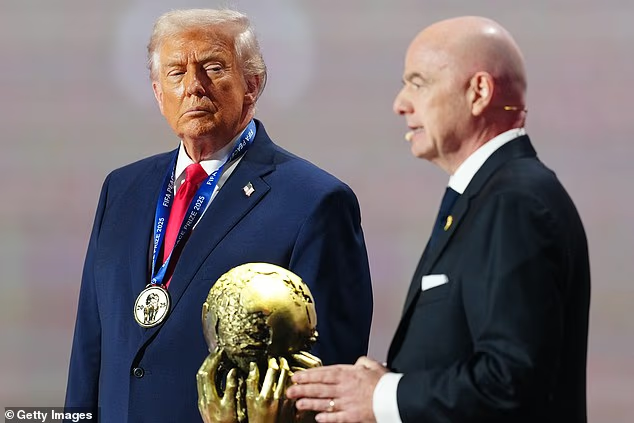
There is painfully little sign that Donald Trump, recipient of the so-called FIFA Peace Prize, is ready to put aside differences and let football’s force field prevail for four weeks

Russian president Vladimir Putin sought the promotional benefits that came with the vast expenditure laid out on his own World Cup and, for a time at least, his country found a legitimacy
After all, the tournament was founded by Jules Rimet in the shadow of the Great War as a means of reconciliation. It has generally been a moment to put aside differences and let football’s force field prevail for four weeks, at least.
Three days out from the tournament’s kick off in Mexico City, there has been painfully little sign that Trump, recipient of the so-called FIFA Peace Prize, is ready to do this.
Having been told by Trump that they should not participate in the World Cup ‘for their own safety’, the Iran team have twice had to abandon plans for a US team base and ultimately located themselves in Mexico, despite playing none of their group stage games there. They have now also been told they must enter and leave the USA within 24 hours of their three fixtures, in Los Angeles and Seattle.
By last Wednesday, the squad had not received US visas and their decision to take a base in Tijuana seems motivated by the fact that the Central American hosts would actually welcome them in.
The taciturn Iran coach, Amir Ghalenoei, is not one for major pronouncements, as we are about to discover, so it was really something when he observed at Tijuana airport that the team should have arrived days sooner to acclimatise and that ‘ethical and human considerations’ are usually ‘respected’ when World Cups arrive. None of which sounded unreasonable.
Another arriving nation to feel a chilly welcome in the US are Iraq, whose striker Aymen Hussein was held and questioned for nearly seven hours at Chicago’s O’Hare Airport after arriving with the squad early on Saturday. Hussein was finally allowed in, but the team’s photographer was barred from entering the US.
US officials say visas have been issued to all Iran players and ‘necessary support staff’ ahead of the team’s opening game but that Iran would not be allowed to ‘abuse this system to sneak terrorists into the United States under false pretences’.
Given that fans of Haiti, Senegal, Ivory Coast and Iran have been unable to request visas to enter the US and support their teams, the reception of the Iranians and Iraqis is not entirely unexpected.

The Iranian team arrive in Mexico ahead of the World Cup. By last Wednesday, the squad had not received US visas so opted for a base in Tijuana instead

Iraq’s Aymen Hussein was held and questioned for nearly seven hours at Chicago’s O’Hare Airport after arriving with the squad early on Saturday
Trump, it seems, has no intention of using the World Cup to present a different image of himself and the US to the world, because he is absolutely convinced that he currently has one that does not need fixing.
Many would say that Putin is a smarter host than Trump. He manipulatively sought the promotional benefits that came with the vast expenditure laid out on his own World Cup and, for a time at least, his country found a legitimacy. Trump possesses no such subtlety or nuance.
Unfortunately for the US president, World Cups are notoriously hard for a leader to control. Putin’s rambling speech before the opening game of the 2018 tournament was drowned out by the chatter of fans who gave up listening to him. Brazilian president Dilma Rousseff was roundly booed by fans when she spoke at her own country’s World Cup opening event in 2014.
Trump will position himself in the tournament to who-knows-what effect. If the USA struggle, as their build-up suggests they might, then he will lack the most obvious symbol of MAGA pride. And then there is the distinct chance that the USA will face a highly motivated Iran in the round of 32.
‘Yes,’ Ghalenoei said of that prospect in a World Soccer magazine interview. ‘We embrace the possibility!’