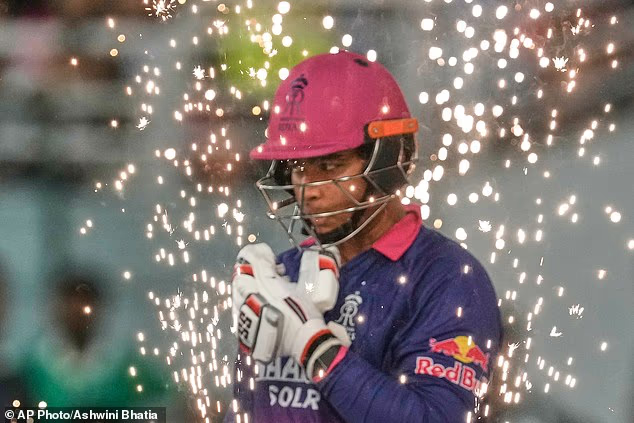
The selection of teenage phenomenon Vaibhav Sooryavanshi for India’s T20 squad means English crowds will soon witness at first hand a player who has torn up the record books and coaching manual in equal measure and with equal relish.
Of his exact age, no one seems quite sure. In an interview in 2023, he suggested he would turn 14 that September, which would make him 18 months older than the 15 years 71 days on his ESPNcricinfo player page. There have even been unsubstantiated claims he is as old as 19.
But England’s white-ball bowlers will have other things on their mind if and when he sets about them in the first of five T20 internationals, at Chester-le-Street on July 1.
The recent IPL was marred by grumbles that run-scoring had become too easy, that bowlers were little more than cannon fodder. But the outlandish feats of Sooryavanshi provided a different focal point, and turned into the story of the tournament.
In last year’s competition, he had signalled his talent with a 35-ball century in his third game for Rajasthan Royals. This time round, he was unstoppable, hitting more runs (778) at a higher strike-rate (237) with more sixes (72) than anyone else.
Three of his last four innings were unmissable: 93 off 38 balls (with 10 sixes) against Lucknow Super Giants, 97 off 29 (12 sixes) against Sunrisers Hyderabad, and 96 off 47 (seven sixes) against Gujarat Titans. For most players, such riches might arise once a season; Sooryavanshi was cashing in practically every week.
Vaibhav Sooryavanshi’s age is under scrutiny and there is plenty of uncertainty
The England hierarchy have already been warned. In the final of the Under-19 World Cup at Harare in February, Sooryavanshi hit Thomas Rew’s team for 175 off 80 balls, with 15 sixes, helping India to an unassailable 50-over score of 411 for nine.
And the way he attacked Jasprit Bumrah, the world’s greatest bowler, when Rajasthan took on Mumbai Indians in April, hitting two of the first three balls he faced from him for six, suggests he will not be cowed by the step up against England’s senior attack. Whether they will be able to do anything to stop him is another matter.
Sooryavanshi’s hero is fellow left-hander Brian Lara, the Trinidadian genius whose high back-lift had the same impact as Viv Richards’s swagger, unnerving opponents before a delivery had been bowled.
But Sooryavanshi, who learned from Lara by watching him on YouTube, has an even more pronounced back-lift, which finished with his bat pointing almost towards cover, before he uncocks his wrists and lets rip.
It is not the only foible that makes him unique. According to his mentor Zubin Bharucha, speaking on the Wisden Scoop show, he has ‘changed what a good-length ball means, because he never actually comes forward’.
Analysis in May suggested that good-length deliveries in the two most recent IPLs had, overall, been hit for six 6.6% of the time. When Sooryavanshi was batting, his weight ultimately transferred on to the back foot after an initial movement towards the ball, that figure rose to 16.4%.
And while the average strike-rate against balls in the ‘slot’ – roughly four to six metres from the stumps – was 206, for Sooryavanshi it was 408. He is, then, twice as lethal as his contemporaries.
Thanks to that initial thrust, an extra dimension is added by his ability to get his head in line with the ball – an orthodox conclusion to an unorthodox approach.

Sooryavanshi doesn’t have many weaknesses… except for his love of ice cream
Throw in his bat speed, which his coaches have helped increase from roughly 55mph to around 68mph, and there is little he cannot access.
Above all, his first instinct is to score runs. As his childhood coach Manish Kumar Ojha told The Cricket Monthly: ‘I’ve never seen him train defence. I wanted to add something new, or perfect an existing stroke. Try and see how many options he could have for every delivery.’
And that may be the scariest part of all: a good-length ball is just as likely to disappear over extra cover as it is over midwicket. Only yorkers or well-disguised slower deliveries appear to reduce him to a realm approaching the mortal. His only other known weakness is a love of ice cream.
Naysayers, meanwhile, have pointed to his red-ball record, with 12 innings for Bihar in the Ranji Trophy yielding only 207 runs at an average of 17. Then again, his most recent knock, against Meghalaya in November, was 93 off 67 deliveries, and it is frightening to think what he might achieve against a Test attack on a flat surface.
His next challenge will come off the pitch as much as on it. Two days after Rajasthan lost their IPL eliminator to Gujarat, Sooryavanshi had a seat at the final in Ahmedabad next to Jay Shah, once the secretary of the BCCI, now the chairman of the ICC. From here on, everyone will want a piece of him.
Behind the scenes, meanwhile, there is already jostling among those who have played a part in his ascent: Sooryavanshi’s success could mean a lifelong meal ticket for the people who unearthed him, and there are plenty claiming to fall into that category.
For now, though, he will continue to put bat to ball with his unprecedented technique and the verve of youth.
Watch him this summer, if you get the chance. Because if you think you’ve seen everything in cricket, you clearly haven’t seen Sooryavanshi.