
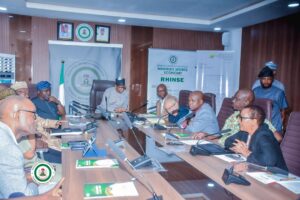
As heated reactions continue trailing Uganda’s emergence as host of the 2031 African Games, the chairman of Nigeria’s bid, Mainasara Illo says they pulled out due to a rotational policy of the Association of National Olympic Committees of Africa (ANOCA).
READ ALSO: NBBF Declares Commitment To Sustainable Future For Development Of Basketball In Nigeria
Sports247 gathered that Uganda, an East African nation, benefited significantly from ANOCA’s policy, which seeks to spread hosting opportunities across the continent rather than concentrating them in a few countries.
Illo added that supporting the rotational arrangement aligns with Nigeria’s longstanding contribution to the growth of the African Games movement and support for unity in the continent.
He further stated that the nation had already hosted the continental showpiece twice – Lagos in 1973 and Abuja 2003 – thereby making it one of only a handful of countries to have staged the African Games on more than one occasion.
The acclaimed sports administrator and former broadcaster also explained that the last four Games have been shared between West Africa and North Africa, thereby paving the way for Uganda to take it up for East Africa.
“In 2019, Morocco hosted the Games and four years later it went to Ghana while Egypt is hosting the 2027 and note that Nigeria hosted it 2003. So, it’s fair to say East Africa deserves another chance to host the rest of the continent,” Illo expatiated.
He also pointed out that West Africa most recently hosted the Games in 2023, when Ghana staged the event in Accra, while East Africa has waited much longer for another opportunity, having last hosted the Games in 1987 when Kenya welcomed the continent’s elite athletes.
The highly experienced administrator, who served as chairman of the Bid Committee for the 2030 Commonwealth Games, added that the rotational policy was initially slated to begin in 2035 but was brought forward to 2031.
The former sportscaster and member of the Local Organising Committee for the 2009 FIFA U-17 World Cup hosted by Nigeria, stressed that the country’s decision not to pursue the hosting rights demonstrates a broader commitment to continental unity and development.
He further stated that, having already enjoyed economic, infrastructural and sporting benefits associated with hosting the Games, Nigeria is seen as supporting a model that allows other regions to experience similar gains.
Sports247 also gathered that Uganda’s selection opens a new chapter for the country, which is now expected to use the Games to accelerate infrastructure development, boost athletes’ performance and showcase the region’s capacity to host major international events.