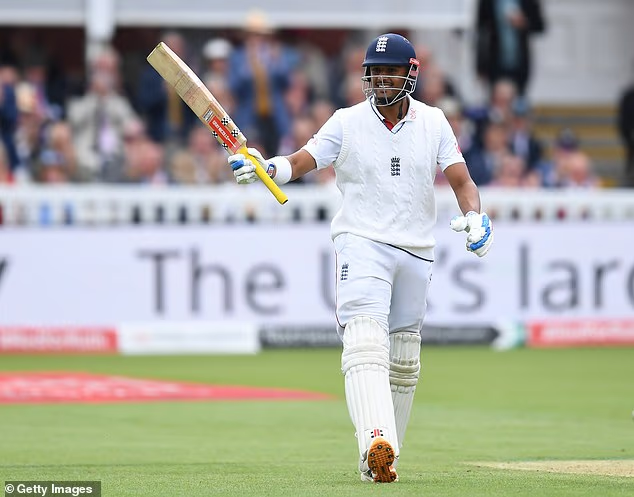
Shortly before 3pm on another seam-dominated day at Lord’s, Emilio Gay tucked Nathan Smith through square leg and set off for the two runs that brought up his first Test half-century, celebrated with pride, modesty and no doubt some relief.
In its own small way, this was a moment of history: no England opener had passed 50 on Test debut since Keaton Jennings took a hundred off India at Mumbai in December 2016. But the real significance of Gay’s runs lay in the here and now. Under glowering north London skies, and with a capricious Lord’s pitch tilted too far in the bowlers’ favour, his eventual 57 was the highest score across two days of batting toil.
Sixteen wickets on the first day and 17 on the second have accurately conveyed the balance of power, and if England prevent New Zealand from scoring the 254 they need to take a 1–0 lead in this three-Test series, there will be a case for making Gay the player of the match.
That scenario grew likelier as England made inroads before stumps. Gus Atkinson removed Tom Latham for the second time in two days, courtesy of a thick-edged drive to Harry Brook at second slip from the third ball of the chase, and later bowled nightwatchman Will O’Rourke with what became the evening’s final delivery.
In between came the hammer blow, Josh Tongue trapping Kane Williamson on the crease, and DRS confirming his demise with Williamson already halfway back to the pavilion. For all his career-long excellence, New Zealand’s greatest batsmen has only four innings left to improve on a mysteriously below-par average on these shores of 28. At 36 for three, his side must for the moment look elsewhere for inspiration.
Before all that, Gay marked his fifty with a crisp whip for four between mid-on and midwicket, the flourish accentuated by a flick of the back leg. It was the stroke, and the gesture, of a player, who – according to England Lions coach Andrew Flintoff – carries himself with something of a strut, but evidently knows when to use it.
Debutant Emilio Gay scored his maiden Test half-century as England seized control at Lord’s

Gus Atkinson bowled Will O’Rourke with the final ball of the day to leave New Zealand 36-3
On the first morning, he had tantalised spectators with a neat straight-drive off Jamieson, but got no further than eight. Now, embarking on a useful opening stand of 52 with Ben Duckett, he declined to chase the game, even though conditions might have seduced him into hitting out while he still could. It was hard to imagine Zak Crawley showing similar nous.
There were moments of fortune, as there had to be for a batsman to survive on a surface that has done little to ease the pressure on MCC to produce a Test strip worthy of the name.
On 20, Gay edged Matt Henry between first and second slips; on 24, he would have been leg-before to Henry had New Zealand asked for a review. There were several plays and misses as the ball decked this way and that, up the slope and down it. But, in that, he was not alone, and the tourists have not helped themselves, dropping five catches across England’s two innings.
And when, after two and a half hours, Gay finally nibbled at one from the persevering Smith that kissed the outside edge en route to Tom Blundell, the value of his performance was brought into perspective.
Brook got into a tangle against O’Rourke and was leg-before for a duck. Next ball, Smith trapped Joe Root for eight. And when Ben Stokes, yet to score, lost his off stump to Smith, England had slipped from 126 for two to 127 for six in 11 balls, and led by a precarious 154. Even by the fast-forward standards of this Test, it was frenetic stuff.
For Stokes in particular, it was a salutary moment. Smith’s delivery was good, but ought not to have been lethal, and left England’s captain with 36 runs from seven innings since grinding out 83 at Adelaide in December.
His Test batting average of 34.58 is now at its lowest since early in the 2019 Ashes, his demotion to No 7 not simply a means to allow Jamie Smith the chance to bat properly, but recognition that, at 35, Stokes’s batting may be irretrievably on the wane.
As if to underline the point, it was Smith who repaired the innings, playing some off-side strokes of genuine class in his 39 before getting one from Smith that kept low – though not quite as low as the grubber from Henry that did for Jacob Bethell shortly after lunch. Ollie Robinson then cracked 29 off 30 balls before becoming Smith’s sixth victim.

England’s bowlers were again on the money after setting the tourists a daunting 254 to win
Several hours earlier, Robinson had completed Test-best figures of five for 39 by bowling Henry for a duck, as New Zealand turned their overnight first-innings score of 61 for six into 113 all out.
Tongue bowled Glenn Phillips and Nathan Smith, before Atkinson had O’Rourke held at second slip, though England might have opened up a bigger lead than 27 had they not become obsessed with bouncing New Zealand’s lower order.
A policy of aiming for the top of off stump had served them so well it made little sense to suddenly drop short. But Stokes has employed the tactic throughout his captaincy, and he didn’t seem fussed when Jamieson lifted Tongue into the pavilion, then pulled successive deliveries from Robinson into the Grand Stand.
They were rare moments of batting defiance in a game where only Brook and Gay have ticked off fifties. If one of those innings confirmed a familiar talent, the other may yet prove the first of many.