
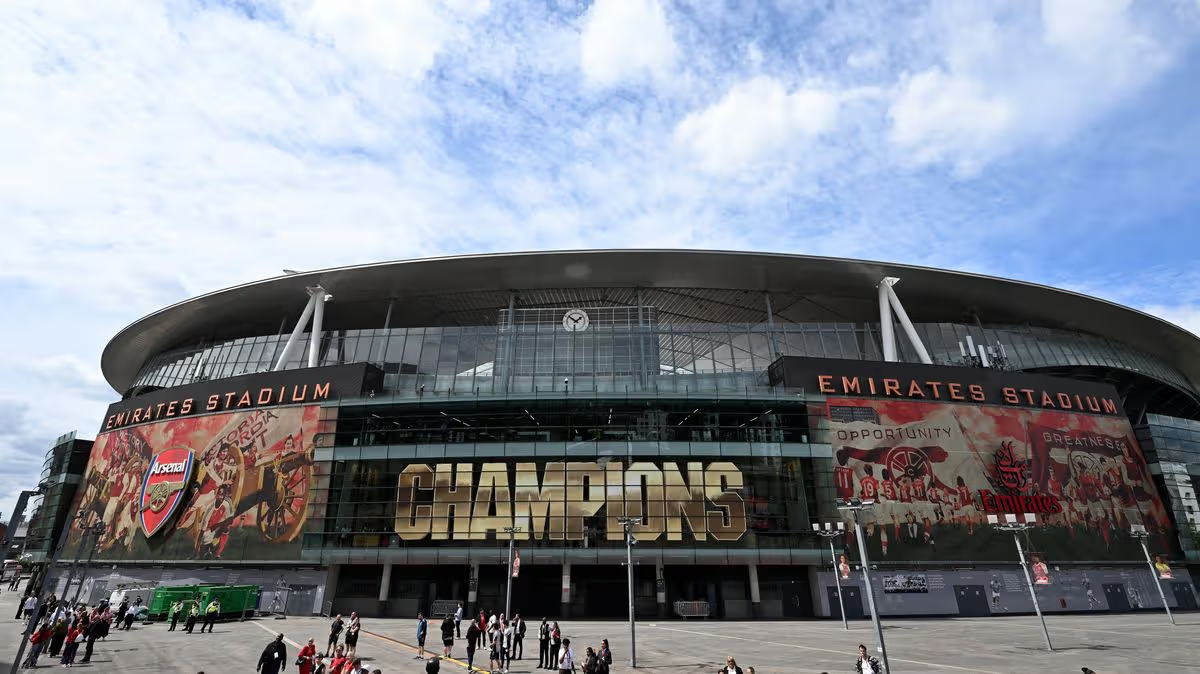
Arsenal look set to benefit from the Premier League’s decision to move from Profit and Sustainability Regulations to a Squad Cost Ratio model similar to that of UEFA with the Gunners’ rivals less joyous
Just when you think you get your head around football’s frenetic financial landscape, they go and change everything! Thankfully, and that word will resonate greatly with Arsenal as we dig in, these latest changes do make everything simpler.
Gone are the Profit and Sustainability Rules, which left the likes of Leicester City, who it is now far too late for, and Nottingham Forest angrily wailing their fists into the air, and in come the new Premier League Squad Cost Ratio Rules (SCR). So why would Arsenal be ‘thankful’ for these new rules compared to the likes of Chelsea and Tottenham, for example?
Well, for Arsenal supporters out of the loop, the club has been abiding by these new rules for some time anyway and to an even harsher extent. UEFA operates with a Squad Cost Ratio model for their Financial Fair Play rules.
FOLLOW OUR ARSENAL FB PAGE! Latest Gunners news, analysis and much more via our dedicated Facebook page
What is the Squad Cost Ratio? Well, it is a ruling which limits clubs’ on-pitch spending to a certain percentage of their football-related revenue and net profit/loss from player sales. The Premier League are setting this at 85%.
However, clubs are allowed to exceed this to a certain extent. Clubs will be assessed once a year in March after the January transfer window, while there will also be monitoring undertaken in October following the summer transfer window.
With clubs and the league agreeing on estimated football revenues, based on past seasons and formulas, the Premier League has explained what this means. Each club is given their Green Threshold, the 85%. So each club will know what they’re able to spend on player and manager/head coach wages, agents’ fees and the amortisation or impairment of transfer fees.
Effectively, no club should be out of the loop of what their Green Threshold (85%) will be at the beginning of each season. However, a Red Threshold is set at an absolute spending limit up to 30% above the Green Threshold.
As of March 1, an SCR compliance test will take place, and if a club’s squad cost is equal to or less than the Green Threshold, then they’re deemed compliant, and no further action takes place.
If a club goes above the Green Threshold, but not beyond the Red Threshold, a further test, the Accounts Confirmation Test, is required, which takes place in June after that season. If found to be still above the Green Threshold after verifying whether a club’s actual revenue and costs reflect the estimated revenue and costs used in season, the club is liable for a levy but not a sporting sanction. The levy is calculated using the smaller of two figures: Firstly, the Green Threshold overspend (measured in-season, based on projected spending), or the Accounts Confirmation Test overspend (measured post-season, based on actual spending). The lower figure is then multiplied by the percentage overspend in excess of 85% to find out the value of a fine.
Furthermore, the 30% limit above the Green Threshold will be decreased by the amount by which the 85% was exceeded. So, with the Red Threshold effectively set at 115% (85% add the 30% upper limit) if a club exceeds their Green Threshold by 20% one season, the following season their Red Threshold would become 95% as opposed to 115%.
A sporting sanction is issued if a club is found to have exceeded their Red Threshold, which is why, despite having a limit above the 85%, a relevant reduction can cause issues for clubs that do. A sporting sanction comes in the form of a points deduction applied during the same season as the breach.
These are laid out at a six-point deduction for a breach, with an additional point for every £6.5million a club exceeds their Red Threshold.
Got it? Wordy stuff, we know. Well, returning to the Arsenal perspective.
The Gunners, as mentioned, have been complying with a Squad Cost Ratio of 70% in UEFA competitions, rather than the Premier League’s 85%. This means, of course, that these changes to the Premier League’s financial regulations have almost no bearing on the club, as it was already adhering to stricter parameters.
The Premier League has deemed clubs not in UEFA competition will adhere to parameters 15% higher than those competing on the continent because these clubs do not benefit from the increased revenue teams receive from playing in the Champions League, Europa League or Conference League.
Arsenal have seen massive benefits from being in the UEFA Champions League and from winning the Premier League, and from those two competitions alone, revenue is believed to have exceeded £300million. The club’s football-related revenue is very healthy, and this summer, sporting director Andrea Berta has several players who many are suggesting could be sold, like Gabriel Martinelli, Gabriel Jesus, Ethan Nwaneri and Benjamin White, who represent financial assets which the club has simply not had.
Arsenal’s record sale remains Alex Oxlade-Chamberlain, from 2017, for £35million. It is hoped to be broken this summer, which will add further capacity for the club to spend.
The deal for Piero Hincapie last summer, a loan with an option to buy, was agreed between Arsenal and Bayer Leverkusen and would be activated in 2026, as it was orchestrated to help comply with Squad Cost Ratios in 2025. It represented a consciousness that the club were close to their threshold and needed to be smart with the final deal of the window.
While Hincapie’s transfer will be relevant to this summer’s moves, there is still plenty of freedom after the successful season and promising player sales that are expected for the club to invest. Arsenal have some expensive players on their wishlist, including Morgan Rogers and Junior Kroupi, with the pair estimated to cost over £150million.
For clubs such as Chelsea and Tottenham, however, without the revenue from European football, despite having a 15% higher headroom than Arsenal, the expectation is that they will need to sell in order to fund significant investment.
However, both clubs have been far more lucrative when it comes to player sales in recent seasons compared to Arsenal, which will offer some reprieve. It is set to be an interesting window for all of London’s clubs, but Mikel Arteta has plenty of reason for optimism about their hopes and plans for the window.