1 Jun 2026 23:00 BST |
7 min read

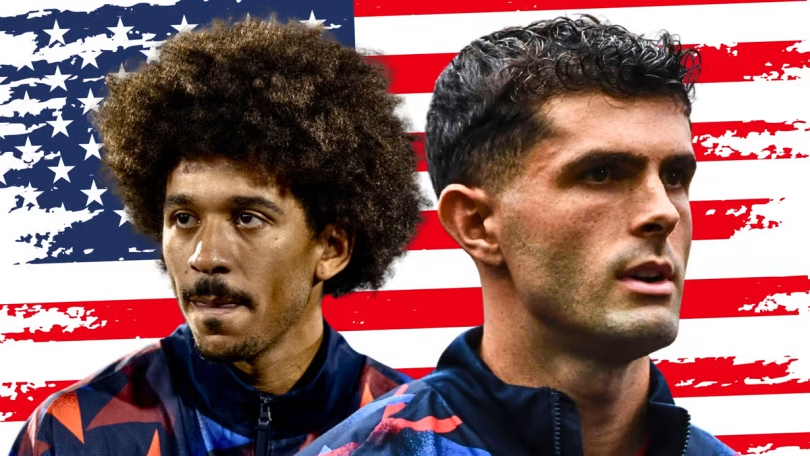
The United States Men’s National Team is heading into a second World Cup on home soil.
Unlike 1994, this edition of FIFA’s showpiece event will be staged together with Canada and Mexico. 32 years ago, the USA reached the round of 16, where they lost to eventual champions Brazil 1-0.
It was a similar outcome at the most recent World Cup in 2022. The USMNT reached the first knockout stage but suffered defeat against the Netherlands. Many of the young players from that Qatar group have now emerged as leaders under Mauricio Pochettino.
The pressure is on the USMNT to perform. Drawn into a group with Australia, Paraguay and Turkey, the bare minimum for Pochettino and company should be to reach the newly created round of 32, a result of the tournament’s expansion to 48 teams.
A lot will, of course, depend on seeding, but anything earlier than a quarter-final exit would be hugely disappointing. The USMNT’s most recent friendly, a 3-2 win over Senegal in which they produced 25 minutes of swashbuckling football, has rekindled some of the optimism that dissipated after a dire March break.
USA World Cup roster
Pochettino announced his World Cup roster last Tuesday at a ceremony in New York City, and it certainly sparked a lively debate. The Argentine went heavy on defenders and light on defensive-minded central midfielders – something that haunted the USMNT at previous World Cups.
Tanner Tessmann, who was expected to be a starter for the USMNT at the World Cup, was a surprising omission. Aidan Morris, another midfield option, was also left at home. Instead, Gio Reyna made the final 26 despite his persistent struggles for form and fitness at club level.
Remember the names.
Our 26 for 2026. pic.twitter.com/FwnA3fwTRL
— U.S. Soccer Men’s National Team (@USMNT) May 27, 2026
For the goalkeeper department, Pochettino exclusively picked domestic options, with Matt Turner, Chris Brady and Matt Freese all plying their trade in Major League Soccer. The glory days of Tim Howard and Brad Friedel are no more, but all three are reliable shot-stoppers.
It is a different story for the backline. Only three defenders play for MLS clubs, with Max Arfsten, Tim Ream and Miles Robinson getting the nod. Serginio Dest, Alex Freeman, Mark McKenzie, Chris Richards, Antonee Robinson, Joe Scally and Auston Trusty all play abroad.
The six players listed as midfielders are Tyler Adams, Sebastian Berhalter, Weston McKennie, Gio Reyna, Cristian Roldan and Malik Tillman. Brenden Aaronson and Tim Weah, who has rotated between right-back, right wing-back and the right wing, are listed as forwards.
Folarin Balogun, Ricardo Pepi, Christian Pulisic, Haji Wright and, surprisingly, Alejandro Zendejas complete the attacking call-ups. Prior to the Senegal friendly, Zendejas had not played for the USMNT since September 2025.
USMNT predicted World Cup lineup
Predicting how exactly the US will line up at the World Cup is difficult because, it seems, not even Pochettino really knows yet. He experimented a lot in the March break before reverting to a more familiar set-up against Senegal.
The Argentine has primarily employed a back-three system as USMNT head coach that looks like a 3-4-2-1 in possession. This set-up allows the US to press aggressively when the ball is lost without compromising the defence, which is a weak spot.
Starting our summer slate with a win! #USMNT pic.twitter.com/moQq0G8JRe
— U.S. Soccer Men’s National Team (@USMNT) June 1, 2026
However, when the system malfunctions, things can go downhill quickly, as it did for the US after they had stormed into a two-goal lead against Senegal. Mistakes began to creep in, and the US struggled with the pressure the Lions of Teranga applied.
Several spots still appear to be up for grabs, including one of the most important: the goalkeeper position. Turner, who had lost his place to Freese, was given an unexpected start against Senegal and was then substituted for Brady at half-time as Pochettino made wholesale changes.
It remains completely up in the air who will start between the sticks at the World Cup. Freese used to be Pochettino’s preferred option, but Turner has been posting remarkable defensive numbers for the New England Revolution this year.
There is similar uncertainty over the defence, though for a slightly different reason. Superstar defender Richards suffered an injury for Crystal Palace in the dying embers of the season, leaving his status for the World Cup uncertain.
His ankle injury is not believed to be as bad as Palace boss Oliver Glasner made it out, but Richards was not fit enough to feature against Senegal. It is currently unclear if he will make it in time for the opener against Paraguay on 12 June.
If he is fit enough to start, he will almost certainly be in the starting lineup because he is simply the US’s best defender. Ream, who is expected to captain the US, will also presumably start, despite clearly being past his best.
Unless Pochettino believes that Freeman – who has played very little since his offseason move to Villarreal – is ready to start at the World Cup, as he did against Senegal, McKenzie is likely to be the third centre-back.
Pochettino was full of praise for Berhalter after the Senegal game, but the central midfield will probably be made up of Adams and McKennie, with Robinson and Dest as the left and right wing-backs, respectively.
Further forward, Pulisic will obviously start. He ended his months-long scoring drought against Senegal. It currently appears to be a coin flip as to who will get the nod alongside him as the other attacking midfielder, though. Reyna started on Sunday and tucked in to provide defensive cover.
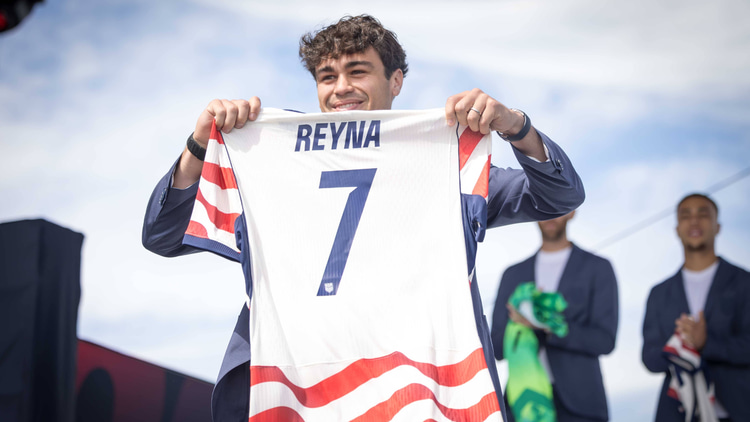
Pochettino feels that Reyna, if need be, could also play in central midfield. Despite the controversial nature of the 23-year-old’s inclusion, the coach believes that the Borussia Monchengladbach star has the kind of natural, game-changing talent that few other players in the pool possess.
If Reyna is fit enough, then he may actually start at the World Cup, which would make for a great redemption story. It is also possible that Berhalter starts alongside Adams and McKennie plays in the Reyna position further forward.
Tillman, who is coming off a somewhat disappointing first season at Bayer Leverkusen, the aforementioned versatile Weah and Zendejas are the other options for that position.
One of the US’s biggest strengths this summer will be the competition for places, and it is the same story for the No.9 position. Balogun seems to be a shoo-in to start at the World Cup, but Pepi gave a good account of himself against Senegal. Wright is another excellent option.
In March, Pochettino also experimented with Pulisic as a false nine, but you would hope for the USMNT’s sake that he immediately abandoned this idea after the break.
With all of that out of the way, here’s how the US’s 3-4-2-1 could look at the 2026 World Cup: Turner; McKenzie, Richards, Ream; Dest, McKennie, Adams, Robinson; Reyna, Pulisic; Balogun
There is certainly enough talent and desire in this squad to make a deep run. If the US can maintain the level they showed in the first half against Senegal, then there is no reason to think that they can’t reach the quarter or perhaps even the semi-finals.
Winning the entire tournament is a different story, of course, but if you want to get your hands on a reproduction of the biggest prize in sports, you can do so thanks to LEGO© who have released a special World Cup set including a souvenir trophy.
Similarly, The FIFA World Cup 2026™ ball is another iconic set that is unique to this competition. It is a LEGO replica of the size 5 football that will be used across North America this summer but is distinguished by popping open to display a packed stadium celebrating the winning team.
The FootballTransfers app
Check out FootballTransfers’ new app for all of football’s big storylines, transfer rumours and exclusive news in one convenient place directly on your mobile device.
The FootballTransfers app is available on Google Play and in the Apple App Store. Download here:
•Google Play
•App Store
View full bio