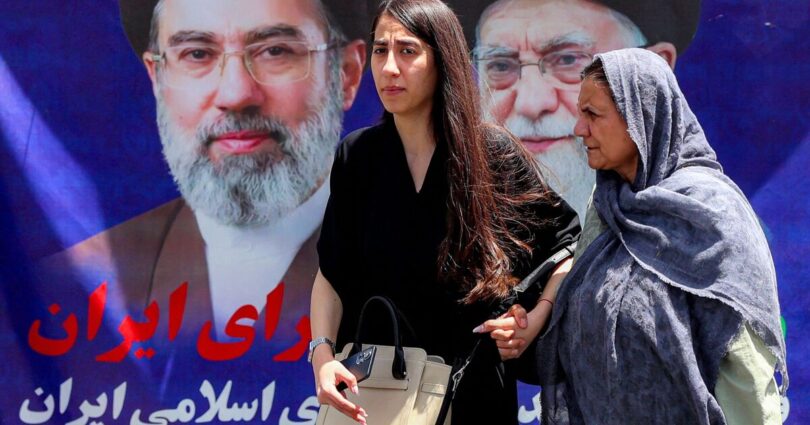
Shoppers in Tehran are constantly reminded the Ayatollah is in charge (Image: Getty)
Britain’s politicians disagree on many issues. But there are also principles that command broad, cross-party support, chief among them the defence of universal human rights and opposition to tyranny. On Iran, that shared ground is becoming increasingly clear. In January, Iran witnessed its fourth nationwide uprising in under a decade. Millions of people, from Gen Z to grandparents, poured into the streets. It bore all the hallmarks of a nation crying for freedom. What followed shocked the world. A near-total internet blackout attempted to conceal the scale of the crackdown.
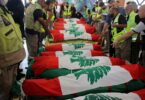
But images and testimonies emerged: rows of black body bags; mothers and fathers screaming in anguish as they searched for their missing children; protesters lying lifeless in the streets. Thousands were killed in a matter of days. Tens of thousands more were arrested. Their only crime was to demand change. Human rights organizations warned at the time that many detainees faced imminent danger. Those warnings have proved well-founded.
Since mid- March, at least 25 political prisoners have been executed. These killings are not isolated acts; they form part of a deliberate campaign to terrorise a population that has already shown its willingness to rise up. The regime’s calculation is simple: to prevent another uprising by making the cost of dissent unbearable.
A significant number of those executed have been linked to the National Council of Resistance of Iran (NCRI), long regarded by Tehran as its principal organized opposition movement. Others were young protesters detained during the January uprising. Many more remain on death row, and death sentences are being issued expeditiously. The message is unmistakable: if you protest again, you risk your life.
This pattern echoes one of the darkest chapters in Iran’s modern history—the 1988 massacre of around 30,000 political prisoners, many of whom were associated with the NCRI and the broader Iranian opposition movement. Today’s executions, while smaller in scale, follow the same grim logic: eliminating perceived threats at moments of vulnerability.
Yet the context has changed. The regime is weaker than at any point in recent decades, its authority eroded by successive uprisings and mounting internal and external pressures. At the same time, organized resistance inside the country has grown more resilient and more visible.
It is in this context that parliamentarians from across the United Kingdom will travel to Paris on June 20 to join a major international rally organized by the National Council of Resistance of Iran (NCRI). The gathering will highlight ongoing human rights abuses and demonstrate support for a democratic republic in Iran.
More than 100,000 people are expected to attend, alongside lawmakers and political figures from both sides of the Atlantic. Such numbers are not abstract. The rally in Paris will therefore serve as more than a demonstration; it is a reminder that, despite repression, the demand for change in Iran has not been extinguished. On the contrary, it is gathering strength.
The NCRI is a democratic alternative to the current regime. Its President-elect, Maryam Rajavi, has outlined a ten-point plan centered on free elections, the separation of religion and state, gender equality, and the protection of minority rights. It is a vision that has drawn support from a broad range of policymakers across Europe and beyond.
Inside Iran, networks associated with the opposition have played a growing role in mobilizing protest activity and challenging the regime’s control. Their expansion has not gone unnoticed; officials now openly warn of their influence, particularly among the younger generation.
A nation is crying out for freedom. It is seeking not foreign intervention, but moral and political support. Its people are making clear that they will determine their own future, but they are also asking that the world does not turn away.
We hear their voices. We cannot, and should not, remain indifferent.
As Elie Wiesel, the late Nobel laureate, warned: “Neutrality helps the oppressor, never the victim. Silence encourages the tormentor, never the tormented.”
For the United Kingdom and its allies, the implications are clear. A policy centered solely on engagement has failed to moderate the regime’s behaviors. At the same time, foreign military intervention has shown its limitations. Neither approach has addressed the root of the crisis.
A more consistent and principled strategy is needed, one that places human rights at its core and aligns with the aspirations of the Iranian people themselves.
That means maintaining sustained pressure on Tehran over its use of executions and repression. It means supporting access to information and communication tools that allow Iranians to organise and make their voices heard. And it means recognizing that lasting change will come not from outside intervention, but by the Iranian people and the organized resistance.
The events of recent months have made one point unmistakably clear: the cost of silence is measured in lives. The images of those black body bags, and the cries of families searching for their loved ones, cannot be ignored or forgotten.
The June 20 rally in Paris is not merely a gathering. It is a call to governments, institutions, and the international community to stand with the Iranian people at a critical moment.
Britain should heed that call.
Lord David Alton is the Chair of Joint Committee of the Parliament on Human Rights
Bob Blackman MP (Conservative) is the Chairman of the 1922 Committee
Lord Steve McCabe (Labour) is a prominent member of the UK House of Lords