UN peacekeeping crisis: Funding, personnel at 25-year low, report warns
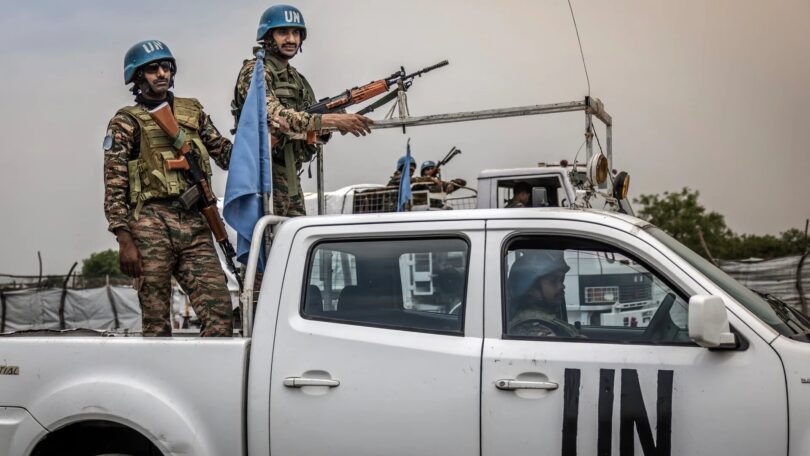
Funding and personnel for United Nations peacekeeping operations dropped to a 25-year low last year after major donors, led by the US, did not pay their mandatory commitments on time, a report by the Stockholm International Peace Research Institute (Sipri) has shown.
The data was released ahead of the International Day of UN Peacekeepers on Friday.
In July 2025, some 35 percent of the UN’s $5.6bn budget for peacekeeping was missing, forcing several missions to cut personnel.
As of 31 December 2025, just 78,633 international personnel were deployed on peace operations, which is 49 percent less than in 2016, and the lowest level since at least the year 2000, Sipri noted. And while the numbers have been in decline throughout the decade, last year saw the sharpest year-on-year drop at 17 percent.
“If things continue in this way, we could see a dramatic weakening of multilateral conflict management and the near-complete sidelining of institutions like the United Nations, due to a perfect storm of funding, political, and geopolitical factors,” Jaïr van der Lijn, director of the Sipri peace operations and conflict management programme, said of the report’s findings.
“The result is likely to be more conflicts, and these conflicts are likely to have even graver impacts on civilians as states abandon long-established norms.”
The US and China collectively provide half of the UN’s entire peacekeeping budget. Contributions are assessed based on a country’s gross national income and how much debt it owes.
In terms of actual personnel, the top 10 contributors to multilateral peace operations are all relatively poorer countries in the Global South: Uganda; Nepal; Bangladesh; India; Rwanda; Ethiopia; Burundi; Kenya; Pakistan; and Indonesia.
Blame
Sipri’s report does not pin the blame for the peacekeeping funding shortfall on Washington, but it does highlight an aggressive politicisation trend that began in 2025.
About a quarter of the UN’s regular operating budget, as well as its peacekeeping budget, is paid by the US. But since his return to power in January 2025, US President Donald Trump and his administration have openly undermined the UN’s mandate and demanded major reforms.

Read More »
Earlier this year, he withdrew funding from several UN and UN-adjacent organisations, including the UN register of conventional arms and the Global Counterterrorism Forum – issues that have generally been important across all US administrations, regardless of political leaning.
Trump also pulled back from climate-related initiatives.
Last year, Reuters reported that it had reviewed an internal document from the White House budget office proposing to eliminate funding for UN peacekeeping missions entirely as part of a major cost-cutting measure at the State Department. That proposal has yet to be publicised or approved by Congress.
In October, the US pushed for a 25 percent reduction in money for peacekeeping. The UN aimed for 15.
“Over the past two decades, reform has been a constant conversation, whether it is responding to very worrying allegations of sexual exploitation and abuse by UN peacekeepers, or incidents like what happened in Haiti when the accidental introduction of cholera led to a very devastating ecological and health crisis in the country,” Daniel Forti, the head of UN affairs at the International Crisis Group, told Middle East Eye on Thursday.
“[But] Washington withholding nearly two-thirds of what it owes to UN peacekeeping, nominally in the name of trying to make it better, is actually just making it even harder for UN missions to do their jobs.”
Last month, Trump’s US ambassador to the UN for management and reform, Jeff Bartos, told MEE that “the president’s been quite clear that the UN has great potential, and it’s our responsibility…to help the UN reach and exceed its potential”.
He said a key change the US wants to implement with peacekeeping missions is the way unused equipment is reimbursed, which would be a significant cost-saving measure of potentially “tens of millions of dollars”.
“We’re deeply grateful to the countries and the troops who come forward to serve in these peacekeeping missions, but we can’t be reimbursing for equipment that’s not being used,” Bartos said.
As part of the Trump administration’s assurances to the UN, it has so far paid $159m towards its regular budget assessment, and another $2bn to pooled funding for the office for the coordination of humanitarian affairs, he added.
MEE has reached out to the State Department for comment on Sipri’s report, but did not hear back by the time of publication.
Lebanon mission wraps up
There were a total of 58 multilateral peacekeeping missions active in 34 countries or territories around the world during 2025, Sipri noted.
Nearly 75 percent of all personnel were deployed with just five missions, four of them in sub-Saharan Africa.

Read More »
Operations in the Democratic Republic of the Congo, Haiti, Iraq, and the Nagorno-Karabakh region of Azerbaijan have all since been shut down, and in some cases replaced with non-UN alternatives, demonstrating that responses to conflicts are increasingly moving outside the traditional UN framework, the report said.
They are instead taking the form of unilateral, bilateral and ad hoc arrangements that are often more militarised and more directly influenced by the self-interest of the states involved, such as the African Union Support and Stabilisation Mission in Somalia and the Gang Suppression Force in Haiti, as well as the International Stabilisation Force proposed by Trump’s “Board of Peace” for Gaza.
In December, the United Nations Interim Force in Lebanon (Unifil), which has been in place since 2006, will wrap up its mission owing to US pressure on members of the Security Council.
Washington has made it clear it wants to see the Lebanese army step up as a replacement, despite its lack of training and equipment, and its inability to carry out its foremost obligation under the 2024 Lebanon-Israel ceasefire deal, which is to disarm Hezbollah.
Despite the deal, Israel’s war on Lebanon is raging.
It has killed more than 3,000 Lebanese and wounded nearly 10,000 since Hezbollah attacked Israel on 8 October 2023, in support of its ally Hamas in Gaza.
On Thursday alone, at least 14 Lebanese were killed in Israeli air strikes.
Next month, UN secretary general Antonio Guterres is set to publish a report outlining his proposed next steps for the Unifil mission.
“While there will be lots of focus on the technicalities of this, a decision about what follows Unifil is a political question first and foremost, and will really depend on the major political issues that are happening, not only between Israel and Lebanon, but also the wider regional conflict between the US and Iran,” Forti told MEE.
“It’s impossible to divorce that discussion.”